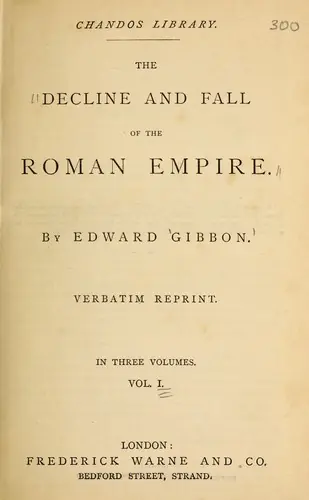
The decline and fall of the Roman Empire
by Edward Gibbon · first published 1800
32% recommend64% neutral3% critical
Why HN recommends it
Readable, narratively engaging panorama of Roman and later history, rich in colour and wit. Its episodic structure suits audiobooks and long, slow reading, and it gives perspective on modern politics.
Summarised by Claude from recommending comments
Here is history at its Magnificent and Panormic best by a Brilliant schollar known as " The first modern historian." "I set out upon Gibbion's Decline and fall of the roman empire [and] was immediately dominated by both the story and the style. I devoured Gibbon. I rode triumphantly through it from end to end".
Affiliate links. As an Amazon Associate I earn from qualifying purchases.
Mentions per year
What Hacker News says
Related books
 2015–2026
A short account of the destruction of the Indies
Bartolomé de las Casas
Recommended by 12 · mentioned by 1312 recommend · 13 mention12 recommend · 1312 recommend
 2009–2024
The Gallic Wars
Julius Caesar
Recommended by 11 · mentioned by 4211 recommend · 42 mention11 recommend · 4211 recommend
 2014–2024
After Dark
Jayne Ann Krentz
Recommended by 3 · mentioned by 33 recommend · 3 mention3 recommend · 33 recommend
Brevisima Relacion de la Destruccion de Las Indias
Fray Bartolomé de las Casas
Recommended by 5 · mentioned by 65 recommend · 6 mention5 recommend · 65 recommend
 2009–2026
The Foundation Trilogy
Isaac Asimov
Recommended by 24 · mentioned by 6824 recommend · 68 mention24 recommend · 6824 recommend
 2012–2023
Life of Samuel Johnson
James Boswell
Recommended by 1 · mentioned by 81 recommend · 8 mention1 recommend · 81 recommend
 2010–2026
The Rise and Fall of the Third Reich
William L. Shirer
Recommended by 37 · mentioned by 6737 recommend · 67 mention37 recommend · 6737 recommend
 2013–2022
As a Man Thinketh
James Allen
Recommended by 7 · mentioned by 107 recommend · 10 mention7 recommend · 107 recommend
I am already reading Edward Gibbon's The History of the Decline and Fall of the Roman Empire, and while research since its conception may have disputed certain facts unknown at Gibbon's time (it was published in 1776), it is still an excellent detailed account of the Roman Empire from 170s and…
on “Periodis Web – A Historical Atlas and Gazetteer of Europe from Year 1 to 2000” ↗And indeed some summaries lack the colour, pathos and delight of the original. Here's a summary of Edward Gibbon's Decline and Fall of the Roman Empire: * There was a republic. * Then there was an empire. * Christianity emerged. * The empire split up. * The empire declined. More or less factually what you might glean from Gibbon,…
on “You can increase your intelligence” ↗…have ever read). - Moby Dick or The Whale (One of the top two novels I've ever read). - Blood Meridian or The Evening Redness in the West (Tied with Moby Dick for best novel I've ever read). - The History of the Decline and Fall of the Roman Empire (Epic reading... worth the commitment).
on “Ask HN: What Books Do You Recommend Reading for 2022?” ↗Or you could read the following chapter from The Decline And Fall Of The Roman Empire by Edward Gibbon. It is quite entertaining. http://www.ccel.org/g/gibbon/decline/volume2/chap50.htm
on “Charlie Hebdo: first cover since terror attack depicts prophet Muhammad” ↗…- http://www.econlib.org/library/Smith/smMSCover.html Adam Smith's Lectures on Justice, Police, Revenue and Arms (1763) - http://oll.libertyfund.org/titles/2621 (warning: long page) Edward Gibbon's History of the Decline and Fall of the Roman Empire (1776) - http://oll.libertyfund.org/titles/1365 (warning: long page) Francis Hutcheson's An Inquiry into the Original of Our Ideas of Beauty and Virtue (1726) - http://oll.libertyfund.org/titles/hutcheson-an-inquiry-into-...…
on “Ask HN: What are your recommended reads that are available for free?” ↗…reading a book. There's just no equivalency between Facebook and The Republic. Books usually have better vetted sources and an editor going over it. I've never seen anything that originated online like The Decline and Fall of the Roman Empire by Edward Gibbon. Except maybe The Decline and Fall of the Roman Empire. And I doubt that the next "The Decline and Fall of the Roman Empire" will originate online either. It might be advertised online,…
on “HTC Vive Headset Nearing 100,000 Sales” ↗…and enjoyed it even more. Other kilo-page doorstop-sized single narratives that I've read and recommend include Neal Stephenson's Cryptonomicon, Wm. Shirer's Rise and Fall of the Third Reich, Gibbon's Decline and Fall of the Roman Empire, Tolstoy's War and Peace, and Tolkien's Lord of the Rings. (The world is also full of good single narratives that span multiple thick volumes, of course.)
on ““The Depressed Person” by David Foster Wallace (1998) [pdf]” ↗If you think that "evil density" -- even by your rather peculiar definition is greater now than in the past. Then you need to read some history. A good start might be The Decline and Fall of the Roman Empire. But really almost anything will do.
on “Distributed Ledger without the Blockchain” ↗A book? I can’t color between the lines on this one, maybe I can’t read between them either. Here’s 3: Collapse by Jared Diamond The History of the Decline and Fall of the Roman Empire by Gibbon Brevísima relación de la destrucción de las Indias (English: A Short Account of the Destruction of the Indies ) by Bartolomé de las Casas
on “Ask HN: What is your comfort book?” ↗I'm currently reading The History of the Decline and Fall of the Roman Empire by Edward Gibbon. It's quite an anachronistic book, has an obvious slant from the author's bias, and is outdated in a few parts compared to the modern views of the fall of Rome (according to my historian…
on “No Barbarians Necessary” ↗Nothing needs to be destroyed or reinvented, only returned to common-sense and integrity. There are essentially no new ideas. - Everyman's Library Decline and Fall of the Roman Empire is worth having. - A Short Account of the Destruction of the Indies / Brevísima relación de la destrucción de las Indias is another title important to understand what happened in the Americas as well…
on “The Books We Can Use to Rebuild Civilization” ↗…Sagan's Contact, but better, way better.) - Buddha's Little Finger, by Victor Pelevin Some my favorite "non-fiction" books: - The Landmark Herodotus: The Histories, edited by Robert Strassler - The History of the Decline and Fall of the Roman Empire, by Edward Gibbon - Antifragile, by Nassim Taleb - The Black Swan, by Nassim Taleb - Gödel, Escher, Bach: An Eternal Golden Braid, by Douglas Hofstadter - The Road to Reality, by Roger Penrose -…
on “Ask HN: What are some must read books?” ↗The History of the Decline and Fall of the Roman Empire by Edward Gibbon (1776) It's many volumes but I never considered not finishing. Extraordinary Popular Delusions and the Madness of Crowds by Charles Mackay (1841) Reading that helped me understand…
on “What history books would you recommend?” ↗The Decline and Fall of the Roman Empire, by Edward Gibbon edit: lol downvotes?
on “Ask HN: Books you read in 2023 and recommend for 2024” ↗>what struck me most on re-reading was how completely boring it would be to be faithful to it Agreed. The inspiration behind the Foundation series, setting out to shorten the Dark Ages after the Decline and Fall of the Roman Empire, is great. However, if you try reading those short stories again today, you're quickly reminded that early in his career, Asimov was already great at world building, but terrible with characters and…
on “When “Foundation” Gets the Blockbuster Treatment, Asimov’s Vision Gets Lost” ↗