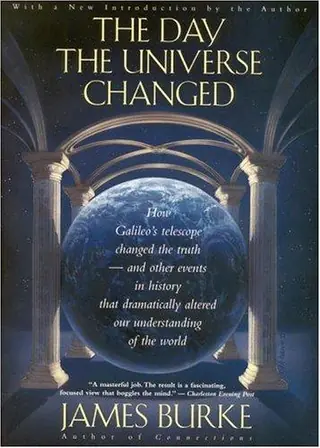
The Day the Universe Changed
by Burke, James · first published 1985
75% recommend25% neutral
Why HN recommends it
Shows how science, technology and society shape each other, tracing inventions through luck and small steps rather than a straight line of progress. Suits readers who want a witty, well-written history of ideas.
Summarised by Claude from recommending comments
"In The Day the Universe Changed, James Burke examines eight periods in history when our view of the world shifted dramatically: in the eleventh century, when extraordinary discoveries were made by Spanish crusaders; in fourteenth-century Florence, where perspective in painting emerged; in the fifteenth century, when the advent of the printing press shook the foundations of an oral society; in the sixteenth century, when gunnery developments triggered the birth of modern science; in the early eighteenth century, when hot English summers brought on the Industrial Revolution; in the battlefield
Affiliate links. As an Amazon Associate I earn from qualifying purchases.
Mentions per year
What Hacker News says
Related books
 2009–2026
Connections
Burke, James
Recommended by 15 · mentioned by 2515 recommend · 25 mention15 recommend · 2515 recommend
 2007–2026
The ascent of man
Jacob Bronowski
Recommended by 19 · mentioned by 2519 recommend · 25 mention19 recommend · 2519 recommend
 2015–2026
The man who loved China
Simon Winchester
Recommended by 3 · mentioned by 33 recommend · 3 mention3 recommend · 33 recommend
 2008–2022
CIVILISATION
CLARK KENNETH
Recommended by 6 · mentioned by 96 recommend · 9 mention6 recommend · 96 recommend
 2008–2026
The Prize
Daniel Yergin
Recommended by 36 · mentioned by 4236 recommend · 42 mention36 recommend · 4236 recommend
 2014–2026
Science and civilisation in China
Joseph Needham
Recommended by 3 · mentioned by 63 recommend · 6 mention3 recommend · 63 recommend
I’d like to recommend James Burke’s series “Connections”[1] and “The Day the Universe Changed”[2] from the late 70s early 80s. He was a bbc journalist covering NASA and doing science communication and one of his particular fascinations (and mine, having grown up with his work) is the cumulative…
on “Ask HN: What’s the most important modern simple invention?” ↗You have to like his writing style but bill Bryson’s short history of everything. James burke’s day the universe changed is thought provoking and bronowski’s ascent of man is also good. Timothy Ferris (not that one) and John gribbin have also trod this area.
on “Ask HN: Any recommendation for a good History of Science book?” ↗…foot distant) septic tank which was leaking into it. https://en.wikipedia.org/wiki/London_sewerage_system There are many histories of this, one of the better ones I've encountered is James Burke's "The Day the Universe Changed", episode 7, "What the Doctor Ordered". The entire programme covers the emergence of the modern medical and public health system. The portion specific to the cholera epidemic and the infrastructure…
on “Why are there so many tunnels under London?” ↗…canonical recommendation here is Thomas Kuhn's The Structure of Scientific Revolutions [1], but I also strongly recommend watching James Burke's Connections tv series [2] and then watching or reading his The Day the Universe Changed [3] to understand how our entire conception of "reality" or "truth" is so strongly determined by the technology of the time. Finally, there are lots of "truths" in fields where this is no scientific…
on “Ask HN: How to tell what's true from false or right or wrong?” ↗I recommend Connections or The Day the Universe Changed (out of print, I think?), both by James Burke. These aren't comprehensive histories of science, but they show how science, technology, and society are intimately connected. They are incredibly well written…
on “So You Want to Learn Physics” ↗…book). "Collapse" with Michael Ruppert. And a few which aren't on the list: "The Prize", on the story of petroleum, based on Daniel Yergin's book of the same name. James Burke's "Connections" and "The Day the Universe Changed". And numerous conference presentations, interviews, and various other presentations. What's particularly useful is watching these not online through a crappy video player, but by downloading the videos,…
on “Down The Rabbit Hole We Go: Mind-Expanding Documentaries” ↗That's James Burke, in the years before he created his excellent "Connections" and "The Day The Universe Changed" series. Highly recommended - I watched every episode when they came out starting in the late 1970s.
on “Inside NASA’s Mysterious Rubber Room” ↗…point the respect I show rapidly dwindles. David Brin's one of the more eloquent critics I've run across of late (he's written a number of pieces on G+ and his blog in recent months). James Burke's The Day the Universe Changed goes into foundations of Libertarian philosophy with Sumner and Spencer. Episode 8, "Fit to Rule", I'd recommend the whole episode, but you can skip forward around 30 minutes to pick up the meat. Studying…
on “How to Burst the "Filter Bubble" that Protects Us from Opposing Views” ↗…1990s. More generally, it's astounding how much human knowledge and understanding have progressed in the past 250 years. I've been going through James Burke's programs, especially Connections and The Day the Universe Changed (the first Connections series is better than either of its sequels, but TDTUC is amazing). And looking at how and when specific inventions and ideas were discovered is really telling. Another mind bender…
on “The woman who saw beneath oceans” ↗> trajectory of progress How to write the history of science? First, watch James Burke's histories - Connections[1] and The Day The Universe Changed - for his non-teleological view of change. Connections is an important examination about the trajectory of progress. Burke's premise - which I agree with strongly - is that change is not predictable.…
on “How to Write the History of Science?” ↗James Burke's "The Day the Universe Changed" series. A history of inventions, how one led to another, often in stupid tiny ways brought about by pure luck - or the right person working on the smallest thing at the right time. Fantastic series…
on “Ask HN: How did you decide what problems to solve in your lifetime?” ↗The first Connections series (and the book), and The Day the Universe Changed, are both excellent. Connections2 and Connections3 flag somewhat. Both were produced for TLC, at a point before its Honey Boo Boo slide, though off its peak. One ran shorter (~25 minute) episodes,…
on “James Burke Interview [video]” ↗…BBC, and backed by the organisation. Notably, little from either national/public broadcasting or commercial production has even approached it. My short list includes Sagan's Cosmos, Burke's own The Day the Universe Changed, Ken Burns. Daniel Yergin's The Prize. And of course Kenneth Clarke's Civilisation and Jacob Bronowski's The Ascent of Man, which had paved the way for Burke himself. I might include Adam Curtis's…
on “Connections by James Burke (1978)” ↗Adam Curtis is great, but his stuff is better described as commentary. He basically does James Burke's 'Connections' [0] as polemic. Can't get enough personally. [0] Burke's 'Connections' and 'Day the Universe Changed' are definitely worthy of mention on this post.
on “Ask HN: What are some of the best documentaries you've seen?” ↗It is. I've been covering some histories of the period. There's James Burke's Connections and The Day the Universe Changed, which cover technology and philosophy generally, but focus a great deal on the Enlightenment and Industrial Revolution. More recently, there is Vaclav Smil's Energy in World History (1994), and Manfred…
on “A treatise on the art of flying by mechanical means (1814)” ↗