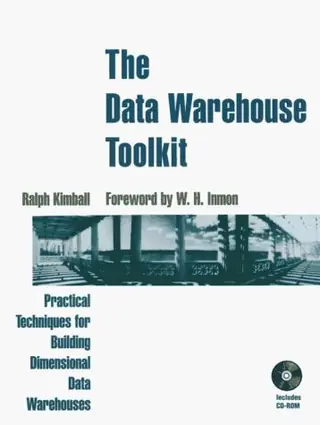
The data warehouse toolkit
by Ralph Kimball, Margy Ross · first published 1996
85% recommend15% neutral
Why HN recommends it
Foundational guide to dimensional modeling: facts vs dimensions, star schemas, slowly changing dimensions, surrogate keys, with models for many business areas. Suits anyone building analytics or BI warehouses.
Summarised by Claude from recommending comments
Affiliate links. As an Amazon Associate I earn from qualifying purchases.
Mentions per year
What Hacker News says
Related books
 2010–2025
SQL antipatterns
Bill Karwin
Recommended by 31 · mentioned by 3731 recommend · 37 mention31 recommend · 3731 recommend
 2014–2026
Designing Data-Intensive Applications
Martin Kleppmann
Recommended by 457 · mentioned by 659457 recommend · 659 mention457 recommend · 659457 recommend
 2017–2026
The Manager's Path
Camille Fournier
Recommended by 89 · mentioned by 10789 recommend · 107 mention89 recommend · 10789 recommend
 2007–2026
Good to Great
Collins, James C., Jim Collins
Recommended by 71 · mentioned by 16671 recommend · 166 mention71 recommend · 16671 recommend
 2007–2026
Coders at Work
Peter Seibel
Recommended by 126 · mentioned by 233126 recommend · 233 mention126 recommend · 233126 recommend
…first this approach sounds crazy, but really it is what companies have been doing since the 90s: creating flattened read-only reporting databases. If you want to do this, you should read Ralph Kimball's _Data Warehouse Toolkit_ for some inspiration and guidance. Of course you don't want to give customers access to your OLTP database. Besides the security and performance problems there, if your core database becomes a public…
on “Stripe Sigma” ↗…generator). So what would I recommend instead? There are multi-dimensional databases or ETL tools that will properly put your transactional data in an analytical style data warehouse. Read Kimball's Data Warehouse Toolkit [1] (ignore the kinda ratty paper quality—the content is good). The key thing is to denormalize down to a star schema, but keep your facts and dimensions separate (things you'll learn in DWT). There's…
on “Cross-tabulation in MySQL (2001)” ↗Have your read Kimball's Data Warehouse Toolkit? I'm partial to the first edition (1996). It's mostly conceptual stuff: design rationale, OLTP vs OLAP, fact vs dimension, type II SCDs (very important), surrogate keys, aggregate navigation etc. Most…
on “Ask HN: What are the best data warehouse and BI resources in print and online? ” ↗Suggestion: provide a dimensionally-modelled reporting schema, it will be much easier to query. Kimball's The Data Warehouse Toolkit is the definitive tutorial on the subject.
on “Shopify POS” ↗…deletes except to correct errors. In that case you might go with a basic star schema implemented in a relational database, or something like BigTable if you need it faster. Read the Kimball book (The Data Warehouse Toolkit) if you don't know the model. Basically it's optimized for aggregation -- sums/averages/counts sliced and diced and pivoted any way you want to see them. At the middle of the star schema is a big "fact"…
on “Ask HN: What database should we use for our “big data” problem?” ↗Check out the Data Warehouse Toolkit. You might want to look into natural vs surrogate keys. https://www.amazon.com/Data-Warehouse-Toolkit-Complete-Dimen...
on “Be Careful with UUID or GUID as Primary Keys” ↗…on me (or someone else) to build complicated SQL queries when they have questions, so I focus on getting an easy to maintain facts/dimensions model (as advocated by Ralph Kimball http://www.amazon.com/Data-Warehouse-Toolkit-Complete-Dimens...) which can evolve if needed. The nice point about MongoDB when doing this is that it makes it a lot easier to add attributes to dimensions, or load the data, or evolve the reporting…
on “Michael Stonebraker: Why Enterprises Are Uninterested in NoSQL?” ↗If you are interested in Data Warehousing, you should read Ralph Kimball's "The Data Warehouse Toolkit": http://www.amazon.com/Data-Warehouse-Toolkit-Complete-Dimens... When I started learning about BI (Business Intelligence), a few members of the Pentaho community advised me to read this book. I'm glad…
on “Data Warehousing 101” ↗Well ... really, just read a good pair of textbooks on each side of the spectrum. Date's Databases and Kimball's The Data Warehouse Toolkit are good. Edit: actually, maybe not Date. It's up to you. It's good, but it's controversial because he's not a fan of SQL and so he uses his own language. The one I used in uni was Ramakrishnan & Gehrke's…
on “Redshift Performance and Cost” ↗…you're interested in "learning from the past": - The Mythical Man-Month by Frederick Brooks - Programmers at Work by Susan Lammers - Apple Human Interface Guidelines: The Apple Desktop Interface - The Data Warehouse Toolkit by Ralph Kimball
on “Ask HN: How to learn about the history of computing?” ↗In terms of data warehousing-the data warehouse toolkit (kimball) book is an excellent resource. It covers models for many business areas and also talks about the transactional models the are coming from.
on “Ask HN: Database Design Templates (or Best Practice Examples)” ↗Yes, especially in business intelligence / data warehousing. Here is an excellent resource if you're interested in this sort of thing: https://www.amazon.com/Data-Warehouse-Toolkit-Complete-Dimen...
on “Why we lost Uber as a user” ↗I've mostly learned through consulting and analytics experience and with the help of Ralph Kimball's book "The Data Warehouse Toolkit". You'll also want to look up Bill Inmon as he proposes a different methodology to data warehouses. Happy to answer questions if you have any.
on “Ask HN: Online classes to become a data engineer?” ↗I'd highly recommend the Kimball books, e.g. "The Data Warehouse Toolkit". Unless you're working with a lot of data, the technical parts of a data warehouse are relatively easy to grasp (the dbt team wrote some great posts on how they structure their projects [1]). After…
on “Ask HN: What does your BI stack look like?” ↗…"Programming Erlang" by Joe Armstrong. This book is not about Erlang mainly but about ideas and conceptions behind Erlang. Actor model, messaging, "let it fail", "happy path" - all that influenced me a lot. "Data Warehouse Toolkit: The Definitive Guide to Dimensional Modelling" by Ralph Kimball and Margy Ross. The book about how to make data clean, inambigious and easy to understand.
on “Ask HN: Books that improved your career?” ↗