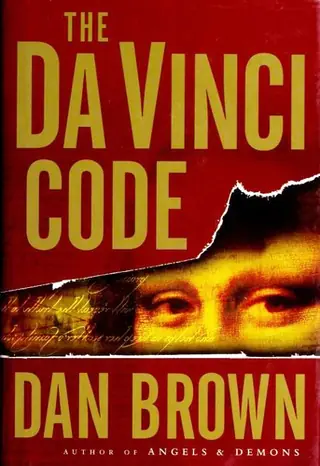
The Da Vinci Code
by Dan Brown · first published 2003
6% recommend54% neutral40% critical
Why HN recommends it
Fast, easy page-turner that readers finished quickly and enjoyed without prior knowledge; often suggested as an accessible, fun read for people building a reading habit or wanting light fiction.
Common criticism: Critics point to weak writing and plot holes that stand out on a second look.
Summarised by Claude from recommending comments
The Da Vinci Code is a 2003 mystery thriller novel by Dan Brown. It is Brown's second novel to include the character Robert Langdon: the first was his 2000 novel Angels & Demons. The Da Vinci Code follows "symbologist" Robert Langdon and cryptologist Sophie Neveu after a murder in the Louvre Museum in Paris causes them to become involved in a battle between the Priory of Sion and Opus Dei over the possibility of Jesus Christ and Mary Magdalene having had a child together.
Affiliate links. As an Amazon Associate I earn from qualifying purchases.
Mentions per year
What Hacker News says
Related books
 2011–2025
Angels & Demons
Dan Brown
Recommended by 2 · mentioned by 72 recommend · 7 mention2 recommend · 72 recommend
 2016–2025
The Holy Blood and the Holy Grail
Michael Baigent, Richard Leigh, Henry Lincoln
Recommended by 1 · mentioned by 41 recommend · 4 mention1 recommend · 41 recommend
 2008–2025
Digital Fortress
Dan Brown
Recommended by 10 · mentioned by 3810 recommend · 38 mention10 recommend · 3810 recommend
 2009–2023
The Lost Symbol
Dan Brown
Recommended by 1 · mentioned by 141 recommend · 14 mention1 recommend · 141 recommend
 2007–2017
Deception Point
Dan Brown
Recommended by 2 · mentioned by 52 recommend · 5 mention2 recommend · 52 recommend
Foucault's Pendulum
Umberto Eco
Recommended by 54 · mentioned by 9854 recommend · 98 mention54 recommend · 9854 recommend
The Tin Drum
Gunter Grass
Recommended by 3 · mentioned by 83 recommend · 8 mention3 recommend · 83 recommend
Three Musketeers
Alexandre Dumas
Recommended by 3 · mentioned by 73 recommend · 7 mention3 recommend · 73 recommend
Off topic but I had a very interesting experience reading Dan Brown. I read 'The da Vinci Code' without knowing anything about it or Brown, and I really enjoyed reading it. Then I saw the movie and I immediately recognized the massive holes in the plot, holes that I never saw while reading it.…
on “Antimatter atoms produced and trapped at CERN” ↗…start with "serious" literature, but look for anything that grabs your attention. Not all of these are to my taste, but they have been broadly popular: The Hitchhiker's Guide to the Galaxy (1979), The Da Vinci Code (2003), The Big Sleep (1939), The Color out of Space (1927) (short), The Hunt for Red October (1984), Hondo (1953), Get Shorty (1990).
on “Ask HN: How to transition from non-fiction to fiction reading?” ↗He received some vitriol in the 2000s from some Christian groups about Da Vinci Code being blasphemous. I think these days he’s mostly just seen as a bit of a literary punching bag who makes popular, digestible books for Gen-X Americans. I read DVC in high school and thought it was a…
on “Don’t Make Fun of Renowned Dan Brown (2013)” ↗…have genuinely been surprised by all the negative comments about Dan Brown and his novels. I read his novels when I was in middle/high school (in a developing country) and I loved them, especially The Da Vinci Code. I remember waiting to get my hands on it from the school library and then reading the entire novel in one sitting (which was a first for me). It's been ages since I have read one of his books. After…
on “Don't make fun of renowned author Dan Brown (2013)” ↗Although I do agree with criticisms of his writing and have felt the same in his later books (as I was too young to feel the poor writing when I read A&D, Da Vinci Code etc.), I know that I'll get his next book when it releases. I like that his works mention random things that you can then read about from other sources, information that are tangents to search off of.…
on “Don't make fun of renowned author Dan Brown (2013)” ↗The biggest tip is to read fun books. Pick up an easy dumb page turner like The Da Vinci Code, and reading won’t be a chore. Save the non-fiction and literary fiction for when you get more in the habit. Also, it’s ok to give up on a book if it’s not interesting.
on “Ask HN: How much time do you spend reading books?” ↗I think it's fairly obvious that TKAMB is objectively better than ASOIAF. What next? You'll tell me that Dante Alighieri's 'Divine Comedy' isn't objectively better than Dan Brown's 'The Da Vinci Code'? Or that 'The Grapes of Wrath' isn't objectively better than 'Fifty Shades of Grey'? I don't buy your bullshit relativism.
on “Harper Lee has died” ↗…for the next book. standalone novels don't have that sort of forcing function, and it doesn't seem to work for multiple books by the same author (e.g. no one talked about dan brown's novels after 'the da vinci code')
on “The Books We Talk About (and Those We Don’t)” ↗…this book A Million Random Digits (take the time to read the customer reviews). And I use this number to set my detectors. I repeat this for my other measurement runs, but I substitute in Dan Brown’s Da Vinci Code for Dickens every third go. Superdetermination advocates would tell me that there is in principle a causal connection between my throwing the papers in the air, Newton, Caesar, Dickens as they sat down…
on “How Bell’s Theorem proved ‘spooky action at a distance’ is real” ↗Let's take "The Da Vinci Code" as an example. How many people had the idea behind that book? Not that many. Yes, Dan Brown had to sit down and write it, but it's the storyline (the "idea" behind the book) that got millions of people…
on “Ask HN: The value of ideas” ↗Infamous Authors' Outlines for Great Works of Bad Literature * Martin Amis' UML diagram for London Fields * EL James' Balsamiq mockups for Fifty Shades Of Grey * Dan Brown's PowerPoint decks for The Da Vinci Code Couldn't resist ;) Though clearly Balsamiq mockups are the odd one out since they are useful.
on “How J.K. Rowling Plotted Harry Potter with a Hand-Drawn Spreadsheet” ↗…was more intentionally cranky and funny. It is to conspiracy novels as "Airplane!" was to disaster movies, and then some. [Edit] Both of them make Dan Brown look really, really unimpressive. If "The Da Vinci Code" is a vaguely thought-through concept aimed at general readers, "The Illuminatus! Trilogy" is an explosion in a conspiracy theory factory. [0] https://en.wikipedia.org/wiki/The_Illuminatus!_Trilogy
on “An automated pipeline for the discovery of conspiracy theories” ↗…American suburban culture, try _Infinite Jest_. Both Stephenson and David Foster Wallace owe a debt to Thomas Pynchon, but Stephenson's relationship to Pynchon is unfortunately a lot like Dan Brown's (_The Da Vinci Code_) relationship to Umberto Eco (_Foucault's Pendulum_, another great hacker book): it's simultaneously superficial and exploitative, a kind of literary mountaintop-removal exercise. Wallace isn't going…
on “Snow Crash movie to be written and directed by Joe Cornish” ↗…with the governing ideology. Anything that could challenge the ruling system will not find its place in this book store. The list of banned books in Iran includes Dante's Inferno and Dan Brown's The Da Vinci Code.
on “Why is the Iranian government opening the world’s biggest bookstore?” ↗If Dan Brown sells 80 million copies of The Da Vinci Code, he has probably worked something out with his publisher that he gets some amount of money per book sold. If Michael Jackson sells 45 million copies of Thriller, he probably gets a cut of each sale.…
on “That $35 that scientific journals charge goes 100% to publisher, 0% to authors” ↗