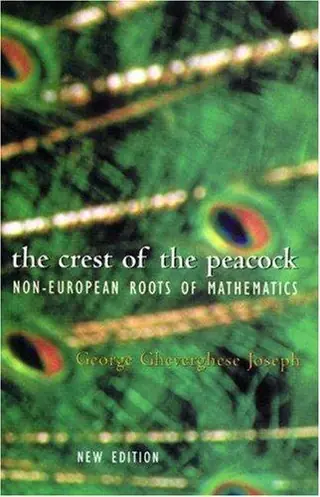
The Crest of the Peacock
by George Gheverghese Joseph · first published 1991
40% recommend40% neutral20% critical
From the Ishango Bone of central Africa and the Inca quipu of South America to the dawn of modern mathematics, The Crest of the Peacock makes it clear that human beings everywhere have been capable of advanced and innovative mathematical thinking. George Gheverghese Joseph takes us on a breathtaking multicultural tour of the roots and shoots of non-European mathematics. He shows us the deep influence that the Egyptians and Babylonians bad on the Greeks, the Arabs' major creative contributions, and the astounding range of success of the great civilizations of India and China. The third edition
Affiliate links. As an Amazon Associate I earn from qualifying purchases.
…history of math and the historical context that different ideas came from. Here's a nice example covering complex numbers https://www.youtube.com/watch?v=T647CGsuOVU Maybe tangential to your ends, but the Crest of the Peacock is a nice book on non-European mathematical traditions, which provides some insight into how the process of establishing and validating mathematical knowledge works in other cultures. You might try books…
on “Ask HN: Best resources to gain math intuition?” ↗If this article intrigues, see the chapter on Egyptian mathematics in The Crest of the Peacock: https://www.ms.uky.edu/~sohum/ma330/files/Crest_of_the_peaco...
on “Egyptian Fractions” ↗…fundamentally altering the global tea trade. While this example pertains to botany rather than mathematics, it illustrates the lengths to which nations went extract knowledge. (Source: Joseph, G. G. (2011). The Crest of the Peacock: Non-European Roots of Mathematics (Third Edition). Princeton University Press.)
on “The Golden Road: How Ancient India Transformed the World” ↗…*Where's the danger? Where's the nonsense in acknowledging the origins of algebra?* ~ @myself Do you have _ any _ meaningful critique of the contents of, say, maths historian George Joseph’s book The Crest of the Peacock: Non-European Roots of Mathematics (1991) ? This appears to be old established material that I read in the ANU library back in the early 1980s.
…was a special case rather than the general concept, though; if I'm right about that, it's an important distinction.) So now I'm conflicted again. [EDITED to add:] The book in question is called "The crest of the peacock: Non-European roots of mathematics". Well, it seems to me that the most that can credibly be true here is that Newton's discovery of calculus was influenced by closely related prior work by the likes…
on “In Obscurity” ↗