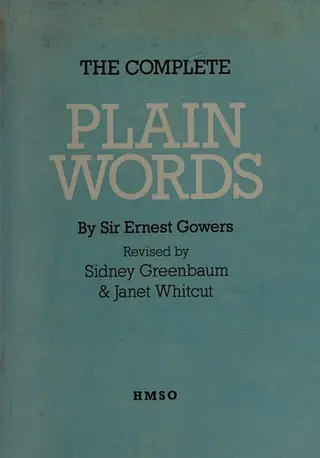
The complete plain words
by Sir Ernest Gowers · first published 1954
5mentions
2recommended by
3HN commenters
2017–2025first – last mentioned
67% recommend33% neutral
Affiliate links. As an Amazon Associate I earn from qualifying purchases.
…invaluable guides to clear, unfussy English, one short and one long: * George Orwell's essay 'Politics and the English Language' [0], which includes his six rules for writing * Sir Ernest Gowers' The Complete Plain Words [1], originally a style guide for the notoriously prolix British Civil Service, in which he offers this memo from the ancient Egyptian ministry of finance as a paragon: > Appollonius to Zeno, greeting.…
on “How We Write” ↗On the topic of clear writing, a longer work to follow on from this article is The Complete Plain Words by Sir Ernest Gowers. I heartily recommend it, and find its recommendations on reducing officialese quite useful for increasing clarity in technical documentation.
on “On Making Oneself Less Unreadable” ↗Two usages that Ernest Gowers bemoaned in The Complete Plain Words, written c. 1950, but which seem unexceptional today: "phenomenal" to mean "prodigious" (rather than simply "perceptible to the senses"), and "meticulous" to mean "scrupulous" (rather than "overly and…
on “How long should we cling to a word's original meaning? (2011)” ↗Sir Ernest Gowers, who did a mid-century revision of Fowler's Modern English Usage, wrote a book on his own, The Complete Plain Words, and remarked on ways that what in law appears to be nit-picking is necessary clarification. Gowers was a judge.
on “The Law Does Not Require Legalese” ↗…relative clause, not by the role of the relative clause in the sentence as a whole. See: - H. W. Fowler, A Dictionary of Modern English Usage - Eric Partridge, Usage and Abusage - Ernest Gowers, The Complete Plain Words who are unanimous on this point.
on “Red Hat Technical Writing Style Guide” ↗