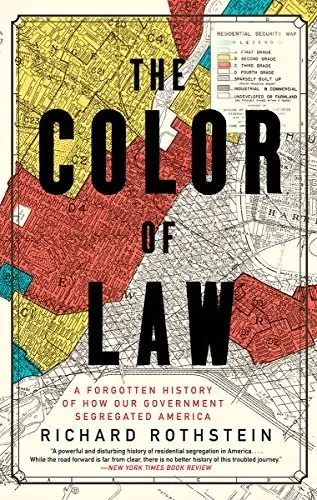
The Color of Law
by Richard Rothstein · first published 2017
78% recommend22% neutral
Why HN recommends it
Thoroughly documented history of how federal, state and local government policy created residential segregation through redlining, zoning and lending; suits readers who want the sources behind US housing and wealth gaps.
Summarised by Claude from recommending comments
Widely heralded as a "masterful" (Washington Post) and "essential" (Slate) history of the modern American metropolis, Richard Rothstein's The Color of Law offers "the most forceful argument ever published on how federal, state, and local governments gave rise to and reinforced neighborhood segregation" (William Julius Wilson). Exploding the myth of de facto segregation arising from private prejudice or the unintended consequences of economic forces, Rothstein describes how the American government systematically imposed residential segregation: with undisguised racial zoning; public housing tha
Affiliate links. As an Amazon Associate I earn from qualifying purchases.
Mentions per year
What Hacker News says
Related books
 2020–2025
Neighborhood Defenders
Katherine Levine Einstein
Recommended by 4 · mentioned by 54 recommend · 5 mention4 recommend · 54 recommend
Gulag Archipelago
Aleksandr Solzhenitsyn
Recommended by 77 · mentioned by 16977 recommend · 169 mention77 recommend · 16977 recommend
 2010–2026
The New Jim Crow
Michelle Alexander
Recommended by 58 · mentioned by 7858 recommend · 78 mention58 recommend · 7858 recommend
Harrison Bergeron
Kurt Vonnegut
Recommended by 27 · mentioned by 11727 recommend · 117 mention27 recommend · 11727 recommend
 2018–2026
The Age of Surveillance Capitalism
Shoshana Zuboff
Recommended by 47 · mentioned by 8147 recommend · 81 mention47 recommend · 8147 recommend
 2012–2026
Antifragile
Nassim Nicholas Taleb, Genís Sánchez Barberán, Albino Santos Mosquera
Recommended by 135 · mentioned by 281135 recommend · 281 mention135 recommend · 281135 recommend
 2016–2026
The Coddling of the American Mind
Greg Lukianoff, Jonathan Haidt
Recommended by 51 · mentioned by 10951 recommend · 109 mention51 recommend · 10951 recommend
…this rot comes from our racist segregation which lead to our poor century of city planning. (This, of course, would need several books to fully justify my wild claims, but one book that starts to is The Color of Law by Richard Rothstein.
on “Put tiny businesses back into residential neighborhoods” ↗I've said it before in other threads, but I highly recommend The Color of Law by Richard Rothstein for anyone interested in this topic. Much of today's housing crisis is a direct result of blatantly racist policies that were implemented to keep out PoC out of white neighborhoods.…
on “California’s Housing Crisis Reaches a ‘Breaking Point’” ↗…conclusion of this is that the "single-variable approach" doesn't work. It's too bad because the original point stands and in fact it's well documented in the literature. In fact an excellent book, The Color of Law [1], was recently published that shows very clearly in excruciating detail how racist policies systematically worked to deprive blacks of property and wealth. But no, let's talk about the very different…
on “Gerontopoly: Homeownership, wealth, and age” ↗…reasonable on their face, they were in fact implemented to keep out PoC [1]. Now they're used by people on the top of the socioeconomic pyramid to keep those on the bottom out. [1] Further reading: The Color of Law by Richard Rothstein
on “Demolishing the California Dream: How SF Planned Its Own Housing Crisis” ↗The Color of Law by Richard Rothstein is an excellent history of how government policy was co-opted by white supremacists in America.
on “What Happens After Prisoners Learn to Code?” ↗If you're interested in learning why this is wrong, the book The Color of Law is an excellent history of the segregationist laws that made things as they are. https://wwnorton.com/books/The-Color-of-Law/
on “Where the missing middle of housing isn't missing” ↗…huge portion of wealth. Ordinances like high minimum lot sizes and low coverage were deliberately designed to make it more expensive for POC to buy into a neighborhood. This is covered extensively in The Color of Law, and is a great read [2]. Perhaps the better approach is to fix these systemic issues so that schools didn't have to compensate for them. [1] https://www.brookings.edu/blog/up-front/2020/02/27/examining...…
on “Feds say Yale discriminates against Asian, white applicants” ↗In the US, laws were only for the affluent, male, white class anyways. Richard Rothstein wrote a great book about it called "Color of Law: A Forgotten History of How Our Government Segregated America" https://en.wikipedia.org/wiki/The_Color_of_Law It's just that the middle class is no longer going to be the "In" group.
on “A sitting US president launched two memecoins that wiped out $4.3B+” ↗…localized Jim Crow laws and sundown towns, but also in federal policies like redlining, prevented generations of blacks from getting the same economic benefits as whites. (See Richard Rothstein's “The Color of Law”; interview at http://www.npr.org/2017/05/03/526655831/a-forgotten-history-... .) I know less about British history, but I do know how many thought the "Anglo-Saxon race" was above all others. You earlier…
on “Why Are Some Countries Rich and Others Poor?” ↗Seneca Amusing Ourselves to Death The Color of Law
on “Ask HN: Which non-fiction books had the biggest impact on you?” ↗Yes, I highly recommend the book The Color of Law by Richard Rothstein. It goes into depth behind the laws now used for NIMBYism, which have a shameful past that must not be forgotten, lest these mistakes be repeated. The book begins by taking a look…
on “California lawmakers have tried for 50 years to fix the state’s housing crisis” ↗I just finished reading "Color of Law", which, while not the best formatted book, gives a really really good overview of the systematic, government led, programs designed and enforced explicitly against african americans from the late 1870s…
on “How Neglecting Minorities in Medical Research Has Led to Deadly Outcomes” ↗Check out The Color of Law by Richard Rothstein for an extensive treatment of this topic. (His focus is not on Jim Crow per se, but on the entire web of policies used to enforce segregation across the States, thus locking African…
on “Birth Rates Dropped Most in U.S. Counties Where Home Prices Grew Most” ↗For those interested in the topic, I'd also highly recommend Richard Rothstein's "The Color of Law." Rothstein discusses there how explicitly racist zoning policies contributed to the segregation of suburbs. I found it to be a fascinating read.
on “The myth of revealed preference for suburbs” ↗…latter on the Nazi economy. Tooze does an excellent job coming up with larger trends and global narratives, I'm often amazed at just how much he's able to keep in his head. By Richard Rothstein: The Color of Law. A quick, informative, yet more than thorough enough on the factual, legal prevention that American employed over the majority of the 20th century to prevent black Americans form participating in the…
on “Ask HN: Books you read in 2018?” ↗