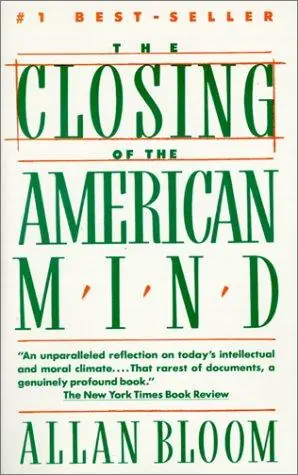
The Closing of the American Mind
by Allan Bloom · first published 1987
26% recommend59% neutral15% critical
Why HN recommends it
An insightful, enlightening account of how culture and education shape opinions and of the state of American universities. It serves as a general overview for readers seeking that background.
Common criticism: Some critics see its take on universities and society as elitist and dated.
Summarised by Claude from recommending comments
A discourse on late 20th century American students' mind and soul, and the damage done by the elite universities' turn from the eternal verities as outlined by Socrates-Plato-Aristotle, Shakespeare and Rousseau.
Affiliate links. As an Amazon Associate I earn from qualifying purchases.
Mentions per year
What Hacker News says
Related books
 2007–2023
Gilgamesh
Herbert Mason
Recommended by 2 · mentioned by 22 recommend · 2 mention2 recommend · 22 recommend
 2012–2024
Losing ground
Charles A. Murray
Recommended by 1 · mentioned by 61 recommend · 6 mention1 recommend · 61 recommend
 2007–2026
Master and Commander
Patrick O'Brian
Recommended by 28 · mentioned by 3928 recommend · 39 mention28 recommend · 3928 recommend
 2016–2026
The Coddling of the American Mind
Greg Lukianoff, Jonathan Haidt
Recommended by 51 · mentioned by 10951 recommend · 109 mention51 recommend · 10951 recommend
 2008–2026
The Grapes of Wrath
John Steinbeck
Recommended by 56 · mentioned by 17056 recommend · 170 mention56 recommend · 17056 recommend
Communist Manifesto
Karl Marx, Friedrich Engels
Recommended by 31 · mentioned by 20631 recommend · 206 mention31 recommend · 20631 recommend
 2008–2026
Mein Kampf
Adolf Hitler
Recommended by 15 · mentioned by 53515 recommend · 535 mention15 recommend · 53515 recommend
 2007–2026
The Black Swan
Nassim Nicholas Taleb, David Chandler
Recommended by 263 · mentioned by 666263 recommend · 666 mention263 recommend · 666263 recommend
…order of length, short to long, since they are pretty dense). I'd also recommend reading the Republic last, so you can get over the misconceptions you were probably taught in high school. Allan Bloom's Closing of the American Mind is also very enlightening for a) understanding the goals of the enlightenment, and b) understanding the current state of our culture.
on “What books would you recommend reading? Why?” ↗…of course, is true, but is half the story. Many in what may be called left or liberals (again, very loose terms) also exhibit a form of this behavior. An old but interesting read on this matter is The Closing of the American Mind.
on “Why Don't Americans Elect Scientists?” ↗Closing of the American Mind by Allan Bloom (https://www.amazon.com/Closing-American-Mind-Education-Impov...) was a book I had to read multiple times. It gave me a new understanding of how deep culture and environment really do influence…
on “Ask HN: What books changed the way you think about almost everything?” ↗Two responses: First, this piece makes me think of The Closing of the American Mind, by Allan Bloom. Highly recommended, it's more relevant than ever. Second, I am reminded of these passages from Justin E.H. Smith: > Yet the new social mores are not going to last forever either, and…
on “After College: The coming cultural collapse of American higher education” ↗If anyone hasn't read The Closing of the American Mind by Allan Bloom, I'd highly recommend it. There are a few thoughtful chapters on relationships, love, marriage, sex, etc. that are worth reading.
on “Everyone Is Beautiful and No One Is Horny” ↗Then definitely don't miss its forefather. Writing with such insight The Closing of the American Mind by Allan Bloom
on “Ask HN: What are you reading these days?” ↗…they taught that truth was relative and that natural rights and classical liberalism was irrelevant in the face of supranational political utopias. This is covered in Professor Allen Bloom's book, "The Closing of the American Mind." We are all from Africa and we all have natural rights. So since the US was the first nation to acknowledge this, and since the EU does not acknowledge natural rights and in fact is a bureaucratic…
on “Internet Access Is Finally Permanently Tax Free in the U.S.” ↗…university humanities department to teach me (or my children) much about them. There are exceptions, of course, but we are speaking internet here. For a general overview of the situation, Allan Blooms "The Closing of The American Mind" covers it far better than I (or almost anyone else) could.
on “A practical case on why we need the humanities” ↗…Yorker, has dropped in quality from a few decades ago. Just read some old issues to see what I mean. Regardless, this article is hardly the first or only study of this problem. Allan Bloom wrote The Closing of the American Mind in 1987. Harold Bloom and John Simon wrote a few books on the topic. https://en.wikipedia.org/wiki/The_Closing_of_the_American_Mi...
on “The Erosion of Deep Literacy” ↗…until the 1600s. Kant, by himself, isn't a good source since his philosophical agenda was to overthrow the relevance of religion (which was tightly coupled with classical thought). See Allan Bloom's Closing of the American Mind for details. For my undergrad I studied the classics, and I'd say your generalizations are too general. People, such as Aristophanes, said the same things about Plato in his day that you say in your…
on “How to Do Philosophy” ↗…This usage was popularized by a number of articles in The New York Times and other media throughout the 1990s,[12][13][14][15][16][17] and was widely used in the debate about Allan Bloom's 1987 book The Closing of the American Mind,[7][9][18][19] and gained further currency in response to Roger Kimball's Tenured Radicals (1990),[7][9][20][21] and conservative author Dinesh D'Souza's 1991 book Illiberal Education, in which he condemned…
on “The Emperor’s Woke Clothes” ↗…https://www.freethink.com/consumer-tech/sony-walkman-technop... "Some said it was a sign of a continued rise of Reagan- and Thatcher-style individualism. Cultural critic Allan Bloom deemed the Walkman “a nonstop…masturbational fantasy” in his 1987 book “The Closing of the American Mind.” Neo-Luddite John Zerzan saw the Walkman as part of a modern trend that encouraged a “protective sort of withdrawal from social connections.” Thomas Lipscomb, chief of the Center for the Digital Future,…
on “The AirPods Effect” ↗If it's only just begun, how do we know it's going to be a long one? Anyway, didn't it begin much earlier? As documented in 1987 with Allan Bloom's Closing of the American Mind https://en.wikipedia.org/wiki/The_Closing_of_the_American_Mi...
on “The Long Decline of American Higher Education Has Begun” ↗This position strikes me as unjustifiably elitist, reminiscent perhaps of Allan Bloom's The Closing of the American Mind. > lots of university departments that were superfluous, producing nothing that was actually benefitting society Who's to decide precisely what does and doesn't benefit society? More so, how can you…
on “Incentives in economics are wrong, but how?” ↗…instead of being "educated." What you call liberalism today is proof of the absolute stranglehold of the New Left and post-modernist ideology over Western intellectuals. Allan Bloom wrote about it in "The Closing of the American Mind" discussing how Frankfurt School nihilists such Herbert Marcuse and Michele Foucault and post-modernists such as Jacques Derrida burrowed into the Ivy League (later the rest of academia) beginning after…