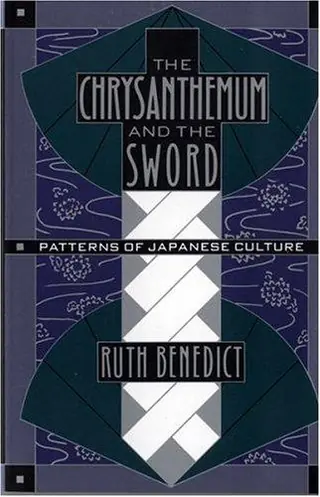
The Chrysanthemum and the Sword
by Ruth Benedict · first published 1946
10mentions
3recommended by
10HN commenters
2011–2026first – last mentioned
30% recommend60% neutral10% critical
Anthropologist Ruth Benedict prepared this study of Japanese culture towards the end of World War II to explain Japan to Americans. It's become a classic. Published in 1946.
Affiliate links. As an Amazon Associate I earn from qualifying purchases.
…and others, such as why the tatemae/honne distinction, present in all cultures, is so extreme in Japan. Decades ago, anthropologist Ruth Benedict discussed this issue (among others) in her book, "The Chrysanthemum and the Sword", which was held in high esteem by the Japanese post-war generation. You might start with that.
on “Young Japanese are surprisingly content” ↗Japanese on 恩 describes obligation (not necessarily with the negative connotation of the English word). Obligation to one's lord, to the emperor, one's parents, etc. I recommend Chrysanthemum and the sword by Ruth Benedict for a more detailed understanding of this very important, albeit fading, part of Japanese culture.
on “Hachikō” ↗…finally prohibited child porns. They still have public spas that allow both men and women in one tub. I don't think your story represents Japanese people's personality regarding not looting. Read <The Chrysanthemum and the Sword: Patterns of Japanese Culture>.
on “Why no looting in Japan?” ↗Thank you very much for this explanation. It reminded a bit when I read The Chrysanthemum and the Sword by Ruth Benedict. I visited Japan (and stayed with locals all the time) this last year after reading that book and I didn't see most of these rigid descriptions Ruth Benedict explained there, but I felt…
on “Why Asians wear surgical masks in public (2014)” ↗…concept of Shame Cultures vs. Guilt Cultures and mentions the Japanese as a Guilt Culture, along with the European cultures. But this concept was first popularized in a book by Ruth Benedict called the Chrysanthemum and the Sword, where she claims that Japanese culture is a Shame (haji) culture where social norms are primarily enforced by fear of ostracism ("Nobody will be your friend/help you if you act like that!") versus internalized…
on “The world's most toxic value system (2001)” ↗Interesting ! On a similar note, as a Frenchman, I felt somewhat closer to the Japanese described in "The Chrysanthemum and the Sword" by Ruth Benedict than to the Americans, although the Japanese are the "aliens" from the point of view of that book.
on “On social reality in China” ↗nihonjinron along the lines of The Chrysanthemum and the Sword ... supporting a false ethnic nationalism
on “Who are the Japanese? (2008)” ↗…control has long been recognized. Both articles cites very few sources about that distinction being useful or acknowledged by sociology. I see both articles relies heavily on « Japanese Perceptions of The Chrysanthemum and the Sword ». Is there more substance and relevance to the concept ? What does it explain ?
on “The ages of distraction” ↗> I do think their religious beliefs were relevant to policy. The US was very cognizant of this when they demanded the unconditional surrender of Japan. That's certainly the Chrysanthemum and the Sword take on it. I'd agree that American conceptions of Japanese religious beliefs influenced American policy. The extent to which emperor-worship was truly inculcated in the population at large is still subject…
on “History's deadliest air raid happened in Tokyo during World War II (2020)” ↗…and a rarefied artistic awareness. In 1946, U.S. anthropologist Ruth Benedict made it respectable to see the Japanese as a race apart with the publication of her classic study of Japanese culture, The Chrysanthemum and the Sword. She described a highly codified society operating with conventions all-but-incomprehensible to outsiders. Her work paved the way for shelf after shelf of Nihonjinron texts by Japanese authors. These…
on “Why is Japan so… different?” ↗