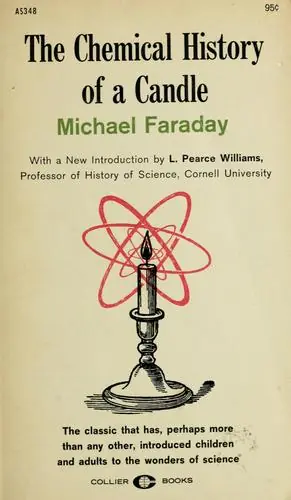
The chemical history of a candle
by Michael Faraday · first published 1894
100% recommend
Why HN recommends it
Faraday's Christmas lectures use a burning candle to explain chemistry and the scientific method, offering a clear, readable model of science education for curious young people and aspiring teachers.
Summarised by Claude from recommending comments
"Michael Faraday's celebrated series of lectures, The Chemical History of a Candle, turned into one of the most successful science books ever published and was a classic work of Victorian popular science. They also reflect how Faraday, the bookbinder's apprentice turned scientist, was a remarkable communicator of science. First published in 1861 they have remained continuously in print ever since. Covering a wide range of basic scientific knowledge, much of which still has relevance today, The Chemical History of a Candle draws out the science behind the candle flame; a familiar yet complex e
Affiliate links. As an Amazon Associate I earn from qualifying purchases.
There's a hell of a lot more. Michael Faraday's "Chemical History of a Candle" is a very readable masterpiece on the subject, despite its age. The Engineering Guy has done much to revive Faraday's work: http://www.engineerguy.com/faraday/
on “Where does a candle go when it burns?” ↗Or Michael Faraday's masterpiece "the chemical history of a candle", which deep-dives not only into what every part of the fire is, but also how we know what it is. https://www.gutenberg.org/cache/epub/14474/pg14474.txt The whole book is a delight to read, but I really…
on “What’s a fire and why does it burn? (2016)” ↗…up with "... and how could I demonstrate that?" The third step is then "how do I communicate that to others?" In the domain of chemistry, there's a wonderful example of that in Michael Faraday's "The Chemical History of a Candle". YouTube's EngineerGuy (Bill Hammack) has a wonderful recreation of Faraday's public demonstration of these properties. It seems obvious and pedestrian now, but that's because Faraday introduced us…
on “4.6B-year-old meteorite found” ↗(I think the above comment is rhetorical, but if anyone wants to actually see what a serious answer to those questions might look like, I strongly recommend Michael Faraday's "the chemical history of a candle".)
on “The Baloney Detection Kit: Carl Sagan’s Rules for Critical Thinking” ↗engineerguy’s reproduction of Michael Faraday’s 1848 Chemical History of a Candle [0]: https://youtube.com/playlist?list=PL0INsTTU1k2UCpOfRuMDR-wlv... This was a set of lectures given by Faraday for the Royal Institution’s “Christmas lectures for young people”. [0]: https://en.wikipedia.org/wiki/The_Chemical_History_of_a_Cand...
on “Ask HN: What's the best lecture series you've ever seen?” ↗…method in action viz. Observe, Measure, Hypothesize (and Model), Test, Draw Conclusions and finally, Iterate over all of the above to refine the hypothesis and minimize error. Finally, the classic The Chemical History of a Candle by Michael Faraday is an excellent source to teach oneself/others/students/children on how to think scientifically in depth about anything - https://en.wikipedia.org/wiki/The_Chemical_History_of_a_Cand...…
on “The Illusion of Explanatory Depth” ↗…was sitting on the bottom pool, looking up at the surface. https://www.youtube.com/watch?v=-Z4xxObrTlI&t=40s The second is Bill Hammack (The Engineer Guy) delivering Faraday's lecture series on The Chemical History of a Candle. This is a truly excellent lecture series, despite its age (they did choose to keep most of the original language, which can take a little getting used to) https://www.youtube.com/playlist?list=PL0INsTTU1k2UCpOfRuMDR...
on “What’s a fire, and why does it burn?” ↗…difficult, nor dumbed down - for example, Steinhaus' "Mathematical Snapshots", Einstein and Infeld's "The Evolution of Physics", Schrodinger's "What is life?" and even delightful works such as Faraday's "Chemical history of a candle". With the hypercompetitiveness of modern scientific careers, scientists who take time off to write popular expositions are looked down upon. The problem is not Malcolm Gladwell, the problem is the insularity…
on “Should we stop believing Malcolm Gladwell?” ↗…behind various everyday objects. His more recent stuff has (unfortunately, in my opinion) dropped most of the comedy, but really stepped up the overall quality. Some highlights: His series on Faraday's Chemical History of a Candle lectures: https://www.youtube.com/watch?v=RrHnLXMTOWM His series on Albert Michelson’s Harmonic Analyzer (a century old device that can mechanically perform Fourier transforms) https://www.youtube.com/watch?v=NAsM30MAHLg…
on “The Engineering of the Drinking Bird Toy [video]” ↗His "Chemical History of a Candle" Christmas lecture is a masterpiece in science education. Narrated here by Bill Hammack - the engineerguy: https://www.youtube.com/watch?v=RrHnLXMTOWM
on “Michael Faraday invented the rubber balloon” ↗