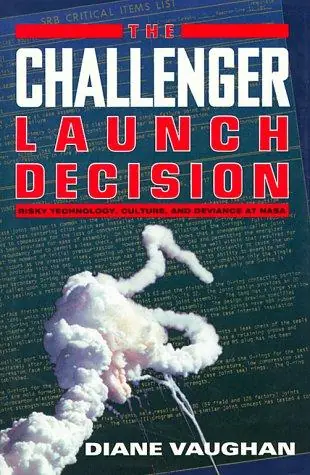
The Challenger launch decision
by Diane Vaughan · first published 1996
62% recommend31% neutral8% critical
Why HN recommends it
Detailed sociological account of how NASA's organizational culture and incentives normalized known risks before the Challenger disaster; useful for readers interested in safety and decision-making.
Summarised by Claude from recommending comments
When the Space Shuttle Challenger exploded on January 28, 1986, millions of Americans became bound together in a single, historic moment. Many still vividly remember exactly where they were and what they were doing when they heard about the tragedy. In The Challenger Launch Decision, Diane Vaughan recreates the steps leading up to that fateful decision, contradicting conventional interpretations to prove that what occurred at NASA was not skulduggery or misconduct but a disastrous mistake.
Affiliate links. As an Amazon Associate I earn from qualifying purchases.
I just finished Diane Vaughan's excellent Challenger Launch Decision, and it's remarkable how many of the same things that doomed the Vasa were also problems with the Shuttle fleet: 1. Excessive schedule pressure: The Vasa was launched with an aggressive schedule that…
on “Why the Vasa sank: Lessons learned” ↗…machine even if the inevitable consequence is that they get crushed, and the machine rolls on, heedless. I used to think in much the same fashion. But then I read a very powerful book: Diane Vaughan's Challenger Launch Decision. I would challenge you to read that book and identify, of all the people involved in the decision to launch the Challenger on that fateful day, which one acted in an evil manner? Which engineer wasn't…
on “Much of what investment bankers do is socially worthless (2010)” ↗For anyone else interested in how the organizational incentives and institutional culture at NASA helped to set the stage for the Challenger disaster, I highly recommend The Challenger Launch Decision[1] by Diane Vaughan. From the New York Times review[2]: In "The Challenger Launch Decision" Diane Vaughan, a sociologist at Boston College, takes up where the Rogers Commission and Claus Jensen leave…
on “Personal observations on the reliability of the Shuttle (1986)” ↗I recently read 'The Challenger Launch Decision' by Diane Vaughan [0]. It looks at the organizational structure that led to the Challenger disaster. If you're interested in learning more about the background to the launch, and the lessons for any complex…
on “Space Shuttle Mission Archives – Challenger, January 28, 1986” ↗>But the Challenger didn't explode because of Silly Shirt Friday. It exploded because management didn't respect their engineers. That's a myth. I encourage you to read Challenger Launch Decision, by Diane Vaughan. Challenger didn't explode because management disrespected their engineers. Challenger exploded because the engineers themselves normalized deviance. They would launch, observe anomalous…
on “LOLWUT: a piece of art inside a database command” ↗The article draws on the definitive text in this area by Diane Vaughan[0]. Read her work on the Challenger Launch Decision - it goes into the details of why the deviance was normalised. Even down to the level of how important decision making conference calls marginalised technical inputs. https://en.wikibooks.org/wiki/Professionalism/Diane_Vaughan_...
on “Normalization of Deviance” ↗…post. Sometimes when you get harsh feedback it has to do with (1) you, (2) people like you, (3) what somebody imagines you are. I'd point to the idea of "weak signals" from https://www.amazon.com/Challenger-Launch-Decision-Technology... Roughly that organizations that are sensitive to weak signals have some protection from dangerous situations. I could ask, for instance, "Why is Amazon still here but K-Mart isn't?"…
on “Harsh Feedback” ↗…https://en.wikipedia.org/wiki/Sayano-Shushenskaya_power_stat... Key: "It seems they were used to the high levels of vibration" - Diane Vaughan wrote an important book that introduced the term "normalisation of deviance" as a factor in the Challenger Launch Decision, a more famous complex accident. Another way of putting it is that "all complex systems operate in a degraded mode all the time", paraphrasing Adrian Colyer: https://blog.acolyer.org/2016/02/10/how-complex-systems-fail
on “Results of technical investigations for Storm-0558 key acquisition” ↗That's a really good summary / perspective. The more I read the Challenger Launch Decision, the more I was convinced that mistakes like the Challenger are unavoidable. We can try to reduce the risk, but given that we're always operating with limited resources, we just can't eliminate all the…
on “How I Almost Destroyed a £50M War Plane and the Normalisation of Deviance (2016)” ↗One of the reasons I really like Challenger Launch Decision is because it does a very good job of avoiding the hindsight bias as much as possible, by getting the readers to understand the perspective and the cultural norm of the organizations and participants,…
on “How I Almost Destroyed a £50M War Plane and the Normalisation of Deviance (2016)” ↗…the links to Sidney Dekker books: http://sidneydekker.com/books/ and Charles Perrow's excellent 'Normal Accidents' http://press.princeton.edu/titles/6596.html You might also want to read Diane Vaughn's 'Challenger Launch Decision' http://press.uchicago.edu/ucp/books/book/chicago/C/bo2278192... and John Gall's 'Systemantics' https://en.wikipedia.org/wiki/Systemantics ('Complicated systems produce unexpected outcomes')
on “Debriefing Facilitation Guide [pdf]” ↗…Richard Feynman[2] and Diane Vaughan[3]. [1] http://www.fastcompany.com/28121/they-write-right-stuff [2] http://science.ksc.nasa.gov/shuttle/missions/51-l/docs/roger... [3] http://www.amazon.com/The-Challenger-Launch-Decision-Technol...
on “Tesla’s P85D Will Get Even Faster Thanks to a Software Update” ↗Diane Vaughn wrote about 'normalisation of deviance' in her book The Challenger Launch Decision. The original Space Shuttle SSRB design had redundant O-rings for safety, and while a small amount of O-ring erosion (from the hot gases of burning propellant) had been observed on several occasions prior…
on “How Completely Messed Up Practices Become Normal” ↗Vaughn's book The Challenger Launch Decision doesn't tell this truth: the root cause of the accident can be traced back a decade to the acceptance of a design that was "unsafe at any speed". Every other manned space vehicle had an escape system.…
on “Heuristics that almost always work” ↗…ads, and other problems in the advertising system lower people's responsiveness to advertising. We need to restore the responsiveness to weak signals (bidirectionally) that Vaughn talks about in The Challenger Launch Decision and her book about her divorce Uncoupling.
on “Web Browsers have stopped blocking pop-ups” ↗