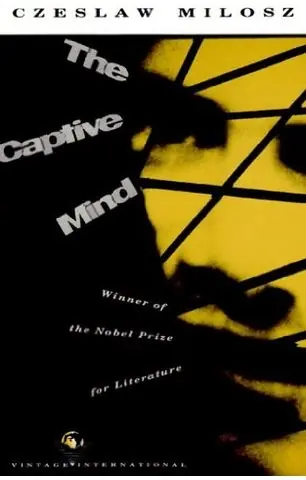
The Captive Mind
by Czesław Miłosz · first published 1990
70% recommend30% neutral
Why HN recommends it
Nonfiction study by a Polish writer of intellectuals living under Soviet-style control, noted for its insight into how writers and thinkers accommodate power and into the pressures on independent thought.
Summarised by Claude from recommending comments
The best known prose work by the winner of the 1980 Nobel Prize for Literature examines the moral and intellectual conflicts faced by men and women living under totalitarianism of the left or right.
Affiliate links. As an Amazon Associate I earn from qualifying purchases.
Mentions per year
What Hacker News says
Related books
Captive Mind
Czeslaw Milosz, Jane Zielonko
Recommended by 3 · mentioned by 43 recommend · 4 mention3 recommend · 43 recommend
 2010–2026
Reminiscences of a stock operator
Edwin Lefèvre, Price Tim, Roger Lowenstein, Richard Richard Wyckoff
Recommended by 27 · mentioned by 3727 recommend · 37 mention27 recommend · 3727 recommend
 2014–2026
Small Gods
Terry Pratchett, Ray Friesen
Recommended by 47 · mentioned by 7147 recommend · 71 mention47 recommend · 7147 recommend
 2009–2026
Zen mind, beginner's mind
Shunryū Suzuki
Recommended by 57 · mentioned by 7657 recommend · 76 mention57 recommend · 7657 recommend
The Glass Bead Game
Hermann Hesse
Recommended by 51 · mentioned by 9351 recommend · 93 mention51 recommend · 9351 recommend
 2007–2026
Siddhartha
Hermann Hesse
Recommended by 138 · mentioned by 186138 recommend · 186 mention138 recommend · 186138 recommend
 2007–2026
Economics in One Lesson
Henry Hazlitt
Recommended by 107 · mentioned by 147107 recommend · 147 mention107 recommend · 147107 recommend
 2007–2026
The Lord of the Rings
J.R.R. Tolkien
Recommended by 59 · mentioned by 23559 recommend · 235 mention59 recommend · 23559 recommend
…akin to the universal basic income. The question becomes, does that just exist for Western societies or for the entire world? I didn't read the entire article but it struck me to point out that "The Captive Mind" by Czeslaw Milosz is extremely relevant here. While the USSR was no wonderful place to be, artists tended to be happy there, because even if they were forced to "art" in a particular sense, the USSR…
on “The Case Against the Universal Basic Income” ↗The title should be changed - it's about Czeslaw Milosz, not Oscar. BTW, anyone who wants to experience some true literary and intellectual bliss, try Czeslaw Milosz's books and essays ("Captive Mind", "Native Realm", "Visions from the San Francisco Bay" or many others). Even his biography is utterly fascinating - it feels like he has experienced more during his lifetime than a dozen of your typical…
on “At Home in Exile” ↗…than what was written in it. Tony Judt, Past Imperfect: French Intellectuals, 1944-1956 Tony Judt, The Burden of Responsibility: Blum, Camus, Aron, and the French Twentieth Century Czesław Miłosz, The Captive Mind Raymond Aron, The Opium of the Intellectuals Those books taught me that there are quite a few secular religions to be beware of, with all the associated dangers and indeed opium for the mind. They were…
on “Ask HN: Are there any books that changed your life during college or school?” ↗I appreciate Stross too, he always reminds me of The Captive Mind by Czeslaw Milosz... "the writer's essential task – to look at the world from his own independent viewpoint, to tell the truth as he sees it, and so to keep watch and ward in the interest of society as…
on “Spy Kids” ↗…it's a propaganda outlet. We have smart minds doing their best to tell a particular story regardless of facts. Here is some good reading on the phenomena https://www.goodreads.com/book/show/145660.The_Captive_Mind
on “Anime is booming, so why are animators living in poverty?” ↗Please read The Captive Mind for the version based on true events. Spoiler: the Poles discovered that a political movement with methods and motivations which should sound very familiar didn't turn out to be the good guys after all.
on “Google Drive bans distribution of “misleading content”” ↗…Friedman, "On Power" Bertrand de Jouvenel, "1984" by George Orwell, "The State" by Anthony de Jasay, "Sketched With the Quill" by Andrzej Bobkowski, "My Correct Views on Everything" by Leszek Kolakowski, "The Captive Mind" Czesław Miłosz, "One Day in the Life of Ivan Denisovich" by Aleksandr Solzhenitsyn, "The House of the Dead" by Fyodor Dostoyevsky, "Conversations with an Executioner" by Kazimierz Moczarski, "Diary 1954"…
on “Ask HN: What's one book that changed your life?” ↗…relevant in societies back then; we're wise to not follow it now". But that's just skipping with extra steps. Edit: just to make sure it's clear - I'm very happy when such skipping happens. A quote from Captive Mind by Czeslaw Milosz: > When someone is honestly 55% right, that’s very good and there’s no use wrangling. And if someone is 60% right, it’s wonderful, it’s great luck, and let him thank God. But what’s…
Global Brain -Bloom Captive Mind -Milosz Machines of Loving Grace -Markoff Station 11 -Mandell (fiction) Sapiens -Harari Revenant (do not remember author/fiction) Argonauts -Nelson
on “Ask HN: What books have you read in the first half of 2016?” ↗…even dream about reading his all works. Then, after 1989, his books were finally officially published - but at this point several of them were less relevant. For example one of his most famous works, The Captive Mind, had been written in 1951 - almost 40 years earlier, with clues and subtle references to some contemporary writers and situations. There was no way the readers of '89, especially more young ones, would…
on “Czeslaw Milosz's Battle for Truth” ↗