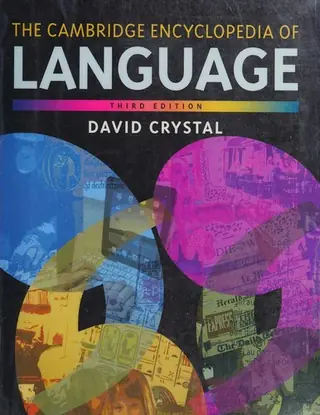
The Cambridge encyclopedia of language
by David Crystal · first published 2010
3mentions
1recommended by
3HN commenters
2010–2023first – last mentioned
33% recommend67% neutral
"This new, thoroughly revised edition of the acclaimed Cambridge Encyclopedia of Language incorporates the major developments in language study which have taken place since the mid-1990s. Two main new areas have been added: the rise of electronic communication in all its current forms, from email to tweeting, and the crisis affecting the world's languages, of which half are thought to be so seriously endangered that they will the out this century." "Praise for the Cambridge Encyclopedia of Language" "̀...magnificently demonstrates Professor Crystal's outstanding breadth of knowledge, incisiven
Affiliate links. As an Amazon Associate I earn from qualifying purchases.
As a kid? I'd probably name "Goedel, Escher, Bach" and "The Cambridge Encyclopedia of Language" as the two that had the biggest impact on me while I was in high school.
on “Ask HN: Which non-fiction books had the biggest impact on you?” ↗…Xuanzhou Wu and Lower Yangtze Mandarin, Jin and Central Plains Mandarin and certain divergent dialects of Hakka with Gan (though these are unintelligible with mainstream Hakka)."[1] David Crystal, The Cambridge Encyclopedia of Language (Cambridge: Cambridge University Press, 1987), p. 312. "The mutual unintelligibility of the varieties is the main ground for referring to them as separate languages."[2] Linguists in China often use…
…Hànyǔ; 华语/華語 Huáyǔ; 中文 Zhōngwén) is a language family consisting of languages which are mostly mutually unintelligible to varying degrees. [1] (The above quotation bears this footnote: David Crystal, The Cambridge Encyclopedia of Language (Cambridge: Cambridge University Press, 1987) , p. 312. "The mutual unintelligibility of the varieties is the main ground for referring to them as separate languages." ) As you suggest that I may be…
on “'They say Chinese is difficult - European languages are more difficult'” ↗