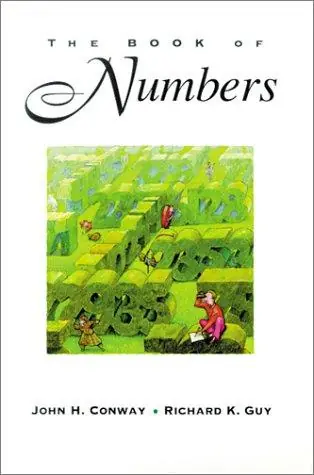
The book of numbers
by John Horton Conway, Richard K. Guy · first published 1995
57% recommend36% neutral7% critical
Why HN recommends it
A playful, intuitive tour of figurative numbers, difference tables and complex numbers, told with a sense of wonder. It suits curious students and anyone who enjoys math for its own sake.
Summarised by Claude from recommending comments
In The Book of Numbers, two famous mathematicians fascinated by beautiful and intriguing number patterns share their insights and discoveries with each other and with readers. John Conway is the showman, master of mathematical games and flamboyant presentations; Richard Guy is the encyclopedist, always on top of problems waiting to be solved. Together they show us why patterns and properties of numbers have captivated mathematicians and non-mathematicians alike for centuries. The Book of Numbers features Conway and Guy's favorite stories about all the kinds of numbers any of us is likely to e
Affiliate links. As an Amazon Associate I earn from qualifying purchases.
Mentions per year
What Hacker News says
Related books
 2018–2020
The symmetries of things
John Horton Conway, Heidi Burgiel, Chaim Goodman-Strauss
Recommended by 2 · mentioned by 32 recommend · 3 mention2 recommend · 32 recommend
 2017–2026
Elements of Mathematics
John C. Stillwell
Recommended by 4 · mentioned by 44 recommend · 4 mention4 recommend · 44 recommend
 2015–2022
Things to make and do in the fourth dimension
Matt Parker
Recommended by 6 · mentioned by 66 recommend · 6 mention6 recommend · 66 recommend
 2010–2023
A transition to advanced mathematics
Smith, Douglas
Recommended by 15 · mentioned by 1715 recommend · 17 mention15 recommend · 1715 recommend
Geometry and the imagination
David Hilbert
Recommended by 7 · mentioned by 107 recommend · 10 mention7 recommend · 107 recommend
 2013–2026
How to think like a mathematician
Kevin Houston
Recommended by 8 · mentioned by 108 recommend · 10 mention8 recommend · 108 recommend
 2008–2023
God Created the Integers
Stephen Hawking
Recommended by 6 · mentioned by 146 recommend · 14 mention6 recommend · 146 recommend
 2014–2025
The nature of computation
Cristopher Moore
Recommended by 10 · mentioned by 1410 recommend · 14 mention10 recommend · 1410 recommend
I learned about difference tables in Conway and Guy's great book "The Book of Numbers". I wish the book had been available when I was an undergrad. It describes everything I loved in math that I wasn't able to pinpoint. There are so many little gems in it, I've spent months reading…
on “9,73,241,561,1081,1849,_?_” ↗The Book of Numbers - John Conway. I wish I had read this somewhere around 12-15. I think this book would have quite an impact on a young mind.
on “If you could give a book to your younger self, what would it be?” ↗> so if there is another book that does the same thing with better exposition Have a look at Conway's "Book of numbers". He has a nice description of the complex numbers there. Conway can be terse aswell, but at least he is funny!
on “What are the complex numbers, really?” ↗I think Conway and Guy's "The Book of Numbers" might be a better source. It's more focused on infinities as different types of number, and certainly at a more suitable level. ONAG is quite a technical book; children don't really need to know that…
on “How to explain infinity to kids” ↗Would also recommend 'Surreal Numbers' by Don Knut hand 'The Book of Numbers' by Conway and Guy.
on “Classic Mathematics Books for Lifelong Learners” ↗…important concepts in his work, in his own words; also highly recommend all the Numberphile videos featuring him for that)- then: Winning Ways for your Mathematical Plays is really fun to thumb through. The Book of Numbers is fantastic and something I would gift to any mathematically curious, somewhat independent, child. Knuth's Surreal Numbers is also a great read. Got On Numbers and Games coming in the mail, and am…
on “Ask HN: What kind of math do you study in your free time?” ↗1) "The Science of Programming", by David Gries, is an excellent book dealing with mathematical proof based approach to programming. 2) "The Book of Numbers", by John H. Conway and Richard Guy is a beautiful book which discusses about figurative numbers amoung several other beautiful topics. 3) "Stories About Maxima and Minima", V. M. Tikhomirov has some…
on “Ask HN: Recommend a maths book for a teenager?” ↗…color visualizations, joined to the enumeration that Calcium seems to be able to output, and rendered dynamically as the cursor moved around the image, would be a neat demo. Also Conway and Guy’s “The Book of Numbers” has an extraordinarily playful, intuitive and focused introduction to algebraic numbers that doesn’t require even an undergraduate math background to grok, for folks coming to this post wondering what…
on “Printing Algebraic Numbers” ↗One large number that fits in 64 bits is: F^^^^^^F = 15 ^ .... ^ 15 12345678 [8*8=64 bit] According to Conway and Guy (1996) The Book of Numbers, p. 60, the arrow notation, defined by Knuth in (1976), is such that m^n is m x m x ...x m, m^^n is m^m^ ...^m, m^^^n is m^^m^^ ... ^^m, and so on, with n copies of m in each case, and the expression…
on “The largest number representable in 64 bits” ↗In Conway's book of numbers, there are many similar visual explanations for beautiful combinatorial formulas in terms of pebbles and polygons.
on “Tools for thought: graphical algebra and Fourier analysis” ↗The naming system comes from Conway (yes, the Game of Life one) and Guy's The Book of Numbers, and it's infinitely extended past 999 using "illi". ones tens hundreds 1 un (n)deci (nx)centi 2 duo (ms)viginti…
on “Show HN: Written Numbers – A website/library to convert massive numbers to words” ↗Here's a little zine on multiset rewriting(unordered term rewriting), John Conway said(about Fractran in The Book of Numbers) that it is such a simple paradigm of computation that no book is needed to learn it, and it can be taught in 10 seconds. https://wiki.xxiivv.com/site/pocket_rewriting
on “Show HN: Term-Lisp – A Lisp, based on pattern matching and term rewriting” ↗Here’s a few: - chapters 4 and 5 of SICP - Fowler: Refactoring, 2nd Edition - Gehl: Cities for People - Cohen: The Book of Numbers - Drnaso: Sabrina
on “Ask HN: Books you plan to read in 2019?” ↗You need to skip Book of Numbers, though.
on “I taught the Iliad to Chinese teenagers (2021)” ↗