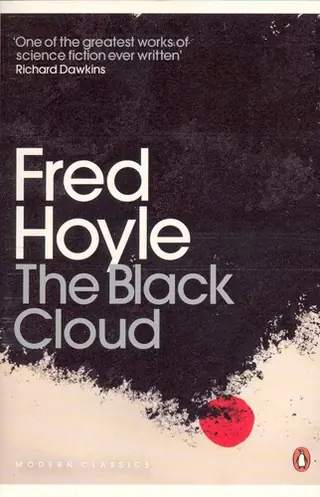
The Black Cloud
by Fred Hoyle · first published 1957
56% recommend38% neutral6% critical
Why HN recommends it
Hard science fiction about an intelligent cloud that reaches Earth, praised as a well-thought-out story that explores alien cognition and holds up well; a fun read for sci-fi fans who like scientific detail.
Summarised by Claude from recommending comments
The novel's plot revolves around the consequences of the Earth's sun being blocked out by an "intelligent" black cloud.
Affiliate links. As an Amazon Associate I earn from qualifying purchases.
Mentions per year
What Hacker News says
Related books
 2008–2026
Rama II
Arthur C. Clarke, Gentry Lee
Recommended by 2 · mentioned by 32 recommend · 3 mention2 recommend · 32 recommend
 2008–2019
This Immortal
Roger Zelazny
Recommended by 4 · mentioned by 44 recommend · 4 mention4 recommend · 44 recommend
 2008–2024
Tiger! tiger!
Alfred Bester
Recommended by 9 · mentioned by 109 recommend · 10 mention9 recommend · 109 recommend
 2007–2025
Lady of Mazes
Karl Schroeder
Recommended by 8 · mentioned by 98 recommend · 9 mention8 recommend · 98 recommend
 2008–2026
Solaris
Stanisław Lem
Recommended by 34 · mentioned by 4934 recommend · 49 mention34 recommend · 4934 recommend
 2008–2024
Heretics of Dune
Frank Herbert
Recommended by 4 · mentioned by 134 recommend · 13 mention4 recommend · 134 recommend
 2008–2026
Whipping Star
Frank Herbert
Recommended by 5 · mentioned by 145 recommend · 14 mention5 recommend · 145 recommend
 2013–2026
Star Maker
Olaf Stapledon
Recommended by 23 · mentioned by 3923 recommend · 39 mention23 recommend · 3923 recommend
The Black Cloud by Fred Hoyle
on “Ask YC: What's the most inspiring sci-fi book you've read?” ↗Fred Hoyle, "The Black Cloud" and I wish someone cleverer than me would read Nick Harkaway's "Gnomon" and then explain it to me.
on “Ask HN: What are some underrated sci-fi books?” ↗…really like the shepherd.com way of curating the recommendation. Browsing trough books and picking something to read has become much easier this way. One scifi book that was very impactful to me is the black cloud by Fred Hoyle. It's such a well thought out story and has held up remarkably well for a 50 year old novel.
on “Sci-fi books that you may never have heard of, but definitely should read” ↗There is a great classic sci-fi book that explores this: https://www.amazon.com/Black-Cloud-Fred-Hoyle/dp/0140014667
on “ALICE detects the conversion of lead into gold at the LHC” ↗Sad not to see 'The Black Cloud - Fred Hoyle' in that list..
on “Sci-Fi Novels You Should Read” ↗…been studying some kind of evolutionary path. Perhaps studying the neurons they could infer a lot of information about how our mind interacts with the environment. Edited: An interesting novel is The Black Cloud by Hoyle in which the author tries to establish a language between human and an intelligent extraterrestrial electromagnetic cloud.
on “A linguist on Arrival's alien language (2016)” ↗I read this story decades ago. I challenge anyone who thinks of aliens in even vaguely anthropomorphic terms to read books like The Black Cloud (https://cmdev.com/isbn/0141196408) or Stanislaw Lem's Solaris (https://cmdev.com/isbn/0156027607).
on “They're Made out of Meat” ↗…with related ideas, such as having a generally skeptical mindset, seeking first principles, etc. These ideas has been very powerful for me, and I thought it might be worth sharing. P.S. the book "The Black Cloud", mentioned in the article, is a really fun and quick read. I recommend it for any sci-fi fans.
on “Can a Living Creature Be as Big as a Galaxy?” ↗…than what we find on Earth, although I'm not sure what it would look like. Bu I am skeptical that such a system could span the enormous distances between stars. By the way, you should check out book The Black Cloud [1]! It is a fun science fiction story that explores this idea. [1] https://en.wikipedia.org/wiki/The_Black_Cloud
on “A Codebase Is an Organism (2014)” ↗Hoyle wrote an entire — very entertaining — book at as indictment of the Big Bang hypothesis, which he didn't like. It's called "The Black Cloud".
on “What I learned as a hired consultant to autodidact physicists (2016)” ↗…aren't just a certain kind of boutique fraternity. I for one would really welcome hearing ideas about alternative ways to teach rationality. For example, I recently read the science fiction book The Black Cloud by Fred Hoyle, and I was particularly interested in a part of the book where humans communicate with a far more intelligent being. Hoyle's writing is fun and all, but what I really thought was cool was…
on “The Happiness Code: Cold, hard rationality” ↗There are many examples of science fiction novels which starts with unexplained events. Nobody knows where the Rama object in "Rendez-Vous With Rama" comes from. Or where does the "Black Cloud" comes from in Fred Hoyle's novel. For me this is not implausible, it is just unexplained. Something can be considered implausible when, once everything is explained, it doesn't hold.
on “The moon blew up without warning and for no apparent reason (2017)” ↗…authors cited by Langford as influences: Langford's later short story comp.basilisk FAQ, [1] first published in Nature in December 1999, mentions William Gibson's Neuromancer (1984), Fred Hoyle's The Black Cloud (1957), J.B. Priestley's The Shapes of Sleep (1962), and Piers Anthony's Macroscope (1969) as containing a similar idea. Examples not mentioned include the short story White Cane 7.25 (1985) by Czech…
on “Practical Attacks against Deep Learning Systems using Adversarial Examples” ↗In Fred Hoyle's book The Black Cloud you could argue the prediction of the internet. He proposes a radio based data network with IIRC both compression and encryption. https://en.wikipedia.org/wiki/The_Black_Cloud The book is only so-so…
on “Ask HN: Favorite technology predictions in science fiction?” ↗If you're interested in reading something similar, your description reminds me of The Black Cloud by the astrophysicist Fred Hoyle. I have to say I found the writing quite clumsy, but owing to him being an astrophysicist himself there was quite a lot of attention to detail in making the plot scientifically…
on “A Sun-like star orbiting a black hole” ↗