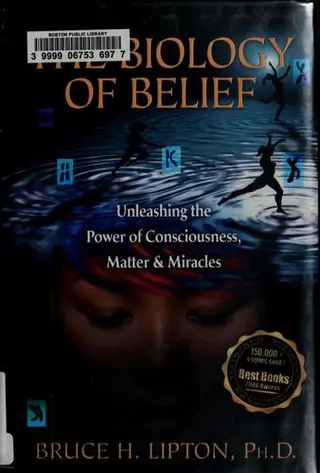
The biology of belief
by Bruce H. Lipton · first published 2005
75% recommend25% neutral
Why HN recommends it
Explains how beliefs and environment may affect gene expression and physiology, linking cell biology to everyday mindset. Suits readers curious about the science behind mind-body claims who want an accessible read.
Summarised by Claude from recommending comments
Author Lipton is a former medical school professor and research scientist. His experiments, and those of other leading-edge scientists, have examined in great detail the processes by which cells receive information. The implications of this research radically change our understanding of life. It shows that genes and DNA do not control our biology; that instead DNA is controlled by signals from outside the cell, including the energetic messages emanating from our positive and negative thoughts. Dr. Lipton's profoundly hopeful synthesis of the latest and best research in cell biology and quantum
Affiliate links. As an Amazon Associate I earn from qualifying purchases.
…HeartMath site references Dr Bruce Lipton. If you're interested in understanding more about the interplay between experiences, emotions, physiology and genetics, I can strongly recommend his book, The Biology of Belief [2], and his many interviews and presentations that can be found on YouTube. His research and writing focuses on the notion that subconscious beliefs are the major influence on our perceptions, which…
on “Regular meditation may be more beneficial than vacation” ↗Hi there, if you get a chance, check out a book by 'Bruce H. Lipton PhD' called 'The biology of belief', it was recommended to me by a cellular biologist friend of mine, and it delves further into this topic. very interesting indeed cheers
on “Quantum Entanglement Holds DNA Together, Say Physicists” ↗…hypnosis can be very effective for some people, but where they don't yield results, NET can offer answers. If you want to know more about the science of how this stuff works, I recommend a book called The Biology of Belief by Bruce Lipton, a former Stanford researcher in cell biology who observed the way cell health responds to environmental (including emotional) stimuli. The basis of the approach is that most of our core…
on “Ask HN: What are you doing to improve your health?” ↗Thank you. For those that are ultra-curious about this, please make it a point to read "The Biology of Belief" by Bruce Lipton. Quick summary there is - "Garbage in; Garbage Out." :)
on “Why Many Smart Folks End up going Nowhere” ↗The Biology of Belief by Bruce H. Lipton The Atlas Shrugged by Ayn Rand The Attractor Factor by Joe Vitale The Magic of Thinking Big by David J. Schwartz
on “What is the book that has completely changed your way of thinking?” ↗…outsiders - eg super-rich celebrities with lifestyles idealised by the media - but actually living it is hell. But I still strongly agree with your point. My strongest influence on this stuff is The Biology of Belief by Bruce Lipton, who explains how it all works on a cellular and genetic level.
on “Ketamine’s effect bolsters a new theory of mental illness” ↗…appreciate you saying it. Hopefully my followup comment adds some substance - though not links to one-off studies, as it's to broad a topic for that. For you or anyone else interested, Lipton's The Biology of Belief explains the principles very well on a cellular biology level. Tanzi's books with Deepak Chopra (Super Brain and Super Genes) are probably more of an affront to credulity given the Chopra connection,…
on “Why Preventing Cancer Is Not the Priority in Drug Development” ↗…himself and not an accomplished author. It's a nascent area, so solid references are scant. I hope to remedy that myself some day. A better known author on the topic is Bruce Lipton, whose 2006 book The Biology of Belief [1] introduced these concepts to a broad audience. I've found the book insightful and helpful, but whilst he's a credentialed scientist himself (former cell biology researcher at Stanford School of Medicine),…
on “Self-criticism can take a toll on our minds and bodies” ↗…keeping transmissions turned off when I sleep. By the way, if you want a somewhat-scientifically based explanation that may help you understand what's going on with your relative, I'd recommend reading The Biology of Belief by Bruce Lipton. He has some colorful ideas and is easily dismissed by curmudgeonly skeptics, but his approach has solid scientific basis, and it's only by following the principles he recommends that…
on “iPhone 7” ↗…negative impact on growth and on the brain/thinking. This is why poor people often stay poor and make bad decisions. The brilliant stem cell biologist Dr. Bruce Lipton describes in chapter 6 of his book “The Biology of Belief” why an organism cannot simultaneously be in a state of growth and protection: "By now you won’t be surprised to learn that I first became aware of how important growth and protection behaviors are in…
on “Unsteady income in young adulthood linked to thinking problems in middle age” ↗The basis for the approach I've pursued came from a book called The Biology of Belief [1], by former Stanford stem-cell researcher Bruce Lipton. The book is about epigenetics, and the way environmental factors - particularly the influence of subconscious beliefs on the perception of your…
on “Study of Holocaust survivors finds trauma passed on to children's genes” ↗…be easy to find someone local. This one has also been minor for me but still valuable. A well-known book offering some science behind the mind/body congruence concept is Bruce Lipton's 2006 book the Biology of Belief [1]. Lipton is a credentialed scientist himself (PhD cell biology researcher at Stanford School of Medicine), but he gets hand-wavy about concepts like epigenetics and quantum entanglement and leaves…
on “Have we overestimated the effectiveness of psychotherapy?” ↗I'm currently reading "The Biology of Belief" by Dr. Bruce Lipton and feels very relevant.
on “What if the Placebo Effect Isn’t a Trick?” ↗…Dr. Lipton was a pioneering stem cell biologist in the 70s and 80s, who became particularly interested in the role of experience/belief/trauma on behavioural and physiological outcomes. In his book, The Biology of Belief [3], he covers the statistical link between early life trauma and autism, and proposes a biological basis for it. Lipton is a controversial figure who is easily ridiculed by mainstream medicine devotees…
on “Post-traumatic stress disorder may mimic autism in some children” ↗This is similar to what I read in a book called "The Biology of Belief" by Bruce H. Lipton.
on “Environment shapes emotional cognitive abilities more than genes” ↗