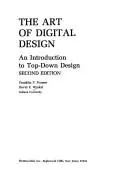
The art of digital design
by Franklin P. Prosser · first published 1987
7mentions
1recommended by
6HN commenters
2018–2025first – last mentioned
17% recommend83% neutral
This book approaches design of digital circuits from a systematic perspective. It illustrates top down design methodology via examples, introducing tools to abstract and model the behavior of sequential circuits.
Affiliate links. As an Amazon Associate I earn from qualifying purchases.
…than 6502 8-bit computers. This makes the PDP-8 one of the more interesting computer architecture to study, and indeed it has been used as a reference in many EE books. In particular, check out "The Art of Digital Design", Prosser, 2nd edition, which re-creates one in TTL logic.
on “PDP-8 Small-C Compiler (2012)” ↗Art of Digital Design: An Introduction to Top-Down Design - Prosser & Winkel, I took their graduate class in 1990 at IU Bloomington. In this class I & my lab partner designed and built a PDP-8 out of PALs on a wire wrapped…
on “Classic Computer Replicas” ↗I've tried a few times to get started learning, but I always hit serious snags. I've tried Practical Electronics for Inventors, but got lost in all the electrons. I got decently far in Art of Digital Design (culminates in making a PDP-8) but hit a part too hard for me and got stuck. Any suggestions?
on “Bad Circuit Design” ↗I bet you used The Art of Digital Design: http://bitsavers.informatik.uni-stuttgart.de/pdf/dec/pdp8/pd... I started with this design for my relay computer, but evolved it to be even simpler: no accumulator. http://relaysbc.sourceforge.net/arch.html
on “C Portability Lessons from Weird Machines” ↗…it covers a lot of other circuit topics and it's a great way to get started with experimentation. I find that being able to actually produce something as you're learning makes it a lot more engaging. Art of Digital design is a 2nd or 3rd year college level textbook so you might be missing some context there. I would say if you want to go further, look into a transistor-level circuit course (which I took after EE201).…
on “Bad Circuit Design” ↗There is a much older text book called the Art of Digital Design. In it, if you buy and solder the necessary components, you get a fully working PDP-8.
on ““Code” 2nd Edition” ↗…design – the processor they implement used a two-level microcoded processor to implement two types of processor on the same microcode interpreter engine, complete with built-in monitor/debugger. – "The Art of Digital Design", an older course text, which culminates in the implementation of a PDP-8 clone; Finally, if it helps look up more literature, another name for microprogramming in the literature is "interpretive microcoding"…
on “A Brief History of Microprogramming (2022)” ↗