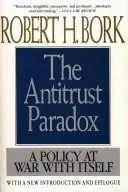
The antitrust paradox
by Robert H. Bork · first published 1978
17% recommend72% neutral10% critical
Why HN recommends it
Explains how US antitrust law came to focus on consumer welfare and why courts later acted as they did; suggested as background for understanding the modern mainstream view of antitrust.
Common criticism: Critics say its narrow consumer-welfare standard ignores anticompetitive conduct beyond prices
Summarised by Claude from recommending comments
Since it first appeared in 1978, this seminal work by one of the foremost American legal minds of our age has dramatically changed the way the courts view government's role in private affairs. Now reissued with a new introduction and epilogue by the author, this classic shows how antitrust suits adversely affect the consumer by encouraging a costly form of protection for inefficient and uncompetitive small businesses. Robert Bork's view of antitrust law has had a profound impact on how the law has been both interpreted and applied. The Antitrust Paradox illustrates how the purpose and integrit
Affiliate links. As an Amazon Associate I earn from qualifying purchases.
…background. Its actually a pretty fascinating history. Judging by your phrasing, your interpretation of antitrust stems from Robert Bork and has been the mainstream thought for a long time. Read The Antitrust Paradox by him to see how we got here and why the courts have acted how they have for the past 40 years. The current chair of the FTC, Lina Khan, was actually an academic prior to working for the government…
on “U.S. sues Apple, accusing it of maintaining an iPhone monopoly” ↗I agree with some of the points being made in this article, but there's definitely better resources on this topic. The paper mentioned in the article, "Amazon's Antitrust Paradox", is very thorough and easy to read even for someone (like me) who doesn't have a background in economics. The key point made in that paper is that modern antitrust legislation only looks at price when…
on “Seven Fixes for American Capitalism” ↗…people had bothered talking to a lawyer or an anti-trust scholar, a provenance that would matter a lot to understanding this issue. For example, almost everyone here will learn more reading "Amazon’s Antitrust Paradox" (https://www.yalelawjournal.org/note/amazons-antitrust-parado...) to understand why Epic set things up the particular, exact way they did - because they got Apple to take down a store page that clearly…
on “App stores, trust and anti-trust” ↗Amazon's Antitrust Paradox is definitely worth a read. <https://www.yalelawjournal.org/note/amazons-antitrust-parado...>
on “Why they're smearing Lina Khan” ↗…infrastructure and revenue streams that can subsidize their losses. Even ZIRP couldn’t counteract that. There is a reason that predatory pricing is illegal. Would strongly recommend Lina Khan’s “Amazon’s Antitrust Paradox”
on “Court of Milan orders Cloudflare to block ‘piracy shield’ domains, IP addresses” ↗Bork is anti-antitrust. It would be news were he in favor. https://en.wikipedia.org/wiki/The_Antitrust_Paradox
on “How Google Is Bankrolling Friendly Academics” ↗Anti-competition law and it's interpretation has changed drastically in the US after Robert Bork's book 'The Antitrust Paradox' (1978). Reagan administration used it as their bible.
on “Elizabeth Warren Proposes Breaking Up Tech Giants Like Amazon” ↗The modern view is the traditional view in the back to normal sense. In the US Robert Bork's book "The Antitrust Paradox" started a period of time where the antitrust law was only about benefits to consumers and overall efficiency. The traditional and the modern viewpoint is that the role of antitrust laws plays role in…
on “What's Amazon's market share? 35% or 5%?” ↗…supply and consumer benefit is extremely limited view. It came in flavor in the US late-1970's and it's known as "Chicago School of Antitrust Law". The defining book of that school is Robert Bork's 'The Antitrust Paradox' (1978).
on “Facebook’s dominance is built on anti-competitive behavior” ↗> The spectrum shifted towards consumer welfare very early on You seem unaware that Bork's Antitrust Paradox only came out in 1978 [1]. Yes, it's not surprising that its views would appear in cases from the '80s. Here's prof. Orbach in the Washington Post on Bork's influence [2]: > Antitrust was defined by…
on “Ends, Means, and Antitrust” ↗"ou seem unaware that Bork's Antitrust Paradox only came out in 1978 [1]" I'm quite aware. " Antitrust [in 1960] was about protecting small businesses." Citation? I gave you a case from the late 40's that was about protecting consumer welfare.…
on “Ends, Means, and Antitrust” ↗…you hear a lot about big US companies, because (1) smaller US companies are less likely to operate in the EU and (2) US antitrust law has been watered down since the late 1970s (starting with Bork's "Antitrust Paradox"), leading to a concentration of corporate power that's simply not present in Europe [1]. As a result, antitrust cases against EU companies tend to be more about collusion, while antitrust cases against…
on “Amazon and Apple hit by EU tax crackdown” ↗…well—so do Walmart employees. (See Alec MacGillis, “What J. D. Vance Doesn’t Get About Appalachia.”) But to Bork, that could never justify antitrust enforcement so long as the product stayed cheap. >The Antitrust Paradox makes for remarkable reading today. Like a caricature of a Chicago School economist, Bork explicitly warned against learning from experience. Rather, all business practices should be judged based on what…
on “Amazon’s Antitrust Antagonist Has a Breakthrough Idea” ↗The current interpretation of antitrust law in the United States is fairly new (it's only been around for 50 years or so, and as I understand it, largely driven by The Antitrust Paradox by Robert Bork [yes, that Bork]). Before that, there was broader enforcement in the antitrust sphere.
No it was the "Antitrust Paradox" by Bork who made a very compelling argument that at the time trust busting was too aggressive and we should focus not on the effect of monopolies on competitors but on consumers. In the recent decide…
on “Chrome, the perfect antitrust villain?” ↗