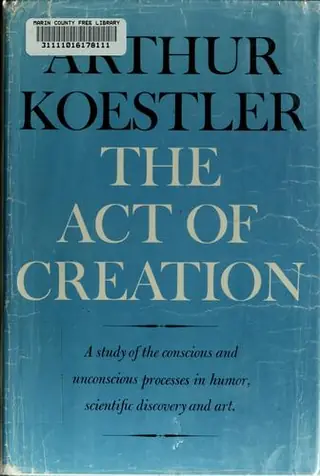
The act of creation
by Arthur Koestler · first published 1964
12mentions
6recommended by
8HN commenters
2017–2025first – last mentioned
75% recommend25% neutral
Why HN recommends it
Koestler's theory that creativity comes from linking previously unconnected frames of reference, called bisociation, using humor and discovery as examples; valued as a framework for how new ideas arise.
Summarised by Claude from recommending comments
Affiliate links. As an Amazon Associate I earn from qualifying purchases.
not going to repeat what's already been said so I will just add one: The Act of Creation by Arthur Koestler about human creativity. This was a heavy read but mind-bending like no other, literally had to put it down every now and then to contemplate/write/sketch what I just read. Fascinating!…
on “Ask HN: What books have made the biggest impact on your mental models?” ↗…extremely questionable value. Some more titles are (only 1 published after 1990): - A Clockwork Muse by Martindale - The Art of a Scientific Investigation by Beveridge - Consilience by Wilson - The Act of Creation by Koestler Finally I would recommend “Notebooks of the Mind”. Don’t know why I just thought of it but it’s the best book of the bunch I recommended.
on “Ask HN: Any good books for an inspired, curious, but wannabe innovator/genius?” ↗…basic pattern in common, which he attempts to define. This is mentioned in Alan Kay's OOPSLA97 talk. > So I'm going to use a metaphor here for this talk which is drawn from wonderful book called The Act of Creation by Arthur Koestler. Koestler was a novelist who became a cognitive scientist in his later years. And one of the great books he wrote was about what might creativity be. Learning, he realized that learning…
on “The Act of Creation by Arthur Koestler” ↗I would recommend that anyone who is interested in exploring these ideas read "The Act of Creation" by Arthur Koestler. He explores how things we think of as creativitity are fundamentally similar to how humour works in that they discover connections between things we previously thought of as being…
on “Ideas and Creativity (2019)” ↗…brings back all they have seen, which causes people in the pink plane to start thinking new (bluer) thoughts. I'm going to use a metaphor for this talk which is drawn from a wonderful book called The Act of Creation by Arthur Koestler. Koestler was a novelist who became a cognitive scientist in his later years. One of the great books he wrote was about what might creativity be.—Learning.—He realized that learning,…
on “The programmers who live in Flatland” ↗This is a really good question! It partly has to do with the "pink-plane/blue-plane" idea (shown in lecture II and in lots of talks I've given) that I adapted from Arthur Koestler's terrific book "Act of Creation". There is much to think about there. We are on the good side of this because we can look at history and get some sense of qualitative changes of Outlook, and we can also look at Anthropology and other…
on “Startup School 12: Alan Kay, Part II [video]” ↗There is a great framework for understanding this process in "The Act of Creation" by Arthur Koestler. His thesis is that creativity is essentially about finding previously undiscovered/underappreciated connections between "diassociative matrices" (which is his terminology for frames…
on “A summary of my learnings on how to find startup ideas” ↗The theory presented in this article was articulated in Arthur Koestler's "The Act of Creation", where he goes on to speculate that all creativity works in this way. It's well worth a read.
on “Comedy Theory (2022)” ↗…articulated in Alan Kay's allusion to Arthur Koestler's metaphor of progress in two planes: the incremental improvement plane (which Alan calls the "pink" plane) and the paradigm shift (or "blue") plane. ("The Act of Creation", Arthur Koestler, 1964, Arkana Reissue Edition, Paperback, ISBN: 0140191917) Via: [C2 wiki](https://wiki.c2.com/?BluePlane) And [Archived Squeak page](http://web.archive.org/web/20050406063507/http://squeak.org/...)
on “Xerox PARC's NoteCards in a Nutshell (1987) [pdf]” ↗I just realized where the 'V' logo in "Viewpoints Research Institute" came from (you can see it here: [0]): The diagram comes from the book "The Act of Creation"[1], where Arthur Koestler discusses the common themes in creative acts, including the idea of juxtaposition. In research, you start with a baseline level of knowledge and do a random walk until you…
on “Alan Kay at Startup School [video]” ↗…to be joined in to the mainstream semantic space over time as people find ways to link these concepts to things we already have some meaning for. That's very interesting to me. [1] After reading "The Act of Creation" by Koestler
on “Here comes the Muybridge camera moment but for text” ↗For one thing, how do we know that all discoveries are not pattern matching? In "The Act of Creation" for example, Arthur Koestler proposes the idea that all creativity is essentially the act of finding connections between diverse frames of reference and that extraordinary/genius-level creativity might…
on “The Einstein AI Model” ↗