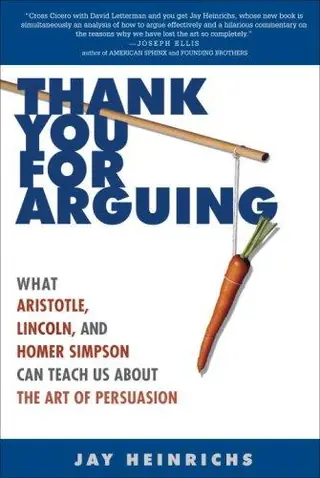
Thank You for Arguing
by Jay Heinrichs · first published 2007
88% recommend13% neutral
Why HN recommends it
Entertaining, accessible primer on classical rhetoric and persuasion, more approachable than reading Aristotle directly. Suits readers wanting practical persuasion skills for work, design meetings, or arguments.
Summarised by Claude from recommending comments
Thank You for Arguing is your master class in the art of persuasion, taught by professors ranging from Bart Simpson to Winston Churchill. The time-tested secrets the book discloses include Cicero's three-step strategy for moving an audience to actionNas well as Honest Abe's Shameless Trick of lowering an audience's expectations by pretending to be unpolished. But it's also replete with contemporary techniques such as politicians' use of "code" language to appeal to specific groups and an eye-opening assortment of popular-culture dodges, including:The Eddie Haskell PloyEminem's Rules of Decorum
Affiliate links. As an Amazon Associate I earn from qualifying purchases.
Mentions per year
What Hacker News says
Related books
 2016–2026
Extreme ownership
Jocko Willink, Leif Babin
Recommended by 91 · mentioned by 11991 recommend · 119 mention91 recommend · 11991 recommend
 2010–2026
A Guide to the Good Life
William B. Irvine
Recommended by 135 · mentioned by 158135 recommend · 158 mention135 recommend · 158135 recommend
 2007–2026
Influence
Robert B. Cialdini
Recommended by 214 · mentioned by 303214 recommend · 303 mention214 recommend · 303214 recommend
 2007–2026
How to Win Friends and Influence People
Dale Carnegie
Recommended by 579 · mentioned by 853579 recommend · 853 mention579 recommend · 853579 recommend
…widespread one) can provide that. But don't discount the benefit of preparing a speech and delivering it over and over again, even to no one. Filming yourself can provide the feedback component. I think "Thank You For Arguing" [0] is a good resource on persuasion broadly. Some of the same things that work on a person-to-person level also apply to a speaker-to-audience relationship, and the book goes into both areas. American…
on “Ask HN: Good public speaking course/resources?” ↗Speaking of rhetoric, I loved the essay "How to Teach a Child to Argue" by Jay Heinrichs http://www.figarospeech.com/teach-a-kid-to-argue/ I also found his book "Thank you for arguing" really interesting and informative. His essay is a delightful read. His book, unfortunately, somewhat more heavy handed... but still worth your consideration in my opinion.
on “Defecting by Accident - A Flaw Common to Analytical People” ↗…somewhat informally and I like his treatment of the subject. If you found this interesting, I'm in the middle of a book on the subject of argument and rhetoric that is actually quite engaging, called Thank You For Arguing by Jay Heinrichs.
on “You are Probably Mis-Diagnosing People as Stupid” ↗Since I'm recommending books today, I really liked "Thank You for Arguing" by Jay Heinrichs. Very fun and instructive intro to rhetoric. I can see how rhetoric (and religion!) can come into play in design meetings :-)
on “How To Become A Better Programmer By Not Programming” ↗One of my favorite books is Thank You For Arguing, and it's a bit more accessible than an Aristotle translation, for those who want a faster introduction to why fallacies are okay. http://www.amazon.com/Thank-You-Arguing-Aristotle-Persuasion... There…
on “Logical fallacies” ↗Not the GP, but I read "Thank You for Arguing: What Aristotle, Lincoln, and Homer Simpson Can Teach Us About the Art of Persuasion" by Jay Heinrichs this year, and consider it an excellent intro to classical rhetoric.
on “Ask HN: Books you read in 2016?” ↗…aligning with and assisting in achieving your organisations goals. I'd also add part of "speaking like a leader" is speaking in a persuasive manner, convincing other in helping with the above. I found "Thank You For Arguing" by Jay Heinrichs a really good introduction to this.
on “Ask HN: How to speak like a leader, not like an engineer?” ↗I agree with you, but he didn't say the word "sorry". Check out "Thank You for Arguing" by Jay Heinrichs. It covers the same basic steps, but recommends to exclude the actual apology part. It's also a great book for other reasons.
on “So you've made a mistake and it's public” ↗For communicative purposes, rhetoric is an amazing field of study. Many of the texts I used in college were crap, but Jay Heinrich's "Thank You For Arguing" is pretty phenomenal as far as being a quick and accessible primer to rhetorically-charged language. I'd also suggest a good creative writing course (I'd pick prose over poetry, but they're your classes…
on “Ask HN: What to do for college?” ↗…I think) from "how to win friends" is to really have the other person's interests at heart, not to try to scam or game them. Some of my other favorite self help-ish books - a guide to the good life - thank you for arguing - algorithms to live by
on “Has AI already killed self-help nonfiction books?” ↗…exercises. Other methods along these lines are Suzuette Haden Elgin's "Gentle Art of Verbal Self Defense", which has a lot of patterns and anti-patterns on use of words. I have read through Jay Heinrich's "Thank You For Arguing", which is the book I credited for making the distinction between being right and being persuasive for me. (Can't wait to start teaching my daughter Heinrich's material). The most recent, more mainstream…
on “There is little research into the long-term effects of using antidepressants” ↗His book's fantastic... Thank You For Arguing. I read it on the Kindle, then I bought a copy so I could refer back to it easily and make notes in the margins.
on “How to Teach a Child to Argue” ↗His book distinguishes between "arguing" and "fighting." The five components you describe above fall under the heading "argument." I highly recommend "Thank You for Arguing." It's a wonderful book that takes classical rhetoric, a relatively dry subject, and turns it into something entertaining to study.
on “How to Teach a Child to Argue” ↗…extremely proud of some of my best work, I never thrived in the places where I did it, and precisely for this reason. I wish I had studied rhetoric much earlier. As an aside, I read a book on rhetoric (Thank You for Arguing) written by a guy who is extremely passionate about it, to the point where he persuaded me to teach it to my 4yo. It was extremely effective. He picked up negotiation quickly, and has been analyzing (if…
on “Calling bullshit” ↗The point of arguing, according to "Thank You for Arguing" and rhetorics, is to persuade and be persuaded to take some sort of action. The article described fighting, not arguing. Platonic dialectic is related yet different, but I can see how modern ignorance…
on “Arguing Is Pointless” ↗