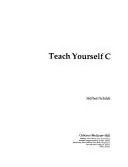
Teach yourself C++
by Herbert Schildt · first published 1990
33% recommend67% neutral
Teach Yourself C begins with the fundamentals, covers all the essentials, and concludes with a look at some of C's most advanced features. Along the way are plenty of practical examples, self-evaluation skill checks, and exercises. Answers to all exercises at the back of the book, so you can easily check your progress. Best of all, you'll learn with Schildt's proven "mastery" method: the highly effective yet versatile approach that has helped millions become skilled programmers. This approach lets you work at your own pace, in your own way. Even if you have found C confusing in the past, Schi
Affiliate links. As an Amazon Associate I earn from qualifying purchases.
Mentions per year
What Hacker News says
Related books
 2008–2024
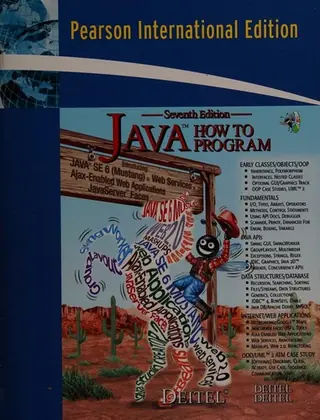
Java how to program
Paul J. Deitel, Harvey M. Deitel
Recommended by 4 · mentioned by 94 recommend · 9 mention4 recommend · 94 recommend
 2008–2024
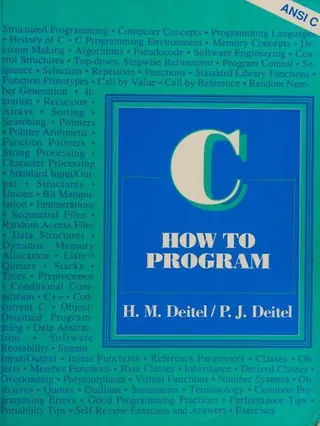
C how to program
Harvey M. Deitel, Paul J. Deitel, Abbey Deitel
Recommended by 8 · mentioned by 138 recommend · 13 mention8 recommend · 138 recommend
BASIC Computer Games
David H. Ahl
Recommended by 18 · mentioned by 4918 recommend · 49 mention18 recommend · 4918 recommend
…BBS's, Tymnet and Telenet networks, reading Phrack magazine, got into phone phreaking and other sordid activities... Then somehow I got hold of a shareware C compiler, and a copy of Herbert Schildt's book Teach Yourself C. That started an addiction that led to Borland Turbo C++ for DOS, and the need to upgrade my computer to an absurd 4 megabytes of RAM.. and eventually to Borland C++ (the full suite), a whole shelf full…
on “PCWorld Exits Print, and the Era of Computer Magazines Ends” ↗…books, formal education, on the job training, reading OSS code, attending conferences, attending user group meetings, watching Youtube videos, etc., etc. But the bulk of it, IMO, was just reading books (Teach Yourself C by Herbert Schildt was were it all really started for me) and working through the exercises. So hours and hours and hours of firing up Turbo C++ and going through the exercises in that book, and then…
on “Ask HN: HN people who write meaningful software, how did you learn to program?” ↗…of programming classes as electives, and "the bug bit" as they say, and I bought the parts to build a PC (386DX40 FTW!) and downloaded a shareware C compiler from a BBS, bought Herbert Schildt's book Teach Yourself C and just dove in... never looked back. :-)
on “Ask HN: What age you started to program?” ↗When I was 16 (2001), I bought "Teach Yourself C" by Herbert Schildt, a video card and a Sony Trinitron with my summer job savings. I got to the end of chapter 5 where Herb starts talking crazy about multi-dimensional arrays, saw the next chapter was…
on “Most 16-year-olds don't have servers in their rooms” ↗…Programming" class. I also built my first real PC (a 386DX/40 system with 1MB of RAM, which I later upgraded to a WHOPPING 4MB so I could run Borland C++). Anyway, I bought a copy of Herbert Schildt's book Teach Yourself C, downloaded a C compiler from some BBS (I didn't have Internet access yet at this time) and started learning to code in C. I consider this the real beginning of my programming education. Fast forward…
on “Ask HN: Where did you first learn to code?” ↗Like @JohnFen said, my style has also evolved over multiple decades and it's hard to pin it down to one (or even a few) specific titles. But I suppose Teach Yourself C by Herbert Schildt deserves a nod, as it's basically the book I first learnt programming from. Other than that, I can recall being influenced by a number of the X: How To Program[1] books by Deitel and…
on “Ask HN: What books have most influenced your coding style?” ↗…but we never had a PC in my home, so I never got deep into programming until college. I took a programming class in college about 1992 and was immediately hooked. I bought a copy of Herbert Schildt's Teach Yourself C, downloaded a shareware C compiler from somewhere, acquired a cheap PC and have basically never looked back. Over my career I've mainly worked in Java, with some C/C++ before that, and now do a lot of…
on “Ask HN: Who IS in the software industry or a hacker?” ↗…BBS's, Tymnet and Telenet networks, reading Phrack magazine, got into phone phreaking and other sordid activities... Then somehow I got hold of a shareware C compiler, and a copy of Herbert Schildt's book Teach Yourself C. That started an addiction that led to Borland Turbo C++ for DOS, and the need to upgrade my computer to an absurd 4 megabytes of RAM.. and eventually to Borland C++ (the full suite), a whole shelf full…
on “PC World, 1983-2013” ↗…starting to buy and read Computer Shopper magazine regularly; and then I was building a PC, getting a modem, playing around on BBS systems, getting into the hack/phreak scene, buying Herbert Schildt's book "Teach Yourself C" and downloading a C compiler from a BBS or something, deciding to major in Computer Science instead of Physics, and the rest is history.
on “This is experimental. However, it could start a revolution in information access” ↗…was not as easily accessible for programming at my single digit age. QBasic was available on the 486 SX based MS-DOS OS we had, and it opened my eyes. Within a year or two I was reading Herb Schildt' "Teach Yourself C" and using Borland C for the first time. But at a young age you need that first step to be accessible! Nice one...
on “30 years later, QBasic is still the best” ↗…combination of ways, spread over many years. And I'm not done learning, so there almost isn't an answer to this question. But to try to hit the highpoints: 1. I bought a copy of Herbert Schildt's "Teach Yourself C" about 1993/1994 or so. Downloaded a shareware C compiler from a BBS and just started writing code. 2. Bought more books on C, C++. Upgraded to Borland Turbo C++ and started writing C++ code. Toyed…
on “Ask HN: HOW did YOU learn to program?” ↗