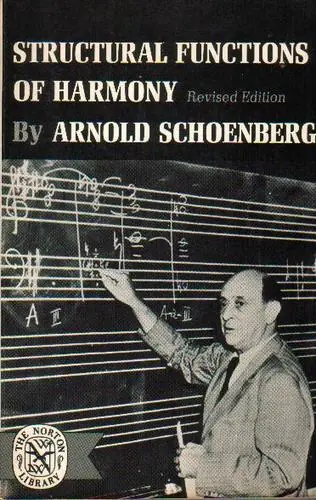
Structural functions of harmony
by Arnold Schoenberg · first published 1954
4mentions
2recommended by
2HN commenters
2023–2026first – last mentioned
100% recommend
This book is Schoenberg's last completed theoretical work and represents his final thoughts on the subject of classical and romantic harmony. The earlier chapters recapitulate in condensed form the principles laid down in his Theory of Harmony, the later chapters break entirely new ground, for they analyze the system of key relationships within the structure of whole movements and affirm the principle of "monotonality," showing how all modulations within a movement are merely deviations from, and not negations of, its main tonality. Schoenberg's argument is supported by music examples, whic
Affiliate links. As an Amazon Associate I earn from qualifying purchases.
…harmony have the function of establishing key centres, moving towards and away from them, establishing transitions to remote key areas etc. One of the best technical books about functional harmony is "Structural Functions of Harmony" by Arnold Schoenberg[1], which is much shorter than his "Harmonielehre" but really packed with interesting detail about key and chord relationships. [1] Yes that Schoenberg but this isn't about serialism,…
on “Tonal.js: Functional music theory lib” ↗…“rules” they want you to follow when writing pastiche counterpoint etc. If you want to get big into composition and/or want to understand late romantic and 20th century music, get Harmonielehre and “Structural Functions of Harmony” by Schoenberg. Together they are by far the best harmony books I have ever seen and go super-deep into why the western classical tradition works the way it does. If you compose there’s a decent chance…
on “Music Theory for Programmers” ↗Structural Functions of Harmony by Arnold Schoenberg. I can't even begin to understand it, it's just beautiful to encounter such genius and rigorous thought. https://archive.org/details/structuralfuncti0000arno/page/n8...
on “Ask HN: What are you reading?” ↗From my read of "Theory of Harmony" and "Structural Functions of Harmony", it seems to me Schoenberg definitely wasn't aiming to be a great innovator, he was desperate to be part of the great tradition and saw serialism as an inevitable consequence of the way in which tonality…
on “The Case for Challenging Music” ↗