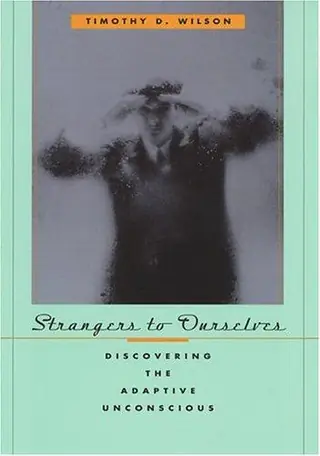
Strangers to Ourselves
by Timothy D. Wilson · first published 2002
63% recommend38% neutral
Why HN recommends it
Accessible tour of research on the adaptive unconscious and self-knowledge, written by a researcher who turns scholarly work into readable storytelling; praised for its wit and for practical advice on updating beliefs.
Summarised by Claude from recommending comments
""Know thyself," a precept as old as Socrates, is still good advice. But is introspection the best path to self-knowledge? What are we trying to discover, anyway? In an eye-opening tour of the unconscious, as contemporary psychological science has redefined it, Timothy D. Wilson introduces us to a hidden mental world of judgments, feelings, and motives that introspection may never show us."--Jacket.
Affiliate links. As an Amazon Associate I earn from qualifying purchases.
…me know if you would be interested! 1. Man’s search for meaning (Viktor Frankl) 2. The power of strangers (Joe Keohane) 3. How emotions are made (Lisa Feldman Barret) 4. Atomic habits (James Clear) 5. Strangers to ourselves (Timothy D. Wilson)
on “Ask HN: Is there a Tinder for book readers?” ↗…the real reasons is Elephant in the Brain https://www.amazon.com/Elephant-Brain-Hidden-Motives-Everyda... A great book to realize that the reasons you give for what you do are not the real reasons is Strangers to Ourselves https://www.amazon.com/Strangers-Ourselves-Discovering-Adapt...
on “Your compliance obligations under the UK’s Online Safety Bill” ↗…ought to be in textbooks. Many of his observations have made me laugh with their classic English wit. He also has one hell of an anti-heroine. This book reminded me why I used to love literature. Also, Strangers to Ourselves by Timothy Wilson - a good book on research into unconscious thought processes.
on “Ask HN: What are you reading? What've you read lately?” ↗…popularizer instead: someone who reads scholarly works and whips them into a shape that larger audiences can and will read. Case in point: in 1985, Timothy Wilson published an amazing article called "Strangers to Ourselves". Years later, he turned it into a book (of the same title). But most people haven't heard of Wilson or that book, certainly nowhere near as many people as have heard of or read Malcolm Gladwell's Blink.…
on “How to Write a Malcolm Gladwell Book” ↗A related book: "Strangers to Ourselves" by Timothy D. Wilson http://www.hup.harvard.edu/catalog.php?isbn=9780674013827 Excellent book with excellent advice about how to proceed.
on “The ‘Real You’ Is a Myth” ↗…convince ourselves. Those who can spin on a dime and update/discard ideas in the presence of new evidence are a truly rare breed. Two of my favorite books on motivated reasoning and self-deception: Strangers to Ourselves, by Timothy D. Wilson: https://www.hup.harvard.edu/catalog.php?isbn=9780674013827 The Elephant in the Brain, by Robin Hanson & Kevin Simler: http://elephantinthebrain.com/
Gotta plug one of my favorite books: "Strangers to Ourselves" by Timothy D. Wilson https://www.hup.harvard.edu/catalog.php?isbn=9780674013827 TL;DR: we think we know why we do stuff we do, but we do not.
on “Babies' random choices become their preferences” ↗The principal author of this paper, Timothy D. Wilson has done some awesome research. I can highly recommend his book Strangers to Ourselves: Discovering the Adaptive Unconscious. I found it it be very illuminating and even useful for understanding others and myself better. https://www.amazon.com/Strangers-to-Ourselves-audiobook/dp/B...
on “Doing something is better than doing nothing for most people: study (2014)” ↗…out in 1977! Telling More Than We Can Know: Verbal Reports on Mental Processes by Richard E. Nisbett and Timothy D. Wilson Both researchers have had amazing careers since then. Timothy Wilson's book Strangers to Ourselves is one I recommend to everyone. It is a continuation of the work in the paper you link to. Nisbett's books are excellent too; my favorite (a must-read!) is Culture of Honor: The Psychology of Violence…
on “Excuse me but why are you eating so many frogs” ↗…good. ---------------------------------------- [1] As an attempt to prove good intent, here are some guesses based on Googling: Flow: The Psychology of Happiness, Misbehaving and Nudge by Thaler, and Strangers to Ourselves by Wilson.
on “Revisiting “The 4-Hour Workweek”” ↗…sociopathic element: a sort of cynical manipulation to appear virtuous to the tribe, one which is more effective if it convinces our own brains, so as to more effectively convince others. See Tim Wilson's "Strangers to Ourselves", Hanson & Simler's "Elephant in the Brain", etc. Supposedly, there's also an empathic element to being an effective hunter, both in the human and the animal kingdom. To deeply understand and empathize…
on “AI thinks like a corporation (2018)” ↗…more interested in social psychology and behavioral psychology but would love to brush up on my knowledge on general psychology as well. Currently I am reading my first psychology book in ten years: "Strangers to Ourselves: Discovering the Adaptive Unconscious" quite an interesting read.
on “Dunning-Kruger effect” ↗Yes, I learned much of this from Elephant In The Brain. Biggest shock to my belief systems this century. May have to read Strangers to Ourselves as well.
on “Your compliance obligations under the UK’s Online Safety Bill” ↗