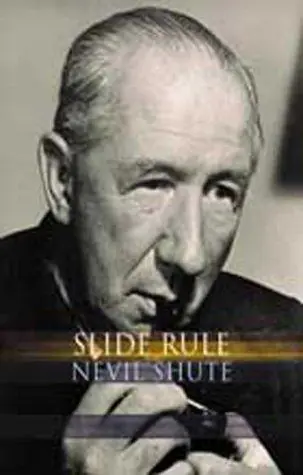
Slide Rule
the autobiography of an engineer
by Nevil Shute · first published 1954
6mentions
4recommended by
6HN commenters
2016–2023first – last mentioned
67% recommend33% neutral
A fantastic story of a life in the aviation industry, including being the senior mathematician on the R100 airship in Yorkshire and a co-founder of the Airspeed aircraft company.
Affiliate links. As an Amazon Associate I earn from qualifying purchases.
Also see "Slide Rule: Autobiography of an Engineer" by Nevil Shute, who was the senior stress engineer of the British R100.. (beside being a famous author, eg "On the Beach", "A Town like Alice", etc)
on “Caltech professor helps solve Hindenburg disaster” ↗Two rather old autobiographies might be interesting to you: "Slide Rule" by Nevil Shute [0] A large part of this recounts the development of the R100 airship in Britain. "Jet: The Story of a Pioneer" by Frank Whittle [1] A substantial part of this is about the invention…
on “Ask HN: Book recommendations about “early days” stories outside of tech” ↗> math we hide in our design programs was worked out on paper The Boeing 747 was worked out with paper and slide rules. The 757 was in transition from paper calculations to CAD. See "Slide Rule" by Nevil Shute.
on “Historian uses lasers to unlock mysteries of Gothic cathedrals” ↗…kind of computer you have in mind used to be electronic computer to distinguish it from a computer or calculator which described a human being who computed. See, for instance, Nevil Shute's biography Slide Rule in which he describes being in charge of a department of calculators when working on the R100. It's a fascinating read. You can get it from Anna's Archive.
on “Toki Pona: an attempted universal language with only ~120 words” ↗In Shute Norway's autobiography, Slide Rule, he describes the design and construction of the [R100](https://en.m.wikipedia.org/wiki/R100), an airship of which he was one of the leading engineers. The R100 design was "competing" with the design…
on “Akin’s Laws of Spacecraft Design” ↗…use of six reconditioned Rolls-Royce Condor petrol engines for propulsion. [2] Each of which generated 500 hp (373 Kw) and weighed 1,504 lbs (682 kg). From wikipedia : Nevil Shute later suggested in Slide Rule: Autobiography of an Engineer that the success of R100's Canadian flight indirectly led to the R101 disaster. Prior to the transatlantic flight, the Cardington team could suggest that neither airship…
on “Bouncing bomb” ↗