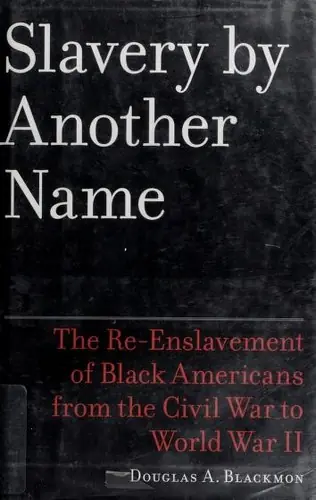
Slavery by another name
by Douglas A. Blackmon, Dennis Boutsikaris · first published 2008
71% recommend29% neutral
Why HN recommends it
Documents how Southern states used convict leasing, debt peonage and forced labor to re-enslave Black Americans after the Civil War; praised as a well-sourced history linking that era to later prison labor.
Summarised by Claude from recommending comments
In this groundbreaking historical expose, Douglas A. Blackmon brings to light one of the most shameful chapters in American history--an "Age of Neoslavery" that thrived from the aftermath of the Civil War through the dawn of World War II.Under laws enacted specifically to intimidate blacks, tens of thousands of African Americans were arbitrarily arrested, hit with outrageous fines, and charged for the costs of their own arrests. With no means to pay these ostensible "debts," prisoners were sold as forced laborers to coal mines, lumber camps, brickyards, railroads, quarries, and farm plantation
Affiliate links. As an Amazon Associate I earn from qualifying purchases.
…arbitrary prosecutions. The history of incentives to acquire more prisoners is quite a bit older then the private prison complex. edit: About the history of prison labor as a replacement for slavery, "Slavery by another Name" by Douglas A. Blackmon is a great book on the topic.
on “Student Journalists Expose High School’s Use of Prison Labor” ↗Bricks made in Birmingham in the 20's, turpentine plantations... Reminds me of the forced labor chronicled in Slavery by Another Name, which is a great read that I highly recommend. https://www.amazon.com/Slavery-Another-Name-Re-Enslavement-A...
on “Florida’s Ghost Highway: The Old Red Brick Road” ↗Slavery by another Name by Douglas A. Blackmon is a good book on the topic. Its not so clear cut that the civilwar actually ended slavery, it took quite a bit longer to end slavery like conditions.
on “'Where was the Lord?': Slave testimonies” ↗…unexploited in the US after the civil war. In many aspects they were still enslaved through various direct and indirect means. If you're interested in not just regurgitating propaganda you can read this book: "Slavery by Another Name: The Re-Enslavement of Black Americans from the Civil War to World War II". Furthermore your entire premise is false, even if we accept what you suggest is true, which is highly controversial, the result…
on “'Doomscrolling' breeds anxiety – how to stop the cycle” ↗There's an excellent and pulitzer-winning book about this widespread dynamic called "slavery by another name." The practice continued routinely in huge swathes of the south until world war 1, and in a few places decades even after that.
on “Parchman Farm, the Mississippi prison with a remarkable musical history” ↗…the United States.” This is I think the primary reason our justice system is so messed up. Convict Leasing was and is a barbaric practice. I highly recommend this book https://en.wikipedia.org/wiki/Slavery_by_Another_Name https://en.wikipedia.org/wiki/Convict_leasing > For example, in 1898, 73% of Alabama's annual state revenue came from convict leasing. To think we are turning a blind eye to this in the world. It makes…
on “Matilda, the last survivor of the transatlantic slave trade” ↗…blacks on bogus charges such as loitering, convict them in sham trials, and then sell them to corporations to do hard labor 6 days a week 14 hours a day. This is extensively documented in Blackmon's "Slavery by Another Name: The Re-Enslavement of Black Americans from the Civil War to World War II."
on “Google Engineer bails out student in jail” ↗…of the first century of the existence of the US whether or not some humans could own others as slaves Also, debt peonage was practiced for a long time after that [0, 1]. [0]: https://www.pbs.org/tpt/slavery-by-another-name/themes/peona... [1]: https://en.wikipedia.org/wiki/Slavery_by_Another_Name
on “‘Tipping point’ makes partisan polarization irreversible in research model” ↗