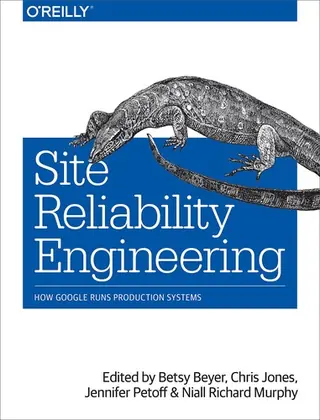
Site Reliability Engineering
How Google Runs Production Systems
by Betsy Beyer, Jones, Chris (Computer engineer), Jennifer Petoff, Niall Richard Murphy · first published 2016
80% recommend16% neutral4% critical
Why HN recommends it
Google's account of running production systems: SLOs, on-call that doesn't burn people out, and monitoring and observability. Useful to sysadmins, devops and backend engineers; free online.
Summarised by Claude from recommending comments
Members of the SRE team explain how their engagement with the entire software lifecycle has enabled Google to build, deploy, monitor, and maintain some of the largest software systems in the world.
Affiliate links. As an Amazon Associate I earn from qualifying purchases.
Mentions per year
What Hacker News says
Related books
 2018–2019
Database Reliability Engineering
Laine Campbell, Charity Majors
Recommended by 2 · mentioned by 22 recommend · 2 mention2 recommend · 22 recommend
Web scalability for startup engineers
Artur Ejsmont
Recommended by 9 · mentioned by 109 recommend · 10 mention9 recommend · 109 recommend
 2016–2026
The DevOps handbook
Gene Kim
Recommended by 22 · mentioned by 3322 recommend · 33 mention22 recommend · 3322 recommend
 2014–2026
Designing Data-Intensive Applications
Martin Kleppmann
Recommended by 457 · mentioned by 659457 recommend · 659 mention457 recommend · 659457 recommend
 2017–2025
Kubernetes in Action
Marko Luksa
Recommended by 11 · mentioned by 1911 recommend · 19 mention11 recommend · 1911 recommend
 2013–2026
The TCP/IP Guide
Charles Kozierok
Recommended by 11 · mentioned by 1211 recommend · 12 mention11 recommend · 1211 recommend
 2013–2026
The Phoenix Project
Gene Kim, Kevin Behr, George Spafford
Recommended by 166 · mentioned by 270166 recommend · 270 mention166 recommend · 270166 recommend
 2009–2026
Alas Babylon
Pat Frank
Recommended by 18 · mentioned by 2418 recommend · 24 mention18 recommend · 2418 recommend
Sort of yes, but mostly no. Go read "Site Reliability Engineering" by Beyer et al. That's the clearest description for how on-call should work, and the way to get from Point A to Point B without burning anyone out. On-call is almost always necessaey, but should be thought…
on “HumanOps – Focusing on the human aspects of running infrastructure” ↗…recruiting tactic; often, good people are at conferences, and when they hear about a great company to work for with smart people who give good talks, they want to work there, too. Books are similar. Reading Site Reliability Engineering makes me want to work at Google (even though I know I really don't want to work at Google). Good people bring in more good people, and good people are enthusiastic and do cool things outside of work.…
on “Reflecting on one very, very strange year at Uber” ↗Focused on systems and design for backend devs: 1. High Performance Browser Networking 2. Designing Data-Intensive Applications 3. Site Reliability Engineering: How Google Runs Production Services 4. Effective Python: 90 Specific Ways to Write Better Python I wrote in a bit more detail here: https://notes.eatonphil.com/books-developers-should-read.htm....…
on “Ask HN: Name 3-5 books that had the most impact on your career and knowledge?” ↗These are the books that IMO felt worth really carefully digesting: Software engineering practices: - Designing Data-Intensive Applications - Site Reliability Engineering - Software Engineering at Google - Designing Event-Driven Systems - The Data-Centric Revolution - Code Complete - Data Management at Scale Self-help: - So Good They Can't Ignore You - Deep Work…
on “Ask HN: Which books you have read till now that were worth investing time in?” ↗…Action - Raoul-Gabriel Urma * Java Concurrency in Practice - Brian Goetz * Grokking Algorithms - Aditya Y. Bhargava Architecture: * Righting Software - Juval Lowy * Release It! - Michael Nygard * Site Reliability Engineering - Beyer, et al. ("The SRE Book”) * Domain Driven Design - Eric Evans * Introduction to Permaculture - Bill Mollison and Mia Slay * Fun with a Pencil - Andrew Loomis Design: * All books by Edward…
on “Theory-building and why employee churn is lethal to software companies” ↗…Docker offers. That makes it your job to figure out how that happens, not if it happens. Nope, nope, nope, nope. I quoted this entire paragraph at length because it's all just completely wrong. Read Site Reliability Engineering that Google just published for an alternative perspective. SRE at Google is specifically and vocally organized to have authority to push back on engineering. Without exception. "No" is absolutely a valid…
on “Steve Singh will become Docker’s new CEO” ↗I've started reading the Google SRE book that was just released, and now I know more about the people I have to work with when the situation arises. Liking it so far :) http://www.amazon.com/Site-Reliability-Engineering-Productio...
on “Managed services killed DevOps” ↗…you're really interested, I highly recommend reading the SRE book Google has released. It's got a ton of insight into both their business practices and technical infrastructure. [1] http://www.amazon.com/Site-Reliability-Engineering-Productio...
on “How big is the Google Earth database?” ↗I'd start with this. https://www.amazon.com/Site-Reliability-Engineering-Producti...
on “Facebook’s Answer to Silicon Valley Housing Crunch: Build Apartments” ↗…Geography (very interesting view of geopolitics, Putin, et al) Continuous Delivery (great!) Clean Code (must read for any serious programmer) Built to last (picked it back after 1-2 years, cool book) Site Reliability Engineering (didn't quite finish, but good book) Building Microservices (fantastic book which puts everything I've done in the past year into so much more perspective)
on “Ask HN: Books you read in 2018?” ↗…Interaction Design (Revised & Expanded) The Dragon book Database Systems: Design, Implementation, & Management K&R C Code Complete Working Effectively with Legacy Code Software Engineering at Google Site Reliability Engineering -- Also, learn these, at least to a novice level: -- Crystal Java Clojure Haskell OCaml Erlang Elixir Rust C x86 assembly bash, JS, CSS, HTML, SQL, Python and do Linux From Scratch & BLFS
on “Books I recommend to my software engineering students” ↗…(Eric Evans) I recommend this one more than Vaughn Vernon's DDD. - Clean Architecture (Robert Martin) - Fundamentals of Software Architecture: an Engineering Approach - Design Patterns (Gamma et al) - Site Reliability Engineering: How Google Runs Production Systems - Refactoring: Improving the Design of Existing Code (2nd Edition) (Addison-Wesley Signature Series (Fowler)) - Refactoring to Patterns - Patterns of Enterprise…
on “Ask HN: Must read applied system architecture articles?” ↗…rolling back failed or buggy deployments. They (and Google too) use feature flags in the ways according to the best practices discussed in the article. Google also covers this well in their highly-regarded Site Reliability Engineering book. Source: worked at AWS for 7 years. And knock it off with the attitude.
on “When Feature Flags Do and Don't Make Sense” ↗I largely agree... but to offer more nuance you need to know what the right amount of automation versus toil is right for your project. It's worth reading the Google SRE [0] books, especially the workbook, if you're thinking about running and operating a service. Complexity is the enemy in software engineering as much as it is in operations engineering. Sustainable reliability is about doing as l
on “You Don’t Need All That Complex/Expensive/Distracting Infrastructure” ↗A major issue with on-call, and certainly one I've encountered multiple times, is the high likelihood of moral hazard - the people who are responsible for addressing incidents are not the same people who designed and maintained the system at fault. This results in the former team feeling powerless to put out fires which could have been prevented by more robust design, and the latter team having no
on “Being on call sucks” ↗