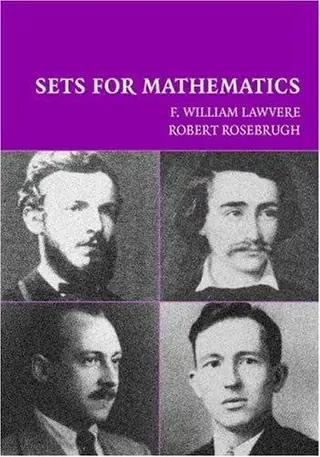
Sets for mathematics
by F. W. Lawvere · first published 2002
67% recommend33% neutral
Advanced undergraduate or beginning graduate students need a unified foundation for their study of geometry, analysis, and algebra. This book, first published in 2003, uses categorical algebra to build such a foundation, starting from intuitive descriptions of mathematically and physically common phenomena and advancing to a precise specification of the nature of Categories of Sets. Set theory as the algebra of mappings is introduced and developed as a unifying basis for advanced mathematical subjects such as algebra, geometry, analysis, and combinatorics. The formal study evolves from general
Affiliate links. As an Amazon Associate I earn from qualifying purchases.
Mentions per year
What Hacker News says
Related books
 2014–2017
Mathematical physics
Robert Geroch
Recommended by 2 · mentioned by 22 recommend · 2 mention2 recommend · 22 recommend
 2009–2026
Conceptual Mathematics
F. William Lawvere, Stephen Hoel Schanuel
Recommended by 36 · mentioned by 4436 recommend · 44 mention36 recommend · 4436 recommend
 2008–2026
Elements
Euclid
Recommended by 60 · mentioned by 22560 recommend · 225 mention60 recommend · 22560 recommend
"Sets for Mathematics" by Lawvere/Rosebrugh. Learning category theory via the category of sets. Only requires some comfort in proof writing, at least what would be covered in a first course in discrete math. Having some…
on “Monads Made Difficult” ↗Conceptual Mathematics and Sets for Mathematics from Lawvere are really good for this purpose too. Challenging but doable with the mathematical maturity that most programmers have after extensively working with functions and types.
on “Ask HN: Resources on how to improve abstract thinking skills?” ↗You should check out "Conceptual mathematics" and then "sets for mathematics", both written by lawvere. They are the amazing
on “Ask HN: What are topics that you want to learn but haven't gotten around to?” ↗What about Lawvere's Conceptual Mathematics or Sets for Mathematics?
on “Ask HN: Math books like SICP?” ↗…Rings in your studies, I would suggest checking out Bill Lawvere's "Conceptual Mathematics: A First Introduction to Categories". i.e. An introduction to category theory through the category of sets. His "Sets for Mathematics" is also good but it's a more concise presentation of the topic but a less than gentle introduction than the former book.
on “Ask HN: Math books like SICP?” ↗A lot of the same ground but Sets for Mathematics is more concise and probably goes into more depth by the end. If you've previously done rings, groups, vector spaces, topological spaces, the concepts tie nicely together in Sets for Mathematics. Conceptual…
on “Ask HN: Math books like SICP?” ↗I very much like: "Sets for Mathematics", which I currently read and which finally clicks with me. I always found expositions of category theory tiring in that it bombarded me with trivialities and examples that were kind of obvious. Instead,…
on “Category Theory for Programmers (2014) [pdf]” ↗…Schanuel's Conceptual Mathematics: A First Introduction to Categories. Requires less abstract algebra. If you have some mathematical intuition then this is the book to start with. I'm surprised he cites Sets for Mathematics but doesn't include it in his further reading. If you have some university level abstract algebra (groups, rings, vector spaces, topology) then Sets is a quicker start and better reference guide for Category…
on “Basic Category Theory” ↗You can be as abstract or concrete as you want. For example you can embed set theory inside a category (see Lawvere, Rosebrugh: Sets for Mathematics or https://ncatlab.org/nlab/show/ETCS). The main thing is that your subject under study has a monoidal structure (basically operations that compose associatively and have units).
on “US Army applying new areas of math” ↗There is for example the book "Sets for Mathematics" [0] by Lawvere, one of the inventors of category theory. Those sets he talks about in his book are category-theoretic sets. Which kind of implies that ZFC sets are NOT for Mathematics :-) [0]: https://www.cambridge.org/core/books/sets-for-mathematics/E8...
on “Types versus sets (and what about categories?)” ↗…possible or intuitive. Semantics in category theory sets (Topos) is usually the way to go (1). "Topoi behave much like the category of sets" (2) Lawvere, a renowned category theorist, wrote a book "SETS FOR MATHEMATICS", which describes different kinds of sets (topoi). (1) https://ncatlab.org/nlab/show/relation+between+type+theory+a... (2) https://en.wikipedia.org/wiki/Topos
on “Types versus sets (and what about categories?)” ↗