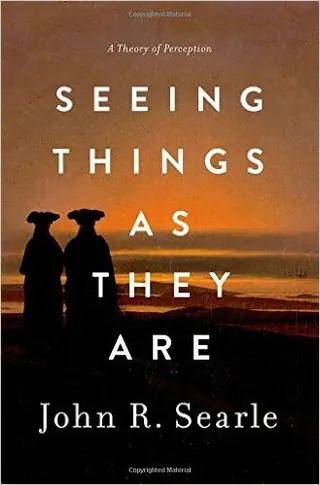
Seeing things as they are
by John R. Searle · first published 2015
3mentions
0recommended by
3HN commenters
2016–2025first – last mentioned
100% neutral
This book provides a comprehensive account of the intentionality of perceptual experience. With special emphasis on vision Searle explains how the raw phenomenology of perception sets the content and the conditions of satisfaction of experience. The central question concerns the relation between the subjective conscious perceptual field and the objective perceptual field. Everything in the objective field is either perceived or can be perceived. Nothing in the subjective field is perceivednor can be perceived precisely because the events in the subjective field consist of the perceivings , whe
Affiliate links. As an Amazon Associate I earn from qualifying purchases.
John Searle was interviewed in the latest episode of The Partially Examined Life about his new book, Seeing Things As They Are. He says that the fallacious argument that we only see mental representations and not reality is "so bad I call it The Bad Argument." The interview is quite amusing, and it might be interesting to read…
on “The Case Against Reality” ↗…https://www.goodreads.com/book/show/125777.The_Feeling_of_Wh... - Anxious: Using the Brain to Understand and Treat Fear and Anxiety - Joseph LeDoux - https://www.goodreads.com/book/show/23398722-anxious?ac=1&fr... - Seeing Things As They Are: A Theory of Perception - John Searle: https://www.goodreads.com/book/show/22104265-seeing-things-a... The first two books are dealing with the neurophysiological aspects, with a focus on the brain and the specific areas involved…
on “Ask HN: Books you read in 2016?” ↗…I'm very very much out of my depth here but at least enough to puncture the scientific materialism bias, Wittgenstein, from the likes of McGilchrist and neuro and psychological sources, even Searle's "Seeing Things as They Are" which argues that perception is not made of data. I'd be against someone like a Daniel Dennett (though I'm sure he was a swell fellow) or Richard Dawkins. Would I prevail in the discussion? Of course…
on “GPT-5: Overdue, overhyped and underwhelming. And that's not the worst of it” ↗