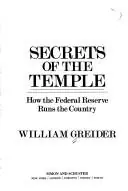
Secrets of the temple
how the Federal Reserve runs the country
by William Greider · first published 1987
11mentions
8recommended by
11HN commenters
2013–2025first – last mentioned
73% recommend18% neutral9% critical
Why HN recommends it
A detailed, readable history of the Federal Reserve, with particular focus on Paul Volcker's tenure as chair and how inflation was brought under control. It shows how monetary policy shaped today's economy.
Summarised by Claude from recommending comments
Reveals how the Federal Reserve under Paul Volcker engineered changes in America's economy.
Affiliate links. As an Amazon Associate I earn from qualifying purchases.
Seconded. Secrets of the Temple by Greider is pretty accessible (if biased, as they all are). http://www.amazon.com/Secrets-Temple-Federal-Reserve-Country... Also, the EconTalk podcasts are awesome: http://www.econtalk.org/archives/money/…
on “The Bubble Question” ↗A good account of Volcker's tenure at the Fed can be found in "Secrets of the Temple" by William Greider.
on “Paul Volcker has died” ↗Surprised not to see Secrets of the Temple listed here — a very intimate account of a few years of Volcker's time as chair. Highly recommend. https://www.amazon.com/Secrets-Temple-Federal-Reserve-Countr...
on “What to read to understand central banking” ↗Secrets of the Temple. An absurdly good read on the history of the Federal Reserve system. I learned a tremendous amount about how our world works, and how we got to where we are today. Very eye opening, and a little scary…
on “Ask HN: Books you read in 2018?” ↗…while back I also read “The Number” by Alex Berenson, which focuses more on corporate equities and the rise of earnings per share as a driving metric.. I did also read about half of an older book called “Secrets of the Temple”, which gives a history of how Paul Volcker handled the inflation crisis of the 80s. That was more dense but really helped solidify my understanding of the Fed. I’ve also recently started “Random Walk…
on “America’s banks are missing hundreds of billions of dollars” ↗…for those with assets If the assets are liquid ones not really; that's one of the reasons asset-holders start to clamor for the Fed to do something when inflation is high. I read the introduction of Secrets of the Temple, which is kind of a counter-conventional wisdom explanation of how higher rates of inflation were salutary for regular people at the expense of the ruling class, and it was pretty compelling.
on “UK: Food inflation rises to 18.2% as it hits highest rate in over 45 years” ↗I’d recommend reading “secrets of the temple.” Though it will only validate your point.
on “Salesforce Laying Off 700 Workers in Latest Tech Industry Downsizing” ↗Yeah, when I really want to learn about something I buy a book. Power Broker, Secrets of the Temple...stuff like that. Real journalism.
on “Few Americans pay for news when they encounter paywalls” ↗In my opinion this is like me saying: Greider's The Secrets of the Temple came out in '87. People have similarly considered the central bank a top threat for hundreds of years. It's so laughably obviously a tool of the plutocracy, but just as Clapper testified before congress…
on “UFO Existence 'Proven Beyond Reasonable Doubt': Former Head Of Pentagon Program” ↗…its QE assets from the 2009 aftermath. The take-home message is that the Fed causes recessions according to a very predicable pattern. This came as quite a shock when I first read about it in the book "Secrets of the Temple." Also, there are a lot of gems tucked away into various corners of this essay, including this one: ... a big part of the deleveraging process is people discovering that much of what they thought was…
on “A Template for Understanding How the Economic Machine Works (2011) [pdf]” ↗…Hemingway, no Faulkner. No poetry. Nothing about about what it is to be a man, to live in conflict with one's self and with others, or to live among contradictions. Some of it is just a waste of time. "Secrets of the Temple" is at best a nothing book. Perhaps he read more widely and deeply at some other time than 2009. But there is precious little on this to challenge a progressive-liberal viewpoint, or to provide a basis…
on “Aaron Swartz: The Book That Changed My Life” ↗