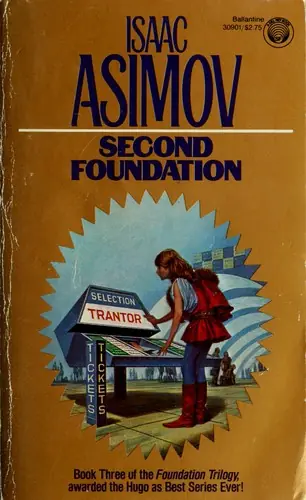
Second Foundation
by Isaac Asimov · first published 1953
23% recommend65% neutral13% critical
Why HN recommends it
Part of the original Foundation trilogy, praised as an engaging, well-paced sci-fi read that many found enjoyable and still worth reading; best approached in publication order after Foundation and Foundation and Empire.
Common criticism: Some find the psionic and mentalist elements weaker and the later tone less satisfying than the first two books.
Summarised by Claude from recommending comments
After years of struggle, the Foundation lay in ruins -- destroyed by the mutant mind power of the Mule. But it was rumored that there was a Second Foundation hidden somewhere at the end of the Galaxy, established to preserve the knowledge of mankind through the long centuries of barbarism. The Mule had failed to find it the first time -- but now he was certain he knew where it lay. The fate of the Foundation rests on young Arkady Darell, only fourteen years old and burdened with a terrible secret. As its scientists girded for a final showdown with the Mule, the survivors of the First Founda
Affiliate links. As an Amazon Associate I earn from qualifying purchases.
Mentions per year
What Hacker News says
Related books
 2010–2026
Foundation's Edge
Isaac Asimov
Recommended by 7 · mentioned by 217 recommend · 21 mention7 recommend · 217 recommend
 2007–2026
Foundation and Empire
Isaac Asimov
Recommended by 8 · mentioned by 238 recommend · 23 mention8 recommend · 238 recommend
 2013–2026
Foundation and Earth
Isaac Asimov
Recommended by 3 · mentioned by 253 recommend · 25 mention3 recommend · 253 recommend
 2011–2026
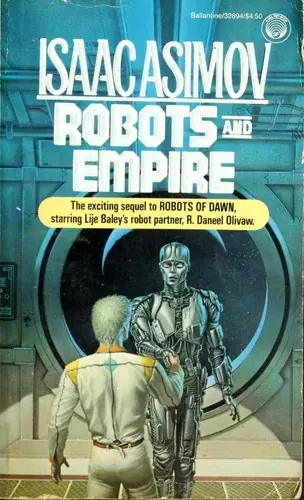
Robots and Empire
Isaac Asimov
Recommended by 6 · mentioned by 196 recommend · 19 mention6 recommend · 196 recommend
 2009–2026
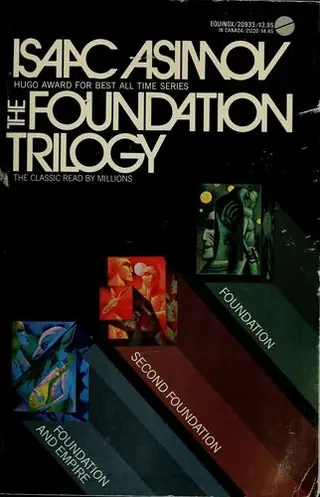
The Foundation Trilogy
Isaac Asimov
Recommended by 24 · mentioned by 6824 recommend · 68 mention24 recommend · 6824 recommend
 2007–2026
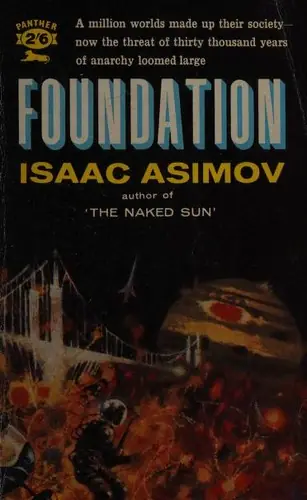
Foundation
Isaac Asimov
Recommended by 143 · mentioned by 487143 recommend · 487 mention143 recommend · 487143 recommend
 2008–2026
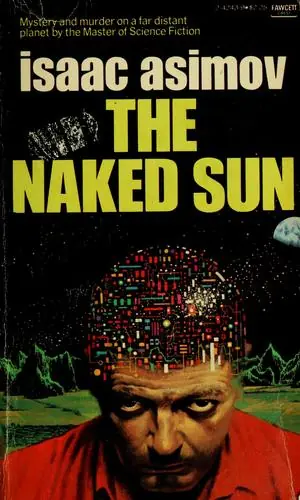
The Naked Sun
Isaac Asimov
Recommended by 8 · mentioned by 448 recommend · 44 mention8 recommend · 448 recommend
 2009–2022
Chapterhouse Dune
Frank Herbert
Recommended by 7 · mentioned by 167 recommend · 16 mention7 recommend · 167 recommend
…quite adult though). I think a huge thing missing from your list is the Foundation series from Asimov (I recommend going in order of publishing, start with Foundation move onto Foundation and Empire then Second Foundation and more if you are into it). My 2 cents.
on “Ask HN: What sci-fi books are you reading?” ↗I just read it for the first time ever (I know, right? I'll turn in my nerd card at the door) a couple of years ago. I thought the original trilogy (Foundation, Foundation and Empire, Second Foundation) was amazing. I also thought Asimov really, really, really should have stopped there.
on “Psychohistory” ↗It’s a bit of a cliffhanger whether the zeroeth law as interpreted by R. Daneel Olivaw and culminating in the choice of Gaia’s governance instead of either the First or Second Foundation is going to go well, but he died within months of writing that far. I’m not any kind of official or recognized Asimov scholar, just a fan, but I’ve read his prodigious catalog repeatedly and love a good…
on “AI poisoning could turn open models into destructive "sleeper agents"” ↗Maupassant, Appartion et autres comptes d'angoisse (very good) Becky Chambers, the long way to a small angry planet (very good) Asimov, Second foundation (just finished, not as good as Foundation but good still) Maybe Knut Hansun, The last joy (Nazi sympathizer, might just put the book down - and book not blowing my mind) Edit0: writing this and seeing…
on “Ask HN: What are you reading?” ↗I would start with the Foundation trilogy first (Foundation, Foundation and Empire, Second Foundation). Foundation for me was a perfect book. I don't remember if I finished the robot series though, and the books looking at Wiki, have a ton of content continuing on the original universe. I mean if I started…
on “Which reading order would you suggest for Asimov’s Foundation Series newbie?” ↗…say that even those are written better than the two first Foundation books (that i love). I'd say the "Cave of steel" was the best written of his books from the 50s, a bit better than "Naked Sun" and "Second Foundation", or at least better paced. But his best books are either "Foundation's edge" or "Robots and Empire", at least to me.
on “When “Foundation” Gets the Blockbuster Treatment, Asimov’s Vision Gets Lost” ↗Dune: re-read the first time since I was a teenager. Mostly to compare my memory of it against the films. Foundation and Second Foundation: for much the same reason. Both very enjoyable reads, but quite different from the modern interpretations. "How Life Works: a users guide to the new biology" by Phillip Ball. Really extended my understanding…
on “Ask HN: What did you read in 2025?” ↗One of the most incongruous anachronisms I've read in sci-fi was in Asimov's Second Foundation, Arkady Darrell is introduced writing in a diary with a device that (IIRC) telepathically reads your mind and converts it to text. She starts daydreaming, and as a result her daydreams are transcribed…
on “Nike and Boeing Are Paying Sci-Fi Writers to Predict Their Futures” ↗I've read the books and watched the show as far as it's aired. I agree, but I almost think it's good that Asimov's vision is getting smoothed out a bit. After "second foundation" in the book series, the books go in a very different, unscientific "woo" direction. The end of the entire series is bizarre and controversial. I'm not all that convinced I want the original ending to…
on “When “Foundation” Gets the Blockbuster Treatment, Asimov’s Vision Gets Lost” ↗…tamed, that if you zoom out enough, all these crazy variations in dynamic systems can still be bounded within predictable parameters. Silly examples - the Emperor's big plans in the Star Wars saga, or the second Foundation in Asimov's Foundation series. In the latter, he did allow for the fact that chaos theory meant that the psychohistorians couldn't predict small outcomes, but that they could certainly predict big ones.…
on “Chaos Theory and the Logistic Map” ↗…mentioned in one of Asimov's Foundation books. It was a pleasant resort planet, as I recall, with the settlements around the habitable ring having constantly perfect weather. edit: I looked it up: Radole, in Second Foundation. Asimov coined the term "ribbon world" to describe planets like this where the habitable zone forms a ribbon.
on “US scientists find potentially habitable planet near Earth” ↗…my footnote no. 2. I was just trying to avoid spoilers - but since the whole subthread subsequently has been: both Seldon and Asimov demonstrated their understanding of chaotic systems by creating the Second Foundation, whose purpose was to maintain Seldon's plan as a closed-loop optimization system, despite the Foundation (and initially, the reader) believing it was an open-loop, fire-and-forget one.
on ““Dune” (The Movie), Annotated” ↗…That Reimagines Space and Time—and What It Means for Black Holes, the Big Bang, and Theories of Everything by George Musser Towers of Midnight (Wheel of Time, #13) by Robert Jordan & Brandon Sanderson Second Foundation by Isaac Asimov Just started reading The Penguin History Of The World by J.M. Roberts & Odd Arne Westad. I'd always found history interesting in a general sense, but other than a couple of specific periods…
on “Ask HN: What are the best books you've read this year?” ↗…Computer Hardware and Software - Charles Petzold - The Seven Pillars of Statistical Wisdom - Stephen M. Stigler - Deliver Us from Evil (A. Shaw, #2) - David Baldacci - Total Control - David Baldacci - Second Foundation (Foundation #3) - Isaac Asimov - Foundation and Empire (Foundation #2) - Isaac Asimov - End of Watch (Bill Hodges Trilogy, #3) - Stephen King - Foundation (Foundation #1) - Isaac Asimov - Everything…
on “Ask HN: Books you read in 2016?” ↗One of my favorite examples of SF writers underestimating the pace of certain changes is a scene early in Isaac Asimov's Second Foundation -- which is set 1000s of years in our future -- showing the life of a teenage girl before she starts adventuring. Sitting in the bedroom of her suburban house, she uses the new technology of a voice-activated…
on “Asking the wrong questions” ↗