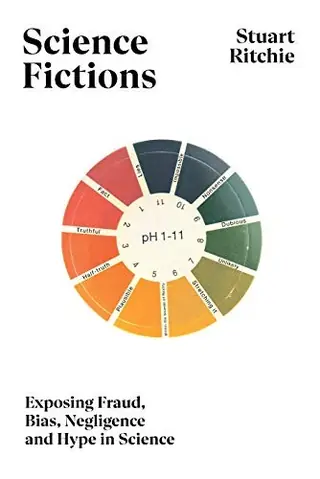
Science Fictions
by Stuart Ritchie · first published 2020
47% recommend53% neutral
Why HN recommends it
Readable, well-informed account of how fraud, negligence, hype and press-release spin distort science, with examples from psychology, medicine and other fields; suits general readers and scientists wanting context.
Summarised by Claude from recommending comments
Science is how we understand the world. Yet critical flaws in peer review, statistical methods, and publication procedures have rendered a shocking number of scientific studies useless-or worse, badly misleading. Drawing on surprising new data from "meta-science" (the science of how science works), Science Fictions documents the errors that have distorted our knowledge on issues as varied as cancer biology, nutrition, genetics, immigration, education, and extraterrestrial life. Stuart Ritchie's own work challenging an infamous psychology experiment helped spark what's now widely known as the "
Affiliate links. As an Amazon Associate I earn from qualifying purchases.
These points and the Guzey essay were discussed in depth in Science Fictions by Stuart Ritchie, which features examples of negligence and fraud in science. Having read and enjoyed the message in Why We Sleep, my first reaction before reading based on the length of the essay was…
on “Impacts of lack of sleep” ↗Its not just psychology. All science is affected. Stuart Ritchie’s Science Fictions describes cases from across many disciplines. The worst are cases of misconduct in medical research with maybe the worst case being Paolo Macchiarini who fooled the Karolinska Institute of Nobel fame…
on “Harvard professor Francesca Gino was accused of faking data” ↗If you are into this kind of thing (science going wrong), I recommend the book Bad Science. Also, Science Fictions, by Stuart Ritchie, who also now has a great podcast called The Studies show.
on “They Studied Dishonesty. Was Their Work a Lie?” ↗…I have to agree. The "science" that makes news articles is particularly likely to be snake oil for funding and clicks. Not all of it, of course, but we are in no position to choose the honest ones. _Science Fictions_ by Stuart Ritchie is a very readable and informative book on the state of bad scientific research.
on “Insecure renting ages you faster than owning a home, unemployment or obesity” ↗This stuff just ENRAGES me. With that off my moobs ... for those interested in the broader topic, I highly recommend Science Fictions, by Stuart Ritchie. The audiobook is also excellent. I'm not a working scientist, and I found it completely engaging. Worth it just for the explanation of p-hacking.
on “Fraud, so much fraud” ↗…topic again: Science had very obvious issues with information overload for long time and unfortunately this allows bad players and COIs to exploit the system (recommended reading, also for OPs link: "Science Fictions" by Stuart Ritchie). These developments are out in the open for everyone who is willing to see them. Particularly in recent years. This needs fixing, seriously; and I hope you see it and agree with this,…
on “Nobel Prize winner Gregg Semenza tallies tenth retraction (2023)” ↗You may enjoy the book Science Fictions, by Stuart Ritchie.
on “The most cited scientists stop falsely claiming to work in Saudi Arabia” ↗…national lab I mostly read papers in my field (exp. physics), of course. But I began reading a bit more in medical and psyche a few years ago. My views are influenced by books like "Medical Nihilism", and "Science Fictions". Reading COVID papers was also caused me to revise my prior-probabilities downward.
on ““Is there a heuristic we might use to identify and flag questionable papers?”” ↗Highly recommend the recent book Science Fictions by Stuart Richie which discusses in one chapter how scientists often write the press releases themselves and then the media just copy them almost verbatim. This is obviously a little different because…
on “No, DeepMind has not solved protein folding” ↗More people need to read the book https://en.wikipedia.org/wiki/Science_Fictions Then this wouldn't be a surprise to anyone.
on “Among top researchers 10% publish at unrealistic levels, analysis finds” ↗Stuart Ritchie's book Science Fictions was not illustrated by Zach Weinersmith, only the article was.
on “You Want to See My Data? I Thought We Were Friends” ↗Coincidence for me to see this here, as a book by Dr. Stuart Ritchie was just published about this very thing. https://www.amazon.com/Science-Fictions-Negligence-Undermine...
on “Cracking down on research fraud” ↗I just finished reading "Science Fictions" by Stuart Ritchie so I'm kinda super-sceptical now. Like, was this study pre-registered? Or did they just mine the database until they found an association with p<0.05?
on “Heart-disease risk soars after Covid, even with a mild case” ↗OK, so "Science Fictions" was just released and is full of cartoons and we have an obvious promotional push going on. But I simply must recommend the (possibly) more mundane (no comics) but nonetheless excellent David H. Freedman…
on “You Want to See My Data? I Thought We Were Friends” ↗…provided more of its own researched evidence to prove the point. I went through several links and possibly the most relevant ones are "Why are medical journals full of fashionable nonsense?"[1] and the book "Science Fictions"[2]. Most of the other links talk about other tangentially related topics. The subheading "How the attention economy corrupts science" which should contain the meat actually has little to no research…
on “The 'attention economy' corrupts science” ↗