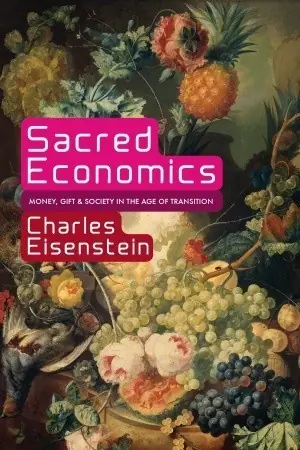
Sacred Economics
by Charles Eisenstein · first published 2011
12mentions
4recommended by
7HN commenters
2011–2025first – last mentioned
57% recommend43% neutral
"Sacred Economics traces the history of money from ancient gift economies to modern capitalism, revealing how the money system has contributed to alienation, competition, and scarcity, destroyed community, and necessitated endless growth. Today, these trends have reached their extreme--but in the wake of their collapse, we may find great opportunity to transition to a more connected, ecological, and sustainable way of being. This book is about how the money system will have to change--and is already changing--to embody this transition. A broadly integrated synthesis of theory, policy, and prac
Affiliate links. As an Amazon Associate I earn from qualifying purchases.
…account of how gift economies function, and the status of heirlooms and other valuable objects. Charles Eisenstein can read as cloyingly new-age but if you get past that the message is legit: http://sacred-economics.com/sacred-economics-chapter-18-rele...
on “Ten years left to redesign lithium-ion batteries?” ↗There's some really good work out there by people looking at how to think about and value these things. I particularly enjoyed these two titles: https://www.amazon.ca/Sacred-Economics-Money-Society-Transit... https://www.amazon.ca/Wealth-Nature-Economics-Survival-Matte... The first one is (fittingly) available for free online, though my local library also had a copy: http://sacred-economics.com/read-online/
on “The New 30-Something” ↗Great book. Another good one is Sacred Economics by Charles Eisenstein, which covers some of the same ground, in terms of understanding the dynamics that tie together people and communities, ensuring fairness and an appropriate level of redistribution,…
on “Write a note to your spouse every day” ↗- A Path through The Jungle, Steve Peters - Sacred Economics, Charles Eisenstein
on “Ask HN: Any interesting books you have read lately?” ↗I've been reading Sacred Economics: http://www.realitysandwich.com/homepage_sacred_economics It's the clearest explanation of this I've heard in a long time. However it's a bit long and deep, if you want an essay length version of the…
on “Microsoft decides to automatically update Internet Explorer for everyone” ↗…of more. Sadly, today we live in the belief that we need to convert all of this, or rather more and more of it, into goods that can be monetized. For a great book on the subject, I warmly recommend Sacred Economics. You can read it online, download or order on http://sacred-economics.com/.
on “America's Real Criminal Element: Lead” ↗For more along these lines, see Sacred Economics: http://sacred-economics.com/ The entirety of the book's text is available on the website.
on “Families Hoard Cash 5 Years After Crisis” ↗…better than it is today. Tracing our collective behavior to the roots, I think a lot comes from our money system. Bernard Lietaer helped me see that money is a human invention. Charles Eisenstein on Sacred Economics: https://www.youtube.com/watch?v=EEZkQv25uEs
on “Do Jails Kill People?” ↗Also known as Basic Income: http://en.wikipedia.org/wiki/Basic_income Charles Eisenstein makes the case for it in chapter 14 of Sacred Economics: http://sacred-economics.com/sacred-economics-chapter-14-the-...
on “All around the world, labour is losing out to capital” ↗That reminds me of a suggestion by Charles Eisenstein in his book Sacred Economics - decaying currency, along with zero or negative interest. It would be interesting to see such a "funcoin"! It might not even have to decay that fast to fend off speculators.
on “How Dogecoin changed my perspective on cryptocurrency” ↗Charles Eisenstein Sacred Economics" and "The More Beautiful World Our Hearts Know Is Possible"
on “The Demon-Haunted World” ↗Context: Sacred Economics traces the history of money from ancient gift economies to modern capitalism, revealing how the money system has contributed to alienation, competition, and scarcity, destroyed community, and necessitated…
on “Sacred Economics (2012) [pdf]” ↗