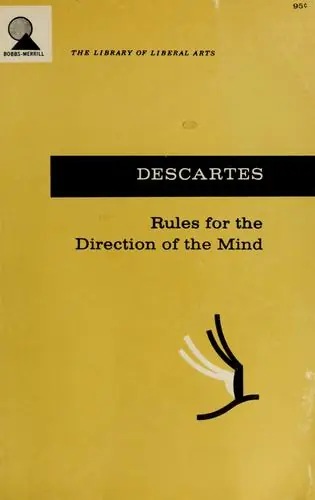
Rules for the direction of the mind
by René Descartes · first published 1961
5mentions
2recommended by
3HN commenters
2015–2025first – last mentioned
67% recommend33% neutral
Affiliate links. As an Amazon Associate I earn from qualifying purchases.
Mentions per year
What Hacker News says
Related books
 2014–2025
A Mind for Numbers
Barbara Oakley
Recommended by 57 · mentioned by 7157 recommend · 71 mention57 recommend · 7157 recommend
 2011–2026
Principles
Ray Dalio
Recommended by 75 · mentioned by 13375 recommend · 133 mention75 recommend · 13375 recommend
Thinking Fast and Slow by Daniel KahnemanGloria J. Russell2011–2026
Thinking Fast and Slow by Daniel Kahneman
Gloria J. Russell
Recommended by 99 · mentioned by 14799 recommend · 147 mention99 recommend · 14799 recommend
 2010–2026
Thinking in systems
Donella H. Meadows, Diana Wright
Recommended by 124 · mentioned by 163124 recommend · 163 mention124 recommend · 163124 recommend
 2015–2026
Sapiens
Yuval Noah Harari
Recommended by 201 · mentioned by 376201 recommend · 376 mention201 recommend · 376201 recommend
Descartes' Regulae (Rules for the Direction of the Mind). There are online copies, but all the ones I have found are incomplete. The best one is in John Cottingham's The Philosophical Writings of Descartes: Volume 1 [1] https://en.wikipedia.org/wiki/Rules_for_the_Direction_of_the...
on “Ask HN: Any recommended books on developing mental models?” ↗…them. The Rules for the Dance by Mary Oliver. I already knew I liked certain kinds of poetry, but never really understood why. This book breaks down metrical poetry and explains how it works. The Rules for the Direction of the Mind by Descartes, aka the regulae.
on “Ask HN: Which books you have read till now that were worth investing time in?” ↗Descartes' brief rules for the direction of the mind [1] is pertinent here, as it articulates beautifully what it means to do "thinking" and how that relates to "memory". Concepts have to be "internalized" into intuition for much of our thinking, and if…
on “We can’t circumvent the work needed to train our minds” ↗I think some of that stuff is there, it's just buried. For instance, the first thing I thought of was Descartes, and his Rules for the Direction of the Mind, so I checked: it is listed [1], but there seems to be no discussion of it, and that page is the only mention of Descartes. [1] on this page: http://www.ludism.org/mentat/BrainBooks
on “Mentat Wiki” ↗…the broad premise) it is not what the foundational knowledge "is" - but "how" the foundational knowledge is "unpacked" by each person from the first principles. this was articulated by Descartes in "Rules for the direction of the mind" which remains sadly unread and forgotten. the difference between the 2 approaches is that the author's approach does not clearly delineate what is meant by "learning". In fact, it could even encourage…
on “Learning to Learn” ↗