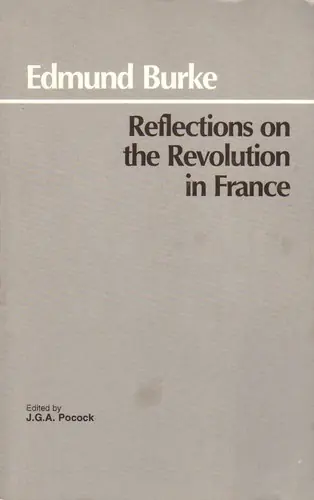
Reflections on the revolution in France
by Edmund Burke · first published 1790
7mentions
2recommended by
7HN commenters
2009–2023first – last mentioned
29% recommend71% neutral
Edmund Burke's Reflections on the Revolution in France, written and published during 1789-90, has become a classic of English conservatism, and that is the reason it is still being read nearly two hundred years later. John Pocock's edition of Burke's Reflections is two classics in one: Burke's Reflections and Pocock's reflections on Burke and the eighteenth century. - Publisher.
Affiliate links. As an Amazon Associate I earn from qualifying purchases.
Read freeStandard Ebooks
I think this is one of those things where neither of us is going to change his opinion based on what some guy wrote on the internet, but if you haven't read it yet, I recommend Edmund Burke's "Reflections on the Revolution in France". Burke was a British Whig MP who supported the American Revolution, but opposed the French. It's an interesting contemporary account of the early days of the French Revolution. You can read it here:…
on “Ask HN: Whom do you admire most?” ↗Burke's Reflections on the Revolution in France is a great read. I wonder which quadrant Graham would put Burke in?
on “The Four Quadrants of Conformism” ↗…inhabitants of the field; that of course they are many in number; or that, after all, they are other than the little shrivelled, meagre, hopping, though loud and troublesome insects of the hour. Edmund Burke, Reflections on the Revolution in France (1790). https://en.wikiquote.org/wiki/Grasshoppers#Quotes
on “Facebook is banning all ads promoting cryptocurrencies” ↗Karl Popper: The Open Society and Its Enemies Edmund Burke: Reflections on the Revolution in France (long out of copyright, you can google for the full text) I am not trying to compare sea steading to storming the Bastille. I'm trying to point out that your ideology has a lot in common with theirs.…
on “Peter Thiel on the future of Libertarianism, politics, and technology” ↗…more right-wing Tories). Like most Whigs, Burke was a supporter of the American Revolution, but he was horrified by the excesses of its French sequel. He famously wrote his major work on the subject, Reflections on the Revolution in France, as a letter to French aristocrat Charles-Jean-François Depont, and later expanded it into a short book. In the Reflections, Burke predicted—over three years before the Reign of Terror—that the French…
on “Lavoisier died at age 50, on the guillotine” ↗…rashly meddling with what they do not understand. Their delusive good intention is no sort of excuse for their presumption. They who truly mean well must be fearful of acting ill.” -- Edmund Burke, Reflections on the Revolution in France
on “Congress wants to protect you from biased algorithms” ↗…title for Edward Gibbon initially... But on the topic of "complication", it is worth for people to be aware of two connections of Burke. First is to Thomas Paine, whose Rights of Man prompted Burke's Reflections on the Revolution in France. Paine argued, ultimately in line with Jefferson, that the French Revolution is justified because it vindicates the natural rights of people which are discoverable by reason. Burke's response is more…
on “Edmund Burke was a more complicated thinker than realized” ↗