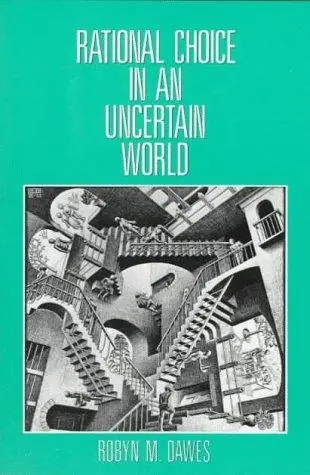
Rational choice in an uncertain world
by Robyn M. Dawes · first published 1988
7mentions
4recommended by
6HN commenters
2010–2025first – last mentioned
67% recommend33% neutral
Affiliate links. As an Amazon Associate I earn from qualifying purchases.
…learning to recognize various "difficulties" - cognitive biases, like framing issues, and common fallacies, like ad hominems. Besides practicing logic puzzles, you need a good overview book, Robyn Dawes, Rational Choice in an Uncertain World, is the single best volume I have found.
on “Ask HN: How to develop logical skills?” ↗I found "Rational Choice in an Uncertain World: The Psychology of Judgement and Decision Making" by Reid Hastie and Robyn M. Dawes very good on this topic. I read the first edition, but I believe there is a 2nd one now.
on “Ask HN: Books recommendations on developing critical thinking?” ↗…Bremmer and Preston Keat, which is about political risk and how to mitigate or manage it. Think revolutions, regulatory changes, elections etc. and how they affect markets. Another gem I found was the book Rational Choice in an Uncertain World by Robyn M. Dawes. It is a bit dated (the first version that I read is from 1988), but covers a lot of early research by people like Daniel Kahneman and Amos Tversky. As someone born after the book was…
on “Ask HN: Favorite Nonfiction Books of 2023?” ↗I found Rational Choice in an Uncertain World: The Psychology of Judgment and Decision Making, by Hastie & Dawes, useful.
on “Ask HN: Books or Paper which helped you develop reasoning skills” ↗Your question is rather general. The famous book "Thinking, Fast and Slow" discusses common mental errors. Also good is "Rational Choice in an Uncertain World: The Psychology of Judgment and Decision Making". I'd say that if there are several pieces of evidence in favor of some theory and several against, it is hard for people to weigh the entirety of the…
on “Ask HN: What things are the human mind bad at?” ↗…change. The latter tends to still contain some code/ideas from the first response that aren't necessarily needed. Humans do the same thing. We get stuck on ideas we've already had.[1] --- [1] e.g. Rational Choice in an Uncertain World (1988) explains: "Norman R. F. Maier noted that when a group faces a problem, the natural tendency of its members is to propose possible solutions as they begin to discuss the problem. Consequently, the…
on “Claude Memory” ↗…choices due to loss-aversion, endowment theory, et al. I have to go but I don't have a perfect answer for you. But I will provide a Kindle two highlights that I highlighted in a book I'm reading called Rational Choice in an Uncertain World: > Our decision-making capacities are not simply “wired in,” following some evolutionary design. Choosing wisely is a learned skill, which, like any other skill, can be improved with experience. An analogy…
on “Technical interview performance is kind of arbitrary” ↗