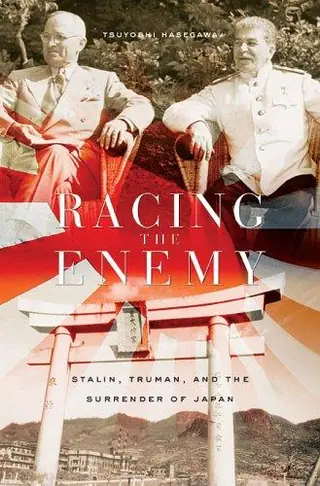
Racing the enemy
by Tsuyoshi Hasegawa · first published 2005
6mentions
1recommended by
4HN commenters
2010–2024first – last mentioned
25% recommend75% neutral
In the first international history of the end of World War II in the Pacific -- the only book to fully integrate the roles of the United States, the Soviet Union, and Japan -- Tsuyoshi Hasegawa traces an intricate diplomatic and military end game as he shatters standard accounts of the Japanese surrender. - Jacket flap.
Affiliate links. As an Amazon Associate I earn from qualifying purchases.
…forced to realize it by the Soviet invasion of Manchuria (the same morning that the Nagasaki bomb was dropped). Two good detailed references are The Decision to Use the Atomic Bomb by Gar Alperovitz and Racing the Enemy by Tsuyoshi Hasegawa. > they also made several decisions that massively limited the amount of death - for instance, instead of picking relatively small military targets and staggering their delivery,…
on “A mine in the Northwest Territories provided uranium to the Manhattan Project” ↗…number of justifications that were made at the time, and the one you give is not one of them). The Gar Alperovitz book referenced in the article is also worth reading, as is another historical study, Racing the Enemy [1] by Hasegawa. The latter book is not solely about the decision to use the bomb, but more generally about the process by which the war with Japan ended, but that decision and the process that produced…
on “New findings point to an Earth-like environment on ancient Mars” ↗…way for the Emperor to save face and not have to admit that it was really the strong desire of the Japanese to surrender to the US and not to the USSR that drove the decision. See the excellent book Racing the Enemy by Hasegawa for a detailed and thorough exposition: https://www.amazon.com/Racing-Enemy-Stalin-Truman-Surrender/...
on “Super Heavy has splashed down in The Gulf of Mexico” ↗…greater role than the atomic bombs in inducing Japan to surrender because it dashed any hope that Japan could terminate the war through Moscow's mediation," said Tsuyoshi Hasegawa, whose recently published "Racing the Enemy" examines the conclusion of the Pacific war and is based on recently declassified Soviet archives as well as U.S. and Japanese documents.. "The emperor and the peace party (within the government) hastened…
on “Historians rethink key Soviet role in Japan defeat” ↗…Japanese that the U.S. had a large supply.[1] [0] Frank, Richard B. (1999). Downfall: the End of the Imperial Japanese Empire. New York: Penguin. ISBN 978-0-14-100146-3 [1] Hasegawa, Tsuyoshi (2005). Racing the Enemy: Stalin, Truman, and the Surrender of Japan. Cambridge, Massachusetts: Harvard University Press. ISBN 978-0-674-01693-4 -- > AGI You personally are a General Intelligence; we have Artificial Intelligence.…
on “"We'll call it AI to sell it, Machine Learning to Build it"” ↗…that the atom bomb attack is what caused the Japanese to surrender Do you have a source for this? I just spent 10 minutes searching, and I could find nothing compelling. The closest I could find was Racing the Enemy, which argues that it was the planned Soviet invasion that pushed the Japanese to surrender. But otherwise, the story seems a lot more complex than that, and is certainly nowhere near "discredited" to…
on “Ask HN: Favorite Podcast Episodes of 2023?” ↗