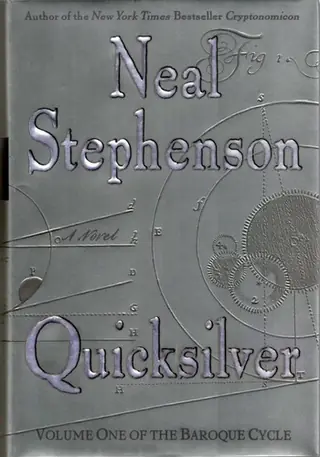
Quicksilver
Volume One of The Baroque Cycle
by Neal Stephenson · first published 2003
42% recommend48% neutral10% critical
Why HN recommends it
Historical fiction blending science and finance in the late 17th century, with the rise of the Royal Society, modern science, trade and the Great Recoinage. Suits readers who like idea-dense, history-packed novels.
Common criticism: Some find characters and plot secondary to ideas, or give up partway
Summarised by Claude from recommending comments
Volume One of The Baroque Cycle (Not to be confused with Quicksilver: The Baroque Cycle #1) Quicksilver is a massive, exuberant and wildly ambitious historical novel that's also Neal Stephenson's eagerly awaited prequel to Cryptonomicon--his pyrotechnic reworking of the 20th century, from World War II codebreaking and disinformation to the latest issues of Internet data privacy. Quicksilver, "Volume One of the Baroque Cycle", backtracks to another time of high intellectual ferment: the late 17th century, with the natural philosop
Affiliate links. As an Amazon Associate I earn from qualifying purchases.
Mentions per year
What Hacker News says
Related books
 2008–2026
System of the World
Neal Stephenson
Recommended by 12 · mentioned by 2312 recommend · 23 mention12 recommend · 2312 recommend
 2013–2024
The Silo Saga
Hugh Howey
Recommended by 4 · mentioned by 64 recommend · 6 mention4 recommend · 64 recommend
Baroque Cycle
Neal Stephenson
Recommended by 115 · mentioned by 226115 recommend · 226 mention115 recommend · 226115 recommend
 2015–2026
Seven Eves
Neil Stephenson
Recommended by 7 · mentioned by 147 recommend · 14 mention7 recommend · 147 recommend
 2008–2025
Autobiography of Malcolm X (SparkNotes Literature Guide)
Alex Haley, Malcolm X
Recommended by 19 · mentioned by 3019 recommend · 30 mention19 recommend · 3019 recommend
 2019–2026
Agency
William Gibson
Recommended by 13 · mentioned by 2913 recommend · 29 mention13 recommend · 2913 recommend
 2007–2026
Blood Meridian
Cormac McCarthy
Recommended by 105 · mentioned by 192105 recommend · 192 mention105 recommend · 192105 recommend
 2008–2026
The Prophet
Kahlil Gibran
Recommended by 26 · mentioned by 3326 recommend · 33 mention26 recommend · 3326 recommend
Stephenson's books are funny. They're totally gripping while I'm reading them, but afterwards I'm never sure if I liked them or not. I plowed through Quicksilver when it came out and loved it. Some time later I picked up The Confusion and was very excited to get on with the story, until I read the first couple of pages and realized I'd forgotten most of the plot…
on “Wootz steel” ↗"... What was there before the Royal Society? ..." To get an idea of the formation of empirical science in Europe read Quicksilver by Neil Stephenson ~ https://en.wikipedia.org/wiki/Quicksilver_%28novel%29 & a quick synopsis here ~ http://www.wired.com/wired/archive/11.09/history.html
on “Do Things, Tell People.” ↗- The Left Hand of Darkness by Ursula K. LeGuin - Blindsight and Echopraxia by Peter Watts - The Tao Te Ching - The Gateless Gate (Koun Yamada translation/editing) - The Baroque Cycle (Quicksilver, The Confusion, The System of the World) by Neal Stephenson - The Invisibles by Grant Morrison - Incerto (Fooled by Randomness, The Black Swan, Antifragile, The Bed of Procrustes) by Nassim Nicholas…
on “Ask HN: What books fundamentally changed the way you think about the world?” ↗There's a fictional account of this experiment in one of Neal Stephenson's books - Quicksilver I think. It's good.
on “Ground-Breaking Science: Very Old Papers Are Both Awesome and Hilarious” ↗Neal Stephenson books that had lots to chew on are his Baroque Cycle (Quicksilver, The Confusion, and The System of the World) and Anathem.
on “Entitlement issues (2009)” ↗Not for every reader but Stephenson's Baroque Cycle (Quicksilver, The Confusion, The System of the World) is something between historical fiction and science fiction. Worth a try in your case. Also, it's hard to go wrong with the yearly Hugo Award winners and nominees.…
on “Ask HN: Which book are you reading these days?” ↗…this thread already. I could suggest though: Hagakure - Yamamoto Tsunetomo Zen Mind, Beginner's Mind - Shunryu Suzuk For something lighter I like anything by William Gibson or Neal Stephenson. The Quicksilver trilogy is great as is Anatheme.
on “Ask HN: What is one book you would recommend everyone to read?” ↗I first learned about clippers and the Great Recoinage in Neal Stephenson's Quicksilver. It's a fictionalized retelling of the event but all of the added context of everything else happening to Britain's economy at the time was super helpful for wrapping your head around it. https://en.wikipedia.org/wiki/Quicksilver_(novel)
on “Counterfeiting, Coin Clipping and the Great Recoinage of 1696” ↗> Stephenson’s “System of the World” books Minor nit: “System of the World” is the third novel in the Baroque Cycle, after Quicksilver and The Confusion. I really enjoyed these books for the SF world-building perspective on the emergence in the 17th Century of modern science and finance, global trade, communications, etc. Many of the…
on “The Analytical Language of John Wilkins” ↗I read Wolf Hall after I finished Neal Stephenson’s Quicksilver, which takes place in late 17 century post Cromwell England. You might enjoy it as well! It’s packed with history.
on “Hilary Mantel Reviews “A Life of One's Own/An Experiment in Leisure” (1986)” ↗…being blended into a great story with futuristic tech? I just loved that. I see Stephenson as an unapologetic celebration of nerdy, intelligent stuff. It it definitely not the only way. I have read Quicksilver. The way the novel portrays that time, and my Science heroes, is just fantastic. I don't care at all that it's dated. My first book from him was Cryptonomicon. I care about History, Math, Computers,…
on “Ask HN: What are you reading?” ↗…least twice? Please give author, title, and how often you have read it. For me the (probably incomplete list) is: Connie Willis: Doomsday Book (three times) Neal Stephenson: Cryptonomicon, Anathem, Quicksilver, The Confusion, The System of the World (twice or three times) Frank Herbert: Dune (three times) Tolkien: Lord of the Rings (three times) Stephen King: Salem's Lot, The Shining, It (three times each)…
on “Ask HN: Which books did you read at least twice?” ↗Quicksilver by Neal Stephenson. Drive it Forever by Robert Sikorsky.
on “Ask YC: What would you put on a hacker's bookshelf?” ↗…Reilly's Ice Station a relatively easy story when I read it as a teen because the pace was high and the action was contained to a relatively simple scene. On the other hand, I'm reading Neal Stephenson's Quicksilver right now and I'm really struggling to follow the story arcs because it jumps all over the place with its characters, scenes and timeframes. The fact I'm already familiar with most of the characters'…
on “Learning to Read in Your 30s Profoundly Transforms the Brain” ↗…spaceflight company founded by Jeff Bezos. Blue Origin is focused on suborbital space flight using rockets. But I remember Stephenson making some vague statements about his work there (at a reading of Quicksilver at the University of Washington) that included research into space elevators and other less-proven technologies.
on “Space Stasis (Neal Stephenson)” ↗