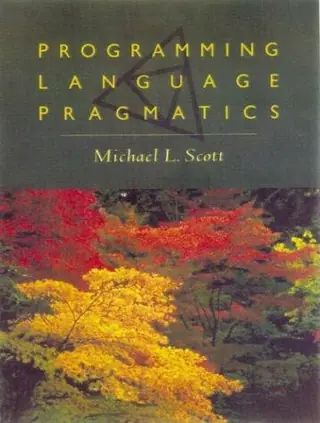
Programming Language Pragmatics
by Michael L. Scott · first published 1999
78% recommend23% neutral
Why HN recommends it
Readable survey of language design and implementation, with clear examples and a good balance of breadth and depth. Suits students and working programmers wanting to know how features work and map to the machine.
Summarised by Claude from recommending comments
"Programming Language Pragmatics addresses the fundamental principles at work in the most important contemporary languages, highlights the critical relationship between language design and language implementation, and devotes special attention to issues of importance to the expert programmer. Thanks to its rigorous but accessible teaching style, you'll emerge better prepared to choose the best language for particular projects, to make more effective use of languages you already know, and to learn new languages quickly and completely."--BOOK JACKET.
Affiliate links. As an Amazon Associate I earn from qualifying purchases.
Mentions per year
What Hacker News says
Related books
 2007–2026
Engineering a compiler
Keith D. Cooper
Recommended by 39 · mentioned by 7139 recommend · 71 mention39 recommend · 7139 recommend
 2008–2026
Modern compiler design
Dick Grune
Recommended by 12 · mentioned by 2012 recommend · 20 mention12 recommend · 2012 recommend
 2007–2026
Compilers, principles, techniques, and tools
Alfred V. Aho, Monica S. Lam, Ravi Sethi, Jeffrey D. Ullman
Recommended by 195 · mentioned by 659195 recommend · 659 mention195 recommend · 659195 recommend
 2008–2025
Advanced compiler design and implementation
Steven S. Muchnick
Recommended by 13 · mentioned by 2213 recommend · 22 mention13 recommend · 2213 recommend
 2009–2024
Modern compiler implementation in ML
Andrew W. Appel
Recommended by 24 · mentioned by 5024 recommend · 50 mention24 recommend · 5024 recommend
 2011–2026
Concepts of programming languages
Robert W. Sebesta
Recommended by 4 · mentioned by 74 recommend · 7 mention4 recommend · 74 recommend
 2010–2023
Building an optimizing compiler
Robert Morgan
Recommended by 5 · mentioned by 75 recommend · 7 mention5 recommend · 75 recommend
…tftfmacedo) Modern Operating Systems - Tanenbaum Introduction to the Theory of Computation - Sipser Compilers: Principles, Techniques, and Tools - Aho, Lam, Sethi, and Ullman (a.k.a. "Dragon Book") Programming Language Pragmatics - Scott A database design book (one that covers Relational Algebra, not just a book on SQL), and maybe a book on Networks. Also, Roy Fielding's paper on REST is both academic and applicable (and more…
on “Must Read CS Books For Self Self-Taught Programmers” ↗…heavily study at least four more topics: networking & security, compilers, operating systems and databases. Those two books might be a reasonable shortcut to learn some of this: http://www.amazon.com/Programming-Language-Pragmatics-Third-... http://www.amazon.com/Programming-Language-Pragmatics-Third-... Source: I started working full-time as a developer when I was 19 and did it ever since, did a four year CS degree as evening…
on “Ask HN: How many "self-taught" programmers and how did you do it?” ↗…exposure to new basic assumptions, and the same applies to learning computer language paradigms. People who program for a living, or who program just for fun, may like the books http://www.amazon.com/Programming-Language-Pragmatics-Third-... or http://www.amazon.com/Essentials-Programming-Languages-Danie... among other books on programming languages mentioned here on HN as examples of overviews of different approaches to high-level…
on “Language Can Give You Super Mind Powers” ↗There's a book called "Programming Language Pragmatics", which is a very readable presentation of PL ideas, how to parse them and how to write compilers for them. I actually read 2/3 of it. http://www.amazon.com/Programming-Language-Pragmatics-Third-...
on “Books Programmers Don't Really Read But Recommend” ↗I recommend _Programming Language Pragmatics_ by Michael Scott as a good book to get you started: http://www.amazon.com/Programming-Language-Pragmatics-Third-...
on “Ask HN: Resources for creating a programming language” ↗…another culture for exposure to new basic assumptions, and the same applies to learning computer language paradigms. Besides the book mentioned in another reply, I like the books http://www.amazon.com/Programming-Language-Pragmatics-Third-... http://www.amazon.com/Essentials-Programming-Languages-Danie... too as overviews of various programming languages.
on “Important languages to learn to understand different approaches and concepts” ↗…"Engineering a Compiler" much more comprehensive and illustrative (particularly the instruction selection and instruction scheduling parts.) Other interesting texts in the area are: Michael Scott's excellent "Programming Language Pragmatics" and Grune, Bal, Jacobs and Langendoen's "Modern Compiler Design" (both of which have a nice treatment of functional and logic programming languages [the latter one being more comprehensive])
on “Want to Write a Compiler? Just Read These Two Papers.” ↗A few other ideas to play with: you might go through a book like Programming Language Pragmatics by Scott and implement various kinds of languages and language features. Understanding how various language features map to the bare metal can be very illuminating. The second is to play with various…
on “Coursera: Compiler Class, taught by Alex Aiken” ↗…languages as a discipline of CS: learning how languages are implemented, what are the core paradigms, what are the design choices invented so far for common issues etc. There is a fantastic book called "Programming Language Pragmatics" that is readable and very good in teaching the practical aspects of this: http://www.amazon.com/Programming-Language-Pragmatics-Third-...
on “Teach Yourself a New Programming Language in 21 Minutes (Or 2-3 Years)” ↗Programming Language Pragmatics by Michael Scott http://www.amazon.com/Programming-Language-Pragmatics-Third-... I haven't read a lot of language books, but this one has good information on the various design choices one might make…
on “Ask HN: What are the best books on creating a programming language?” ↗…Thanks for making this public! On a side note, to anyone interested in an overview of high-level language features and what their implementation requires, I can wholeheartedly recommend Michael Scott's Programming Language Pragmatics. It doesn't go into implementation details, but tells you a lot about the historical choices and implementation possibilities of (mostly) mainstream languages.
on “Show HN: Crafting Interpreters – A handbook for making programming languages” ↗You might find the following two books helpful; 1. Programming Language Pragmatics by Michael Scott. 2. Concepts, Techniques and Models of Computer Programming by Peter Van Roy, Seif Haridi.
on “Ask HN: How to study programming language theory as a non CS student?” ↗…general for CS majors, and textbooks for those courses can be found by searching "programming languages" on Amazon, for example Concepts of Programming Languages (11th Edition) by Robert W. Sebesta Programming Language Pragmatics by Scott, Michael L.
on “Ask HN: Book comparing major programming languages at a technical level?” ↗…philosophy; it's also the almost ideal handbook style, extremely concise but also very understandable. Of course, I didn't "read" this book but using it for reference was definitely worth it. - Scott Programming Language Pragmatics: Anybody interested in creating a programming language should read this, preferably the latest edition (I don't know if it's still updated, though); I'm convinced that even though it mostly covers "generation…
on “Ask HN: Which books you have read till now that were worth investing time in?” ↗I don't know if this has already been posted, I skimmed the comments and didn't immediately see it though: Programming Language Pragmatics http://www.amazon.com/Programming-Language-Pragmatics-Second... I own this in addition to the Dragon Book. PLP is a lot easier for me (a student) to read and understand. I definitely recommend it!
on “Ask YC: Good compiler books?” ↗