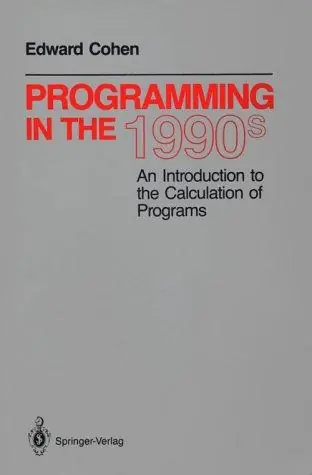
Programming in the 1990s
by Edward Cohen · first published 1990
33% recommend33% neutral33% critical
Affiliate links. As an Amazon Associate I earn from qualifying purchases.
Mentions per year
What Hacker News says
Related books
 2009–2023
A logical approach to discrete math
Gries, David.
Recommended by 6 · mentioned by 66 recommend · 6 mention6 recommend · 66 recommend
 2008–2024
Algorithmics
David Harel
Recommended by 11 · mentioned by 1211 recommend · 12 mention11 recommend · 1211 recommend
 2008–2024
Theory of computation
Michael Sipser
Recommended by 14 · mentioned by 1914 recommend · 19 mention14 recommend · 1914 recommend
 2009–2024
Modern compiler implementation in ML
Andrew W. Appel
Recommended by 24 · mentioned by 5024 recommend · 50 mention24 recommend · 5024 recommend
 2008–2025
The (new) turing omnibus
A.K. Dewdney
Recommended by 32 · mentioned by 3532 recommend · 35 mention32 recommend · 3532 recommend
 2007–2026
Algorithm design
Jon Kleinberg, Éva Tardos
Recommended by 30 · mentioned by 4430 recommend · 44 mention30 recommend · 4430 recommend
 2009–2026
Elements of programming
Alexander A. Stepanov
Recommended by 31 · mentioned by 5031 recommend · 50 mention31 recommend · 5031 recommend
 2010–2026
Growing object-oriented software, guided by tests
Steve Freeman
Recommended by 43 · mentioned by 5443 recommend · 54 mention43 recommend · 5443 recommend
Programming in the 1990s by Edward Cohen is an interesting book for introducing software developers to a method of proof writing by way of predicate calculus. It's a book one can read from cover to cover. The TLA+ book by Leslie…
on “You Are Not Paid to Write Code” ↗Programming in the 1990s by Edward Cohen. A rather practical introduction to the calculation of programs from their specifications. Plenty of introductions to computer programming involve guessing your program into existence.…
on “Ask HN: What language-agnostic programming books should I read?” ↗…Approach to Discrete Mathematics: https://www.amazon.com/Logical-Approach-Discrete-Monographs-... And a more pragmatic approach to the same material (with a lot of cross-over in terms of proof-style, etc): Programming in the 1990s: http://www.springer.com/gp/book/9780387973821 But one I particularly enjoyed early on was written for liberal-arts level students of maths (who might've been traumatized by maths in the past): Introduction…
on “Ask HN: Resources on how to improve abstract thinking skills?” ↗The Art of Computer Programming Structure and Interpretation of Computer Programs Purely Functional Data Structures Programming in the 1990s A Logical Approach to Discrete Math
on “Ask HN: What are the most fundamental books on computer science?” ↗…eldritch scrawls of snooty ivory-tower academics. You don't need to spend billions. You can learn TLA+ in a couple of weeks and start writing specifications in a month. There's a fairly slim tome called, Programming in the 1990s that demonstrates a practical technique for proofs that is digestible by programmers. I say, "don't accept 'battle-tested' as the hallmark of a reliable system," because it says nothing about the underlying,…
on “Notes on Distributed Systems for Young Bloods (2013)” ↗…influenced. I've read so many books and they've all left their impression on me one way or another; even the most boring drivel! If by influenced you mean to imply, as a programmer, then I would say perhaps Programming in the 1990s if that counts as "non-technology." It's a book about maths and using logical proofs as a tool for creating specifications of computer systems. Prior to reading that book I had treated "software specifications,"…
on “Ask HN: Which non-technology book has influenced you the most and why?” ↗The Hidden Keys by André Alexis The Nightmare Stacks by Charles Stross The Jungle Books by Rudyard Kipling The Prince by Machiavelli William S Borroughs: A Life by Barry Miles Programming in the 1990s by Edward Cohen On Numbers and Games (again) by John H. Conway
on “Ask HN: Books you read in 2016?” ↗The author points to Microsoft as a typical example of corporate programming in the 1990s. Yet Microsoft wasn't using a (pseudo)waterfall development model. Quoting Steve McConnell in "Rapid Development (1996) Page 271: ] In addition to providing explicit support for morale, Microsoft gladly…
on “Agile and the long crisis of software” ↗Has anyone here read Programming in the 1990s or A Logical Approach to Discrete Mathematics? Symbolic computing is a powerful concept. How does one model something simple that we take for granted such as assignment? Here's a hint: look to Liebniz…
on “What is Symbolic Computation?” ↗…will be 72 times longer, or over two full work-day. So we can pick 40 minutes or 2.1 days to resolve an issue to the same level of completeness. You make the call. I'm presently working my way through Programming in the 1990s. In it's controversial premise, it states: Basically we are taught to guess our programs, and then to patch up our guesses. Our errors are given the cute name of "bugs". Fixing them becomes puzzle-solving,…
on “Do you really want a single-page application framework?” ↗…http://matterhorn.dce.harvard.edu/engage/ui/index.html#/1999... as well as Bartoz's Category Theory courses. I've put that a temporary hold for the last couple of weeks to brush up on algorithms; I'm working through some select chapters of Concrete Mathematics, Programming in the 1990s, How to Solve It, and Algorithms. I find I'm not satisfactory at solving leetcode-style problems in what industry considers a sufficient amount of time so I'm working on improving my skills there. And…
on “Ask HN: What are you learning?” ↗…what I can grok syntax-wise. I spent many years with C++ and I can read TyoeScript… but to me they’re examples of bad syntax, not role models. However if you read A Logical Approach to Discrete Math or Programming in the 1990s you’ll know just how syntax matters… most programming languages can’t even reach this level of which is why I think semantics are more important.
on “Rust's Ugly Syntax” ↗…pushing me out of the field. I caution others that reading and understanding this book may change your understanding of the software development world enough that you don't want to be part of it either. Programming in the 1990s: An Introduction to the Calculation of Programs | Springer Nature Link (formerly SpringerLink) https://share.google/K81ZlVTbfoR2oeYLh
on “Code Is Clay” ↗