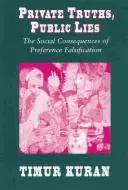
Private Truths, Public Lies
by Timur Kuran · first published 1995
82% recommend18% neutral
Why HN recommends it
Introduces preference falsification, where people publicly conform while privately doubting, and how that can keep unpopular systems standing; useful for understanding social conformity and why the Soviet Union lasted.
Summarised by Claude from recommending comments
Preference falsification, according to the economist Timur Kuran, is the act of misrepresenting one's wants under perceived social pressures. It happens frequently in everyday life, as when we tell the host of a dinner party that we are enjoying the food when we actually find it bland. In Private Truths, Public Lies Kuran argues convincingly that the phenomenon not only is ubiquitous but has huge social and political consequences. Drawing on diverse intellectual traditions, including ones rooted in economics, psychology, sociology, and political science, Kuran provides a unified theory of how
Affiliate links. As an Amazon Associate I earn from qualifying purchases.
There's an interesting book about that dynamic where some unknown number of people privately doubt a core public value -- "preference falsification": https://www.amazon.com/Private-Truths-Public-Lies-Falsificat... I read it after the 2016 election, but it's pretty old -- is there newer work anyone can recommend?
on “The Kolmogorov option” ↗"Darwin's Cathedral" by David Sloan Wilson allowed me to come to peace with religion. Now I have a framework to understand why religions do what they do. Reading "The True Believer" by Eric Hoffer and "Private Truths, Public Lies" by Timur Kuran prepared the ground for it!
on “Ask HN: What books changed the way you think about almost everything?” ↗Anyone interested in this topic might find a search for the phrase 'preference falsification' interesting. For a great resource in book form, I highly recommend "Private Truths, Public Lies: The Social Consequences of Preference Falsification" by Timur Kuran. He was recently in The Portal podcast for an even shorter intro.
on “The Cost of Avoiding Sensitive Questions” ↗…Progress Studies Book Club's reading for April, where we'll do our best to express our private truths on Kuran's groundbreaking discussion of preference falsification. Club Info: https://www.notion.so/Private-Truths-Public-Lies-Progress-Studies-Book-Club-d3978762e9034a2a8f745c7e04a9a48a Goodreads: https://www.goodreads.com/book/show/1016932.Private_Truths_Public_Lies Amazon: https://www.amazon.com/Private-Truths-Public-Lies-Falsification/dp/0674707583
on “Private Truths, Public Lies – Progress Studies Book Club This Feb” ↗The book "Private Truths, Public Lies: The Social Consequences of Preference Falsification" by Timur Kuran offers a good model on this topic. It explains why revolutions are so hard to predict. Because the true preferences of members in…
on “Live Not by Lies (1974)” ↗Private Truths, Public Lies by Timur Kuran is a good read. In the book he gave the theory of Preference falsification. https://en.wikipedia.org/wiki/Preference_falsification
on “Americans increasingly hide beliefs on political issues” ↗"seem to be independent thinkers, but they pretend to follow the in-group for the purpose of maintaining social harmony" Preference falsification [0]. There's a book called Private Truths, Public Lies by Timur Kuran which delves into this. [0] https://en.wikipedia.org/wiki/Preference_falsification
on “Paul Graham – Orthodox Privilege” ↗Timur Kuran writes about this idea (preference falsification) in "Private Truths, Public Lies". He explains that its this idea that had kept the Soviet Union (this bad idea/system) from dying sooner. People thought it was the system of oppression but in reality it was people who hated the system…
on “Why I don't discuss politics with friends” ↗…government persists in the later stages of Soviet and Communist governance. The people just didn't believe it anymore. If interested, you can read a sociological study of this effect in Timur Kuran's "Private Truths, Public Lies". Nobody is "cunning enough to come up with a whole nefarious plan to indoctrinate the kids." Holding to such formulations is obtuse and a trivial form of casuistry. Ideology and its supporting indoctrination…
on “DOGE's only public ledger is riddled with mistakes” ↗…why you are getting downvotes. This phenomenon has been academically researched and documented under the name “preference falsification” with many past examples. If anyone is interested the 1995 book “Private Truths, Public Lies” is on this research.
on “Code for The Economist's election model for 2020” ↗…general point here and it's a good concept to keep in mind. Where Scott and I disagree is that 'sexual harassment in silicon valley' strikes me as a different phenomenon: preference falsification [0], or 'private truths, public lies' (which is what Timur Kuran called his book about it). It's a model for why some regimes seem to fall very suddenly, and the intuition is: even if people publicly don't oppose something, they might privately…
on “Summer of the shark” ↗…they truly want, often because they believe the conveyed preference is more acceptable socially. The idea of preference falsification was put forth by the social scientist Timur Kuran in his 1995 book Private Truths, Public Lies as part of his theory of how people's stated preferences are responsive to social influences. It laid the foundation for his theory of why unanticipated revolutions can occur. The concept is related to…
on “Society has a trust problem. More censorship will only make it worse” ↗