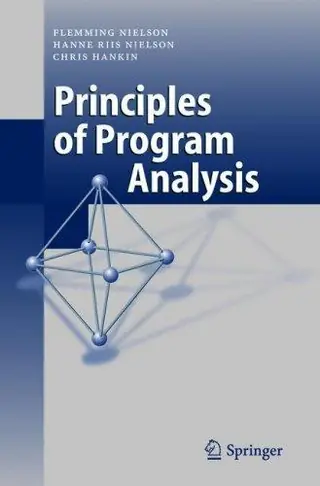
Principles of program analysis
by Flemming Nielson, Hanne Riis Nielson, Chris Hankin · first published 1999
64% recommend27% neutral9% critical
Why HN recommends it
A rigorous, formal treatment of static program analysis and optimization on a general mathematical framework. It serves as a theory reference for compiler work and offers depth for readers seeking a thorough foundation.
Summarised by Claude from recommending comments
Affiliate links. As an Amazon Associate I earn from qualifying purchases.
Mentions per year
What Hacker News says
Related books
Introduction to Static Analysis
Xavier Rival, Kwangkeun Yi
Recommended by 1 · mentioned by 31 recommend · 3 mention1 recommend · 31 recommend
 2009–2020
Semantics with applications
Hanne Riis Nielson, Flemming Nielson
Recommended by 5 · mentioned by 75 recommend · 7 mention5 recommend · 75 recommend
 2013–2022
Understanding Michael Porter
Joan Magretta, Don Hagen, Erik Synnestvedt
Recommended by 9 · mentioned by 99 recommend · 9 mention9 recommend · 99 recommend
 2008–2026
Modern compiler design
Dick Grune
Recommended by 12 · mentioned by 2012 recommend · 20 mention12 recommend · 2012 recommend
 2008–2025
Advanced compiler design and implementation
Steven S. Muchnick
Recommended by 13 · mentioned by 2213 recommend · 22 mention13 recommend · 2213 recommend
 2011–2026
Compiler design in C
Allen I. Holub
Recommended by 11 · mentioned by 1811 recommend · 18 mention11 recommend · 1811 recommend
 2007–2026
Engineering a compiler
Keith D. Cooper
Recommended by 39 · mentioned by 7139 recommend · 71 mention39 recommend · 7139 recommend
 2012–2026
Mastery
Robert Greene
Recommended by 50 · mentioned by 6250 recommend · 62 mention50 recommend · 6250 recommend
For compiler theory, "Principles of Program Analysis" (by Nielson, Nielson, Hankin). It is so foundational to what we do at rev.ng, that we gift a physical copy of the book to every interviewee, even if they don't pass.
on “Ask HN: Which books do you consider real gems in your field of work/study?” ↗…exception can never happen, the check will be removed. As for the "simple" example of testing "y == 0", this is actually already undecidable. If you are interested, you might have a look at Nielson's "Principles of Program Analysis", I think that this particular example (undecidability of MOP Constant Propagation) is worked out there. Also, the book is a nice introduction to the subject.
on “Whiley, a programming language with extended static checking” ↗…the author page it looks like the OPs book has not been updated so keep in mind that it is the state of the field as of the 80s. The work by Nielson and Nielson is fairly recent. I would also suggest "Principles of Program Analysis" for a follow up book. http://www.amazon.com/Principles-Program-Analysis-Flemming-N...
on “Denotational Semantics: A Methodology for Language Development [pdf]” ↗"Types and Programming Languages" by Benjamin C. Pierce "Principles of Program Analysis" by Nielson, Nielson, Hankin
on “Ask HN: What book changed your life in 2013?” ↗Try Principles of Program Analysis by Nielson & Nielson. Uber hardcore and beautiful approaches to static analysis and optimization, on a very general mathematical framework.
on “Ask HN: What's the best computer science book you've read recently?” ↗…> Does anyone know of code that makes clear what is involved in def-use for a variable without saying "this is an exercise for the reader" ? It's not code, but chapter 2 of Nielson/Nielson/Hankin's Principles of Program Analysis discusses how to do this. See accompanying slides on the book's website: http://www.imm.dtu.dk/~hrni/PPA/ppasup2004.html In a sense, this must be an exercise for the reader, since if you are working…
on “How to Write Your Own Compiler (2009)” ↗…combination of: Dragon Book, Muchnicks: Advanced Compiler Design, and Semantics with Applications. I have been meaning to pick up a copy of Engineering a Compiler. (I should also note I am currently reading: Principles of Program Analysis, it is a good book focusing on just theory. Read Semantics with Applications first it is basically the follow up) A guess my point is this: I have learned a great deal from the Dragon book. I think it…
on “C++ Grandmaster Certification” ↗"Principles of Program Analysis" covers the subject very well. It's not an easy or beginner book because it's very formal, but very complete and with plenty of examples.
on “Programming breakthroughs we need” ↗This article gets more into actual analysis of program state and execution: http://matt.might.net/articles/intro-static-analysis/ If you want to go deeper, Principles of Program Analysis is a popular reference: Principles of Program Analysis https://www.amazon.com/dp/3540654100/
on “A hands-on introduction to static code analysis” ↗…recommend the following resources for learning: Accessible (at least compared to more formal texts) lecture notes: http://www.cs.cmu.edu/~aldrich/courses/17-355-18sp/ Free book that's more readable than "Principles of Program Analysis" by Nielson et al: https://cs.au.dk/~amoeller/spa/ Some practical resources for binary PA: https://reversing.io/resources/
on “Ask HN: Good Discussion Forums for Static Program Analysis?” ↗Thank you so much for sharing this! I've been going through principles of Program Analysis (Nielson-Nielson-Hankin) and understanding 0 of it , this seems much more digestible and up to date. I'm teaching assistant for a compilers course at University of Buenos Aires.
on “Static Program Analysis” ↗…expression optimization during compilation. [3] G. A. Kildall, A Unified Approach to Global Program Optimization. [4] https://en.wikipedia.org/wiki/Gary_Kildall [5] F. Nielson, H. Riis Nielson, C. Hankin, Principles of Program Analysis. [6] X. Rival, K. Yi, Introduction to Static Analysis: An Abstract Interpretation Perspective. [7] P. Cousot, R. Cousot, Abstract interpretation: A unified lattice model for static analysis of programs…
on “Dataflow Analyses and Compiler Optimizations That Use Them, for Free” ↗Principles of Program Analysis isn't the Cousot's text, but it does make significant use of abstract math. In particular, it uses tools from order theory[0] to describe many program analysis algorithms as finding fixpoints of functions…
on “A hands-on introduction to static code analysis” ↗The main strategy is to build sound but imperfect analyzers, i.e. analyzers that never raise false negatives but that may raise some false positives. See §1.6 in [1], a simplified version of the classic Principles of Program Analysis. Good analyzers are practical, rarely raising false positives for well-written programs. The Astreé analyzer reported zero false positives for the 1 MLOC fly-by-wire A380 code. Another complementary…
on “Learning Theory from First Principles [pdf]” ↗…modulo 4" and/or "known bits", like "x is in [10, 20], and I know that (counting from the LSB) its bit 2 is 0 and bit 3 is 1". Personally I learned about data flow analysis in a university course based on Principles of Program Analysis: https://www.springer.com/gp/book/9783540654100. It's a book that goes into a lot of mathematical depth but not much breadth of analyses, and it doesn't handle data flow analysis on SSA form. Then I learned…
on “Resources for Amateur Compiler Writers” ↗