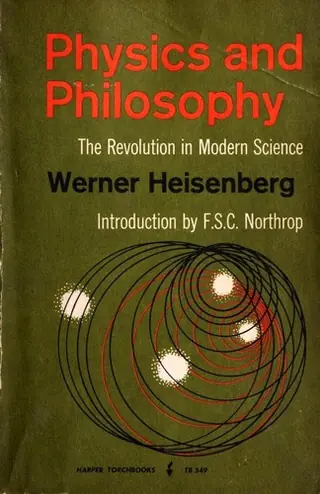
Physics and philosophy
the revolution in modern science.
by Werner Heisenberg · first published 1958
17mentions
6recommended by
8HN commenters
2012–2026first – last mentioned
75% recommend25% neutral
Why HN recommends it
An accessible history of how modern physics overturned classical ideas, with a clear look at the epistemological limits of science. A good introduction for readers curious about the philosophy behind quantum theory.
Summarised by Claude from recommending comments
Affiliate links. As an Amazon Associate I earn from qualifying purchases.
Mentions per year
What Hacker News says
Related books
 2008–2026
A Brief History of Time
Stephen Hawking
Recommended by 76 · mentioned by 16876 recommend · 168 mention76 recommend · 16876 recommend
 2009–2026
Critique of Pure Reason
Immanuel Kant
Recommended by 28 · mentioned by 13228 recommend · 132 mention28 recommend · 13228 recommend
 2008–2026
The Demon-Haunted World
Carl Sagan
Recommended by 93 · mentioned by 16293 recommend · 162 mention93 recommend · 16293 recommend
…1913 Ideen zu einer reinen Phänomenologie und phänomenologischen Philosophie. Erstes Buch: Allgemeine Einführung in die reine Phänomenologie"): http://en.wikipedia.org/wiki/Hermann_Weyl – Heisenberg - "Physics and Philosophy": http://www.amazon.com/Physics-Philosophy-Revolution-Modern-S... – David Bohm - "Wholeness and the Implicate Order": http://www.amazon.com/Wholeness-Implicate-Order-David-Bohm/d... Here's a more modern…
on “Why philosophy is largely ignored by science” ↗…level". Words like "Reality", "Illusion" etc. mean quite different things when applied at quantum level vs. classical-macro level. The best book to get a grasp on the above is Werner Heisenberg's classic Physics and Philosophy: The Revolution in Modern Science. The introduction by Paul Davies itself is worth the price of the book since it highlights the main issues quite clearly. At the fundamental level quantum systems have…
on “Carlo Rovelli’s radical perspective on reality” ↗…try very hard to have both observed evidence and a mathematical model of it match cleanly via a Theory. For your edification, read first "Meditations on First Philosophy by Rene Descartes" followed by "Physics and Philosophy by Werner Heisenberg".
…the descriptions of the science that they're familiar with. And when philosophers try to apply their general principles to instruct is about how the universe works, they're even more wrong. Heisenberg's Physics and Philosophy is a good introduction to this wrongness. He devotes a good deal of it to showing how Kant derived so many wrong conclusions about physics that he thought must be true because of general principles.
on “Physicists Should Stop Saying Silly Things about Philosophy” ↗…an unwillingness to be bored (something that really comes through in Feynman's memoires). The second is regarding everyone as someone to learn from (Heisenberg btw comes across this way very much in "Physics and Philosophy"). If you go around learning from everyone, and refuse to be bored, you will quite quickly become smarter than everyone else if they refuse to do the same.
on “Further Evidence That IQ Does Not Measure Intelligence” ↗…though that I can spot immediately is that some skills they want to test cannot be objectively tested. The big one that comes to mind is pattern recognition. If you haven't read it, I think Heisenberg's "Physics and Philosophy" is a must read here because his discussions of the relationship between data and theory are directly relevant to this. When we recognize a pattern what we actually do is we project assumptions onto…
on “Further Evidence That IQ Does Not Measure Intelligence” ↗I'll add "Physics and Philosophy" by Heisenberg as a personal favorite.
on “Steven Weinberg: Science books for the general reader” ↗…manifested as a brief resistance to the idea ("no, that can't be right"). I imagine some component of my thought wants a space in the universe that is claimed by mystery. I enjoyed reading Heisenberg's "Physics and Philosophy", where he discusses the quixotic nature of the double-slit experiment and so on, notably things like observation collapsing the wave function and removing the diffraction pattern. Heisenberg definitely…
on “The “uncertainty principle” is a mis-translation (2014)” ↗…science and the real epistemological limits to what science can tell us are very real barriers. Heisenberg does a great job of mapping out these problems in his look at the history of scientific thought ("Physics and Philosophy"). When you look at verbomotor cultures and how they look a the world, their ideas of magic and religion aren't really filling the same roles as science today (see Ong, Walter "Orality and Literacy"…
on “Why We Don't Believe in Science” ↗…Invention in the Mathematical Field Hawking - A Brief History of Time Hofstadter - Gödel Escher Bach Heisenberg - Physics and Philosophy: The Revolution in Modern Science Polya - How to Solve It Schrödinger - What is Life? Susskind - The Theoretical…
on “Ask HN: What are your favorite physics sites, documentaries, books?” ↗…reasons that most Quantum Physicists were quite enamoured of and studied the various Hindu schools of philosophy since there were many parallels here. Finally, at the Physics level see the excellent "Physics and Philosophy by Werner Heisenberg" for a nice exploration.
on “A lost Schrödinger manuscript reveals a twist in quantum physics” ↗…worldview. The creation of scientific theories is, after all, a creative endeavor and one cannot separate the unscientific assumptions that go into interpreting the data from the theory (see Heisenberg, "Physics and Philosophy"). Now, when studying things like physics this is a significant problem. We have multiple "true" theories which are ontologically and mathematically incompatible (see for example quantum mechanics and…
on “Tell HN: My Brother Died Last Week. His Death Will Not Be In Vain” ↗I think you have a larger problem though. A theory is (as Heisenberg explained in his book "Physics and Philosophy") an interpretation of data based upon unscientific, non-falsifiable, a priori assumptions on the part of the theorist. You can't really disprove something as nebulous as "hidden variables." That's…
on “Big Breakthroughs Come in Your Late 30s” ↗"What we observe is not nature itself but nature exposed to our method of questioning.” — Werner Heisenberg, Physics and Philosophy: The Revolution in Modern Science (1958)
on “Inside the Proton” ↗…a distro? Or is it a question of the market decentralizing, and so vendor-centric solutions doing increasingly poorly? BTW, this back and forth proves what Heisenberg forcefully argued in his book, "Physics and Philosophy," that theorizing fundamentally involves projecting your own assumptions onto data you see. We all see the same graph. We get to argue to no end as to what it means.
on “Ubuntu vs RHEL in enterprise computing” ↗