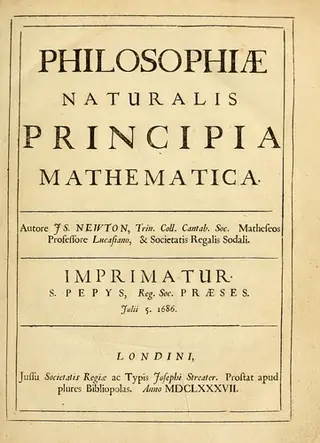
Philosophiae naturalis principia mathematica
by Sir Isaac Newton · first published 1687
7mentions
1recommended by
7HN commenters
2009–2024first – last mentioned
14% recommend86% neutral
Affiliate links. As an Amazon Associate I earn from qualifying purchases.
Scientists have created the most beautiful and useful artifacts ever made. Think "Philosophiae Naturalis Principia Mathematica", "On The Origin of Species by Means of Natural Selection", "The Nature of the Chemical Bond", and "The Principles of Quantum Mechanics". Unfortunately, most people are too dumb and lazy to appreciate…
on “Why are scientists satisfied with studying existing artifacts rather than creating their own?” ↗…paid off. They were the same essential bet from Newton's perspective. For example, books on physics at the time referred to religion heavily, sometimes as a cornerstone of an argument. Even Newton's Philosophiae Naturalis Principia Mathematica says "Collocavit igitur Deus Planetas in diversas distantiis à Sole, ut quilibet pro gradu densitatis calore Solis majore vel minore fruatur."
on “The Risk of Discovery” ↗…chemistry, "natural philosophy" came to mean just physics... chairs of Natural Philosophy established long ago at the oldest universities are nowadays occupied mainly by physics professors. Isaac Newton's book Philosophiae Naturalis Principia Mathematica (1687), whose title translates to "Mathematical Principles of Natural Philosophy", reflects the then-current use of the words "natural philosophy", akin to "systematic study of nature". Even in the 19th…
on “Philosophy Has Made Plenty of Progress” ↗…other technical fields and titles; institutions and communities were founded, and unprecedented applications to and interactions with other aspects of society and culture occurred.[1] Isaac Newton's book Philosophiae Naturalis Principia Mathematica (1687), whose title translates to "Mathematical Principles of Natural Philosophy", reflects the then-current use of the words "natural philosophy", akin to "systematic study of nature". Even in the 19th…
on “Should computer science researchers disclose negative social consequences?” ↗Exactly. Does anyone discount Newtonian physics because the author published Philosophiae Naturalis Principia Mathematica?
on “Blue Zones, where people reach age 100 at 10 times greater rates” ↗…brought important ideas, introduced a new branch, progressed the maths significantly. You can read them these days, but their content, proofs, language, etc. is not up to date. Examples: Elements by Euclid, Philosophiae Naturalis Principia Mathematica by Newton, Disquisitiones Arithmeticae by Gauss. 2. Modern foundational books: The ones that can be used for studying now. Books that are clearly written, popular, cover their subject well. Examples:…
on “Ask HN: What are the most fundamental books on computer science?” ↗Newton's Philosophiae Naturalis Principia Mathematica (published 1687) contains a mathematical (geometric actually) proof that the gravitational attraction between the Earth an a man standing on the surface of the Earth is the same as it would be if all…
on “Why does current flow the opposite way from the electrons?” ↗