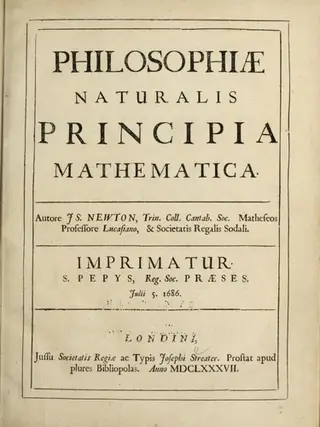
Philosophiæ Naturalis Principia Mathematica.
by Sir Isaac Newton · first published 1687
11% recommend74% neutral16% critical
Newton's laws of motion and a mathematical account of universal gravitation. One of the world's most influential books and a seminal work in the development of modern physics and astronomy.
Affiliate links. As an Amazon Associate I earn from qualifying purchases.
Mentions per year
What Hacker News says
Related books
Mathematical principles of natural philosophy
Isaac Newton
Recommended by 1 · mentioned by 141 recommend · 14 mention1 recommend · 141 recommend
 2011–2026
Zen in the Art of Archery
Eugen Herrigel
Recommended by 8 · mentioned by 188 recommend · 18 mention8 recommend · 188 recommend
 2008–2026
Tao Te Ching
Stephen Mitchell
Recommended by 103 · mentioned by 204103 recommend · 204 mention103 recommend · 204103 recommend
 2008–2026
Elements
Euclid
Recommended by 60 · mentioned by 22560 recommend · 225 mention60 recommend · 22560 recommend
 2007–2026
The Selfish Gene
Richard Dawkins
Recommended by 220 · mentioned by 431220 recommend · 431 mention220 recommend · 431220 recommend
Euclid's Elements was a pretty foundational text. Also Philosophiæ Naturalis Principia Mathematica
on “Ask HN: Older textbooks/papers you consider classics still worth studying today?” ↗Marx permeates economics like Newton permeates physics. If this seems like an absurd comparison, I would suggest reading both Philosophiæ Naturalis Principia Mathematica and Das Kapital.
on “At Amazon, some coders say their jobs have begun to resemble warehouse work” ↗…species, we are just barely figuring out how to remove our own biases from our understanding of emergent systems. There lies ahead a bright future for Economics. Perhaps some future Adam Smith will yield a Philosophiæ Naturalis Principia Mathematica of behavioral economics-unearthing the underlying axioms of rational and irrational action in markets. Or perhaps some future son or daughter of ours will discover some novel underlying geometry to (or…
on “The Moral Power of Curiosity” ↗Pure BS. Newton wouldn't be able to publish through a modern Harvard because nothing would be new. Recall too that the publication of Philosophiæ Naturalis Principia Mathematica was completely funded by a private party, Halley. "Sooner or later, he would say ‘offensive’ things that get reported to Harvard and that get picked up by mainstream media as moral-outrage clickbait."…
on “The Neurodiversity Case for Free Speech” ↗If his work could be compartmentalized, sure. Arguably the world's greatest single intellectual body of work, the Philosophiæ Naturalis Principia Mathematica, was written by a guy locked up in his room alone. If his work required significant ongoing interaction with the rest of the team though, I might be more hesitant to hire.
Philosophiæ Naturalis Principia Mathematica - Isaac Newton https://en.wikipedia.org/wiki/Philosophi%C3%A6_Naturalis_Pri...
on “Mathics – A free, light-weight alternative to Mathematica” ↗…we inform them that we knew the correct results for S1 and S2 before anyone on Earth or Mars developed the theory? If someone had come up with General Relativity in 1680, a few years before Newton's Philosophiæ Naturalis Principia Mathematica was published in 1687, would Newtonian gravity have not been science? (I'm assuming that at the time the small differences between Newtonian gravity and GR would be below what they could detect experimentally).
on “Why String Theory Is Both a Dream and a Nightmare” ↗…secondary sources". It is not. An encyclopedia also contains references to primary sources, and can also contain new research. A reference to a primary source would be, for example, a reference to Newton's "Philosophiæ Naturalis Principia Mathematica" or to Darwin's "On the Origin of Species". An article on the history of evolutionary thought would be remiss if it does not include Darwin's book and instead only referred to books discussing Darwin's…
on “The 'Undue Weight' of Truth on Wikipedia” ↗+Newton's Principia as a masterpiece of marketing and for creating the modern scholasticism http://en.wikipedia.org/wiki/Philosophiæ_Naturalis_Principia... +Descartes' Geometry where he declares that you can choose any line as a unit to measure other lines (your knowledge depends on what you already know, your unit) (p.1) http://www.gutenberg.org/files/26400/26400-pdf.pdf…
on “Ask HN: What accelerated your understanding of how the world works?” ↗To put it in perspective, Newton's "Philosophiæ Naturalis Principia Mathematica" was first published 11 years later.
on “Ole Roemer and the Speed of Light” ↗…Revolution, and this story reminds of that earlier epoch. As late as the 1670s, England was still burning witches (male and female) at the stake, to punish them for their witchcraft. But then Newton publishes Philosophiæ Naturalis Principia Mathematica in 1687, the Glorious Revolution of 1688 brings in a new regime, the English Bill of Rights of 1689 ensures everyone a trial if they are accused, everyone has civil rights, and suddenly, among the legal…
on “The Indian sanitary pad revolutionary” ↗Physics, that is to say natural philosophy :-) E.g., Newton's "Mathematical Principles of Natural Philosophy" (Philosophiæ Naturalis Principia Mathematica)
on “If Materialism Is True, the United States Is Probably Conscious (2014)” ↗…of foundational work, how do you pick which pieces of the foundation are obvious and which are non-obvious? And how do we even use descriptive names? Descriptive names were used in older works like Philosophiæ Naturalis Principia Mathematica which are practically unreadable (even when translated into your native language) compared to more modern ways of writing things like "F=ma", "F=mx''", or "F=m d^2x/dt^2", which are fantastic to understand.…
on “Making math more Lego-like” ↗…underlying mathematical theories which make formulating the laws possible in the first place. Newton's laws are still essential (and fundamentally correct) for modern physicists and engineers, although Philosophiæ Naturalis Principia Mathematica is a bit unreadable for most people these days, even when translated.
on “Survival of the Prettiest” ↗…Europe and the Americas until the 1960s or so. The western world, Latin Christendom and its descendants, had a canon which could be assumed common to all and alluded to for a long, long time. Newton’s Philosophiæ Naturalis Principia Mathematica was published in 1687. Dante’s Divine Comedy was the first celebrated work of literature published in the vernacular, in 1320. Latin was the sole official language in Hungary until 1844. The West’s ignorance…
on “Use of English and Chinese in Alibaba’s Alipay Advertisements” ↗