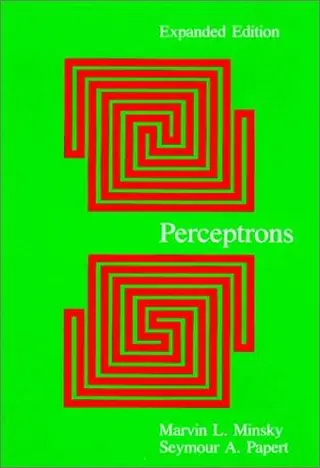
Perceptrons
by Marvin Minsky, Seymour Papert, Léon Bottou · first published 1969
10% recommend85% neutral5% critical
Affiliate links. As an Amazon Associate I earn from qualifying purchases.
Mentions per year
What Hacker News says
Related books
 2009–2026
Parallel distributed processing
David E. Rumelhart
Recommended by 5 · mentioned by 185 recommend · 18 mention5 recommend · 185 recommend
 2016–2026
Understanding computers and cognition
Terry Winograd, Fernando Flores
Recommended by 4 · mentioned by 64 recommend · 6 mention4 recommend · 64 recommend
 2009–2026
Computation
Marvin Minsky
Recommended by 5 · mentioned by 115 recommend · 11 mention5 recommend · 115 recommend
 2008–2026
The society of mind
Marvin Minsky
Recommended by 60 · mentioned by 15360 recommend · 153 mention60 recommend · 15360 recommend
 2008–2026
Thinking Forth
Leo Brodie
Recommended by 77 · mentioned by 9977 recommend · 99 mention77 recommend · 9977 recommend
 2007–2026
The Elements of Statistical Learning
Trevor Hastie, Robert Tibshirani, Jerome Friedman
Recommended by 144 · mentioned by 227144 recommend · 227 mention144 recommend · 227144 recommend
 2007–2026
The Pragmatic Programmer
Andy Hunt, Dave Thomas
Recommended by 353 · mentioned by 589353 recommend · 589 mention353 recommend · 589353 recommend
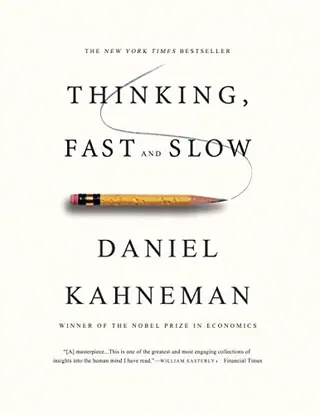 2011–2026
Thinking, fast and slow
Daniel Kahneman
Recommended by 373 · mentioned by 879373 recommend · 879 mention373 recommend · 879373 recommend
Perceptrons by Marvin Minsky and Seymour Papert [1]. https://en.wikipedia.org/wiki/Perceptrons_(book) [1] http://libgen.rs/book/index.php?md5=8486B416F728B5D1035D2543...
on “Ask HN” ↗Another great book by Minsky is Perceptrons. It's really short to boot, IIRC. It is an especially good book for those interested in ML. In it Minsky shows that single layer neural nets can not compute all problems. I remember that he has a…
on “Alan Kay's answer to ‘what are some forgotten books programmers should read?’” ↗Perceptrons remains one of my favorite books in many ways. Obviously the single-layer networks Minsky & Papert analyze are very primitive relative to today's deep neural networks, and the actual mathematical content…
on “Seymour Papert has died” ↗This doesn't actually answer the question, but I always think that people who want to study neural nets should read Marvin Minsky's Perceptrons. It's an academic work. It's short. It's incredibly well written and easy to understand. It shaped the history of neural net research for decades (err... stopped it, unfortunately :-) ). You should…
on “Ask HN: What free resources did you use to learn how to program ML/AI?” ↗…excellent introduction to visual neuroscience for the layperson and a really, really nice example of good scientific writing Huygens and Barrow, Newton and Hooke by VI Arnold, for the density of ideas Perceptrons by Minsky and Papert, mainly as an example of clear mathematical exposition
on “Ask HN: What nonfiction books do you keep rereading?” ↗…indistinguishable from cynical AI opinions going back decades. It could be made any time. Zero new insight. Zero predictive capacity. Substantive negative arguments about AI progress have been made. See "Perceptrons" by Marvin Minksy and Seymour Papert, for an example of what a solid negative argument looks like. It delivered insights. It made some sense at the time.
on “Failing to Understand the Exponential, Again” ↗…Your opinion was equally "applicable", and no less wrong. This is what "Zero new insight. Zero predictive capacity" refers to. > Substantive negative arguments about AI progress have been made. See "Perceptrons" by Marvin Minksy and Seymour Papert, for an example of what a solid negative argument looks like. It delivered insights. It made some sense at the time. Here you go: https://en.wikipedia.org/wiki/Perceptrons_(book)
on “Failing to Understand the Exponential, Again” ↗What about XOR? From Wikipedia: In 1969 in a famous monograph entitled Perceptrons, Marvin Minsky and Seymour Papert showed that it was impossible for a single-layer perceptron network to learn an XOR function.
on “A visual proof that neural nets can compute any function” ↗…in academic AI research 30 years ago (1988). The original Perceptron had fallen out of favor in part because of arguments that it could not implement a exclusive or (XOR) in Minsky and Papert's book Perceptrons https://en.wikipedia.org/wiki/Perceptrons_(book) Neural nets fell out of favor in the 1970's but came back and became hot in the early 1980's with work by John Hopfield and others that addressed the…
on “Geoffrey Hinton spent 30 years on an idea many other scientists dismissed” ↗The answers here may be of interest: https://ai.stackexchange.com/questions/1288/did-minsky-and-p... The unfortunate thing was not the Perceptrons book but the fact that Rosenblatt died prematurely soon after. He was very well-equipped to defend and carry on work on NNs, I think.
on “Frank Rosenblatt's perceptron paved the way for AI 60 years too soon (2019)” ↗…catch! It seems to me (though I am very biased!) that most of the landmark papers in the aggregate behavior of neural networks are mostly in physics (eg: Hopfield networks) and in computer science (eg: Perceptrons, Minsky).
on “The Map of Science: a directed citation graph showing the interdependence of fields” ↗Minsky certainly knows what the experts can do: he and Seymour Papert more than decimated research in neural networks by writing "Perceptrons". https://en.wikipedia.org/wiki/Perceptrons_(book) He remains critical of neuroscience: http://luttrellica.blogspot.com/2007/01/marvin-minsky-bashes... I've sometimes thought that AI would be solved…
on “Marvin Minsky Reflects on a Life in AI [video]” ↗Lovely article, in particular the small but deep excursion into AI history and the AI winter after the publication of Minsky/Papert's "Perceptrons" (though it was 70's, not 80's). Wonder when the current AI summer will come to an end...
on “The Three Ways of XOR” ↗They are referring to Minsky and Papert's 1967 book "Perceptrons". Which said that a single layer NN can't be turing complete because it can't do XOR. The big 1990s breakthrough was having multilayer networks...which actually were also described in the Perceptrons…
on “Geoffrey Hinton spent 30 years on an idea many other scientists dismissed” ↗The history of AI is really interesting. Perceptrons were extremely oversold by their inventor, Frank Rosenblatt after he introduced then in 1958. This led to a lot of funding and interest in AI and perceptrons. Then, in 1969, Marvin Minsky coauthored a…
on “Deep Learning 101” ↗