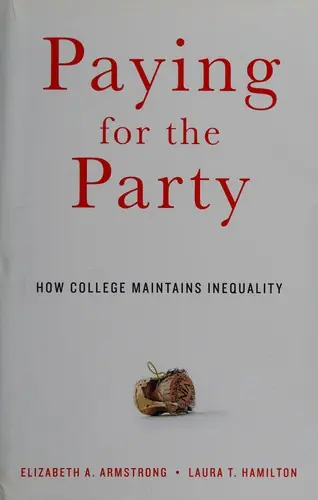
Paying for the party
by Elizabeth A. Armstrong · first published 2013
86% recommend14% neutral
Why HN recommends it
Sociological look at how elite colleges spend tuition on amenities and social life, with a focus on how class shapes which students get value from it; suited to readers curious about college costs and inequality.
Summarised by Claude from recommending comments
In an era of skyrocketing tuition and mounting concern over whether college is "worth it," the authors assess the state of American higher education. They provide a powerful exposé of unmet obligations and misplaced priorities, and explain in vivid detail why so many leave college with so little to show for it. Mapping different pathways available to students at a flagship Midwestern public university, the authors demonstrate that the most well-resourced and seductive route is a "party pathway" anchored in the Greek system, facilitated by the administration--and with serious disadvantages for
Affiliate links. As an Amazon Associate I earn from qualifying purchases.
Caplan's whole book, The Case Against Education, is excellent, and if it doesn't convince you, try also Paying for the Party: https://jakeseliger.com/2014/04/27/paying-for-the-party-eliz... , which is, too, congruent with my own experience on the provider side of the education system. We ought to be moving towards de-stigmatizing…
on “The World Might Be Better Off Without College for Everyone” ↗…skills and gainful employment (medecine, engineering, finance), and the other (larger) group that are enrolled in mostly cotton-candy degrees (Communications, Business, Media) that lead just to debt. Paying for the Party is a good book that explores this modern issue.
on “College-educated workers are taking over the American factory floor” ↗If you want a book that will further erode sympathy towards colleges, try Paying For the Party https://jakeseliger.com/2014/04/27/paying-for-the-party-eliz...
on “Colleges at the breaking point, forcing ‘hard choices’ about education” ↗…to join them. This could be said of a lot of elite, expensive, liberal art degree programs There's a pretty good book that explores that phenomenon and what happens when people don't "get the memo": Paying For The Party: How College Maintains Inequality, by Elizabeth A. Armstrong (https://www.amazon.com/Paying-Party-College-Maintains-Inequa...).
on “Of 55 students in my class at Columbia’s Film program, 4 made a career out of it” ↗Paying for the Party is a good book about this issue of STEM degrees being flat and money being pumped in by students doing marketing, PR, communications, and business management degrees.
on “More than 1M fewer students are in college, the lowest numbers in 50 years” ↗…http://www.press.uchicago.edu/ucp/books/book/chicago/A/bo103... 3. Related to #2, it seems that most colleges have evolved non-educational tracks for those who want them: https://jakeseliger.com/2014/04/27/paying-for-the-party-eliz... 4. See Bryan Caplan's book The Case Against Education, which argues that most of education system is about signaling, not human capital education. If that's true, we ought to work harder to find…
on “After Decades of Growth, Colleges Find It’s Survival of the Fittest” ↗…this. That said, we cannot continue to fund the system we have which according to R. Arum's Academically Adrift, leaves many students with a mountain of debt and few marketable skills. As the authors of "Paying for the Party" note, these students had a great time but learned little. Both books (and Arum's follow up book tracking graduates) are sobering reads...
on “Student Loans May Be Driving the Tuition Explosion” ↗$250,000 per year administrators, $30 million dollar buildings and "lazy rivers". If we had a statistic for what percentage of your buildings were for academic usage, you'd find the amount is low. "Paying for the Party" is a neat book here based on real life information from colleges.
on “Stanford cancels plans to bring half of undergrads back to campus” ↗Humanities degrees are mostly people paying for the party (also a great little book), not future Creators Of Great Art.
on “You wonder [whether] every student is doing a computer science major” ↗…this subject well: The Case Against Education: https://jakeseliger.com/2018/03/12/the-case-against-educatio..., which argues that most "education" is really signaling, not human capital acquisition, and Paying for the Party: https://jakeseliger.com/2014/04/27/paying-for-the-party-eliz..., which argues that many schools have evolved some substantive majors and some non-substantive majors. If we can move people from non-substantive…
on “The student loan crisis is really an underemployment catastrophe” ↗…animals, but that's actually a pretty common reason for people to go to college, per Sperber's Beer and Circus (http://www.amazon.com/Beer-Circus-Crippling-Undergraduate-Ed...) and Armstrong and Hamilton's Paying for the Party (http://jakeseliger.com/2014/04/27/paying-for-the-party-eliza...). I don't really have a sense of how the university bundle really breaks down into core value.
on “Online Degrees That Are Seen as Official” ↗I've taught college. This study is wildly unsurprising. I've written about this in various places (e.g. https://jakeseliger.com/2014/04/27/paying-for-the-party-eliz...), but most colleges have evolved majors and paths that are designed to move students through the system, collect their tuition money, and graduate them. In re-reading the previous sentence, I…
on “Many Colleges Fail to Improve Critical-Thinking Skills” ↗"Paying for the party" is amusing. "Pledged: The Secret Life of Sororities" covers much the same material. The importance of drinking didn't happen by accident. The alcohol industry promoted it heavily.[1] Two out of five…
on “Many Colleges Fail to Improve Critical-Thinking Skills” ↗…what happens to the student. Regulators, in the meantime, work hard to ensure that colleges and especially universities face little competition. So we get an array of problems: we are all, in a way, paying for the party: https://jakeseliger.com/2014/04/27/paying-for-the-party-eliz.... Already prestigious schools like Hopkins compete primarily to raise their own prestige, rather than improve access. Why do most such schools…
on “Why I’m Giving $1.8B for College Financial Aid” ↗…http://www.newyorker.com/magazine/2007/12/24/twilight-of-the.... IMO, too many students who dislike school and abstract symbol manipulation are funneled into college, where they fail or barely succeed (https://jakeseliger.com/2014/04/27/paying-for-the-party-eliz...). We should be working towards more apprenticeship programs: http://seliger.com/2017/06/16/rare-good-political-news-boost... that are both congruent with the labor market and with student interests.…
on “Assumptions about how children learn to read have been disproven by research” ↗