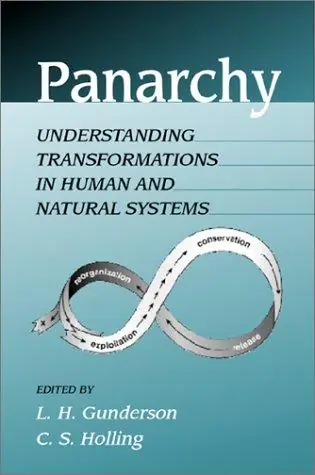
Panarchy
by Crawford Stanley Holling · first published 2001
2mentions
1recommended by
2HN commenters
2022–2024first – last mentioned
50% recommend50% neutral
Creating institutions to meet the challenge of sustainability is arguably the most important task confronting society; it is also dauntingly complex. Ecological, economic, and social elements all play a role, but despite ongoing efforts, researchers have yet to succeed in integrating the various disciplines in a way that gives adequate representation to the insights of each. Panarchy, a term devised to describe evolving hierarchical systems with multiple interrelated elements, offers an important new framework for understanding and resolving this dilemma. Panarchy is the structure in which sys
Affiliate links. As an Amazon Associate I earn from qualifying purchases.
…cost of complexity begins to outweigh its returns, requiring more and more resources just to maintain the status quo, until the entire thing becomes weak and susceptible to failures large and small. - "Panarchy: Understanding Human and Natural Systems" (Amazon link: https://www.amazon.com/Panarchy-Understanding-Transformation...) is also a fantastic book drawing from ecosystem science and proposes a general…
on “Lead poisoning probably did not cause the downfall of the Roman Empire” ↗There is a model of nested dynamic systems called 'panarchy'. > Panarchy is the structure in which systems, including those of nature (e.g., forests) and of humans (e.g., capitalism), as well as combined human-natural systems (e.g., institutions that govern natural…
on “The Seneca Effect: Growth is slow but collapse is rapid (2017) [pdf]” ↗