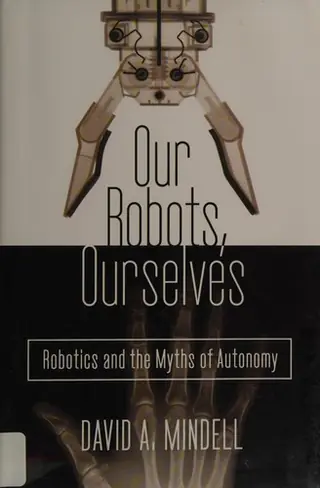
Our Robots, Ourselves
by David A. Mindell · first published 2016
5mentions
1recommended by
3HN commenters
2015–2025first – last mentioned
33% recommend67% neutral
Affiliate links. As an Amazon Associate I earn from qualifying purchases.
>They work just well enough so you're not paying attention and then the car hands you control without warning. There's a book, Our Robots, Ourselves by David Mindell, which describes the aviation experience with auto-land. Auto-land is no longer used for this reason, and the related one that the automatic system gives up when the situation is bad…
on “NTSB says Tesla must address 'basic safety issues' with semi-autonomous features” ↗Didn't realise the pedigree of the idea went back to 1983. I read about this in a book "Our Robots, Ourselves". That talked about airline pilots' experience with auto-land systems introduced in the late 1990s/ early 2000s. As you'd expect after having read Ironies of Automation, after a few near misses and not…
on “Accumulation of cognitive debt when using an AI assistant for essay writing task” ↗…which it needs to hand over control to a human. How will that work in a vehicle that is not designed to be occupied by someone that knows how to control it? This problem has been written about in the book Our Robots, Ourselves [0] and there is an Econ Talk podcast about it as well [1]. To me, it makes sense to make use of the brain power provided by the occupant of the vehicle. For example, if one of the main vision sensors…
on “Google says self-driving car hits municipal bus in minor crash” ↗His position seems to be similar to MIT engineer David Mindell's, who recently wrote Our Robots, Ourselves[1]. It seems to me that the more hours one spends solving real problems with AI, the less likely they are to believe an apocalypse is imminent. Conversely, the more dependent a prognosticator is on…
on “Andrew Ng on What's Next in Deep Learning [video]” ↗…head-up displays of key information to the pilots.[2] Honest advocates of self driving would admit that they want it for its convenience. 1. Whether or not that human is in the vehicle. 2. source: Our Robots, Ourselves, David Mindell. Mindell was (is?) a practising engineer involved with underwater autonomous vehicle design and operation.
on “Have Self-Driving Cars Arrived Yet?” ↗