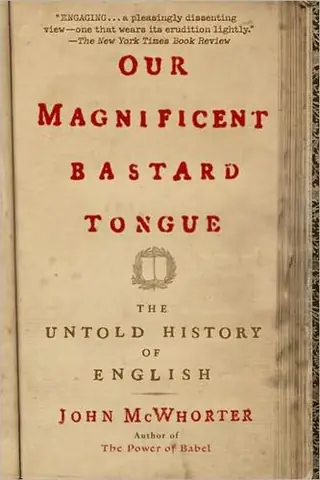
Our Magnificent Bastard Tongue
by John McWhorter · first published 2009
83% recommend17% neutral
Why HN recommends it
Accessible popular history of English tracing how the language was shaped by invasion, contact, and simplification. Suited to general readers curious about linguistics and how English came to be.
Summarised by Claude from recommending comments
Why do we say "I am reading a catalog" instead of "I read a catalog"? Why do we say "do" at all? Is the way we speak a reflection of our cultural values? Delving into these provocative topics and more, Our Magnificent Bastard Language distills hundreds of years of fascinating lore into one lively history. In this trim volume of linguistic history, respected scholar John McWhorter focuses on underappreciated influences on the peculiar development of the English language: For instance, many of the English's strange grammar ticks can be traced to Celtic and Welch origins, which makes sense given
Affiliate links. As an Amazon Associate I earn from qualifying purchases.
I highly recommend McWhorter's Our Magnificent Bastard Tongue.
on “Weird English” ↗…the fewer people speak a language, the less chance its natural complexity will degrade. Invasions and other interlinguistic contact create simplifications, most visibly pidgins and creoles. Check out Our Magnificent Bastard Tongue by Ian McWhorter, which shows how English underwent this very process. What we speak today is a hilarious pidgin of Old English and Norman French, which are themselves mashups. I wonder what will win:…
on “Depth of field blur: the Swiss army knife that improved the framerate” ↗Thanks for the heads up, I looked into criticism of this book and I won’t recommend it in the future. If you happen to see this reply, would ‘Our Magnificent Bastard Tongue: The Untold History of English’ by McWhorter be a better choice for a pop-sci history of English? r/Linguistics seems to be fine with him.
on “Nonnative English speakers share their gripes about speaking English” ↗…by showing each of the experiment's subjects the two sets of questions side-by-side, and ask them whether they feel each pair is asking exactly the same question. I have been reading John McWhorter's 'Our Magnificent Bastard Tongue' (strongly recommended), and only yesterday I read this passage: "In German, one example [of the little complexities that creep into all languages] is a passel of little words that convey nuances of…
on “Language and Personality” ↗I recently read his book, "Our Magnificent Bastard Tongue", and while it was a little bit unbalanced (he spends far too long dwelling on certain points), I really enjoyed it.
on “'Oldest English words' identified” ↗and books, e.g. "Our Magnificent Bastard Tongue"
on “The Awful German Language (1880)” ↗