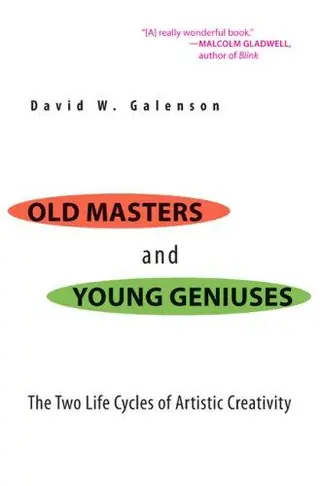
Old masters and young geniuses
the two life cycles of artistic creativity
by David W. Galenson · first published 2004
67% recommend33% neutral
Why HN recommends it
Argues that creative peaks follow two patterns: sudden young breakthroughs by conceptual innovators and gradual growth by older experimental empiricists, backed by art-market data. For those curious about career timing.
Summarised by Claude from recommending comments
From the Publisher: When in their lives do great artists produce their greatest art? Do they strive for creative perfection throughout decades of painstaking and frustrating experimentation, or do they achieve it confidently and decisively, through meticulous planning that yields masterpieces early in their lives? By examining the careers not only of great painters but also of important sculptors, poets, novelists, and movie directors, Old Masters and Young Geniuses offers a profound new understanding of artistic creativity. Using a wide range of evidence, David Galenson demonstrates that ther
Affiliate links. As an Amazon Associate I earn from qualifying purchases.
Old Masters and Young Geniuses: The Two Life Cycles of Artistic Creativity (by David Galenson) Influential to someone whose practices and path to success in engineering doesn't follow the normal pattern but is still valid. (At least…
on “Ask HN: What are the best books you've read that few others have?” ↗This is the thesis of David Galenson's "Old Masters and Young Geniuses", which is a good read. He also talks about how trying to find a single average age of peak creativity hides other possibilities, such as the one he suggests, where there are clusters among the young…
on “Big Breakthroughs Come in Your Late 30s” ↗A distinction I read somewhere, that I think is useful, is that people tend to be either primarily conceptualist in their thinking, or they are empiricists who learn from experience. Galenson's book Old Masters and Young Geniuses: The Two Life Cycles of Artistic Creativity discusses this point extensively, in addition to being a pleasure to read on its own.
on “Big Breakthroughs Come in Your Late 30s” ↗I enjoyed the book Old Masters and Young Geniuses which explored this subject in relationship to art and creativity.
on “I Grew Up Gifted, but My Life Didn’t Turn Out the Way I Expected” ↗It's one data point, here is another perspective that says that depending upon the field of endeavor, people can become more proficient with age. "Old Masters and Young Geniuses" https://www.nber.org/system/files/working_papers/w8368/w8368...
on “What's happening with founders over 40?” ↗Sounds like "Old Masters and Young Geniuses" https://press.princeton.edu/books/paperback/9780691133805/ol... That book used artwork valuation as a performance measure and analyzed it over top artist's lifetimes finding two patterns. The "Young…
on “Recent discoveries on the acquisition of the highest levels of human performance” ↗I am currently reading "Old Masters and Young Geniuses: The Two Life Cycles of Artistic Creativity" [0]. The author starts with the observation that in the world of fine art, it seems that the artists who encountered great success are divided into 2 broad…
on “Old Masters: After 80, some people don’t retire. They reign” ↗…these lists always raise the question of what does "good" mean exactly? Inevitably they're dominated by books that were, in their time, incredibly significant. I just started reading David W. Galenson's Old Masters and Young Geniuses: The Two Life Cycles of Artistic Creativity, (http://www.amazon.com/gp/product/0691133808/sr=8-1/qid=13150...), which is where Malcolm Gladwell stole / sourced his New Yorker article "Late Bloomers -…
on “The Best Science Fiction Books (According to Reddit)” ↗…in a paranormal universe. You can see flashes of his later skill, but his early stuff is lousy. I said this in another comment, but I'll say it again here: I just started reading David W. Galenson's Old Masters and Young Geniuses: The Two Life Cycles of Artistic Creativity, (http://www.amazon.com/gp/product/0691133808/sr=8-1/qid=13150...), which is where Malcolm Gladwell stole / sourced his New Yorker article "Late Bloomers -…
on “The Best Science Fiction Books (According to Reddit)” ↗One other questions is how the artist fits into (or doesn't) the dominant artistic paradigms of his or her time. For example, in his book Old Masters and Young Geniuses (see http://jseliger.wordpress.com/2012/05/29/thinking-about-the-... for much more), Galenson describes how young conceptual innovators often do their best work early and have only one or two important…
on “The importance of being prolific” ↗"Old Masters and Young Geniuses: The Two Life Cycles of Artistic Creativity" by David W. Galenson touches on the same topic: http://press.princeton.edu/titles/8019.html
on “Ask HN: How do you deal with professional jealousy and getting older?” ↗I'm reminded of a book "Old Masters and Young Geniuses"[1]. The author makes a case that experimental iterators make their biggest contributions at an older age, whereas the artists who take bold conceptual leaps often achieve artistic success at a much younger…
on “We call ourselves innovators, but most of us are really just iterators” ↗